Football games for children aged 4 to 6: 8 cards for coaches and families
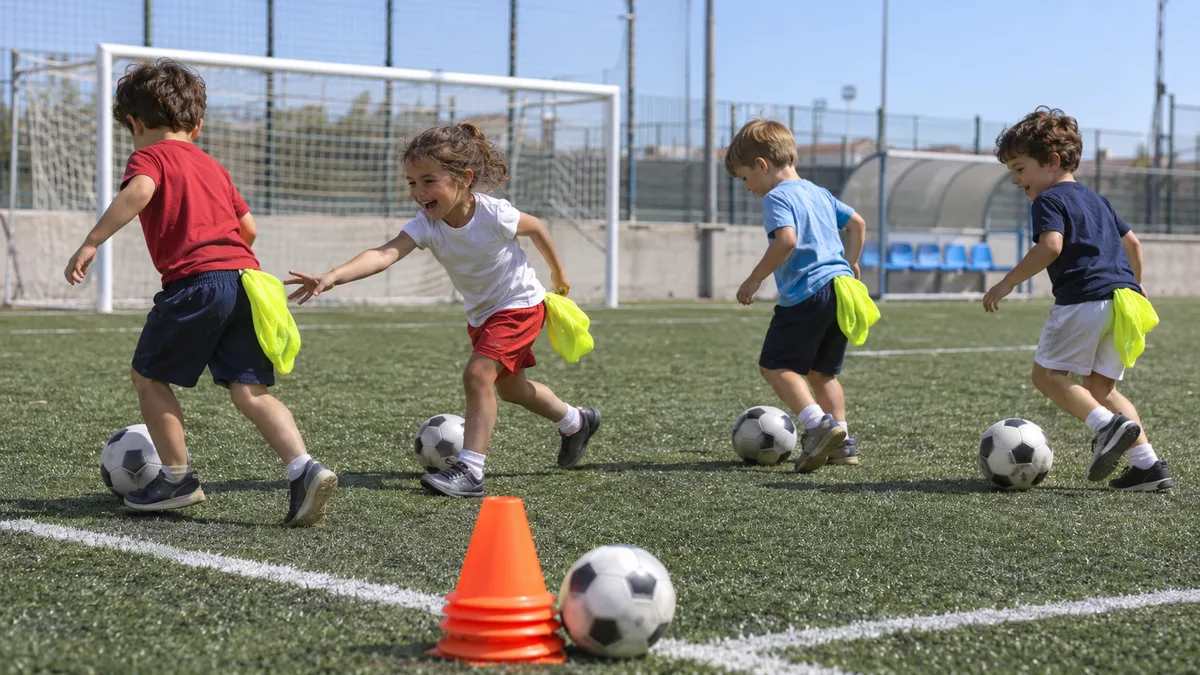
The best football games for children aged 4 to 6 are short, with one ball per child and a rule that fits in one sentence. This article gathers 8 cards to choose from by exact age and fit into a session of about 45 minutes.
- Age 4: 2 cards with their own ball and no waiting turns.
- Age 5: 3 cards of chasing, shooting and following.
- Age 6: 3 cards, the first one in pairs.
- Duration: between 5 and 7 minutes per game.
What to expect from children aged 4, 5 and 6 with a ball
At age 4 the child plays almost alone, even when surrounded by others: they want their own ball, lose sight of it easily and get distracted after a few minutes. They run, fall and get up without fuss, but coordinate foot and eyes poorly and forget rules with more than one condition.
At age 5 they stay with one activity a little longer and start to notice teammates. They dribble with more control, although they still watch the ball, understand a chasing game and accept a simple rule if it is repeated. Waiting for a turn and losing are still hard.
At age 6 group play with a shared goal appears: taking balls to a home, passing to a partner, playing a small game. They still need no positions or tactics. What they gain is the ability to cooperate for a few minutes and to accept that someone else touches the ball. These are general descriptions: every group has children who are ahead and others who are behind.
The official category for each age differs by federation: check yours. To see these games inside a full session, there are the guides for under-7s on day one and for prebenjamín players, and for a wider view of content by age, grassroots football drills by age.
How to set up a game: space, equipment and explanation
Space matters more than equipment. A 15 x 15 metre square marked with four cones suits a group of 8 to 10 children. With a larger group, set up a second square instead of enlarging the first: that way each child stays closer to the ball and touches it more.
- Balls: one per child, light and slightly soft if possible.
- Cones: to mark the space, the homes and the small goals.
- Bibs: in two colours, to form groups without arguments.
- A box or a large cone as a shooting target.
Explain in one sentence. For example: “Take the ball to the red home and stop it with your sole.” If a second sentence is needed, it is better to demonstrate with one child than to add words. Try it once slowly, then start.
Stop before they get bored. When two or three children pick up the ball or look away, the game has already gone on too long. Each card gives an approximate duration of between 5 and 7 minutes, and the coach decides by watching the group. To open the session, the ball games for warm-ups also work.
Football games for 4-year-olds (2 cards)
At this age, games work best when everyone does the same thing at once, with their own ball and a clear signal. Times and numbers of children are approximate: the coach adjusts them.
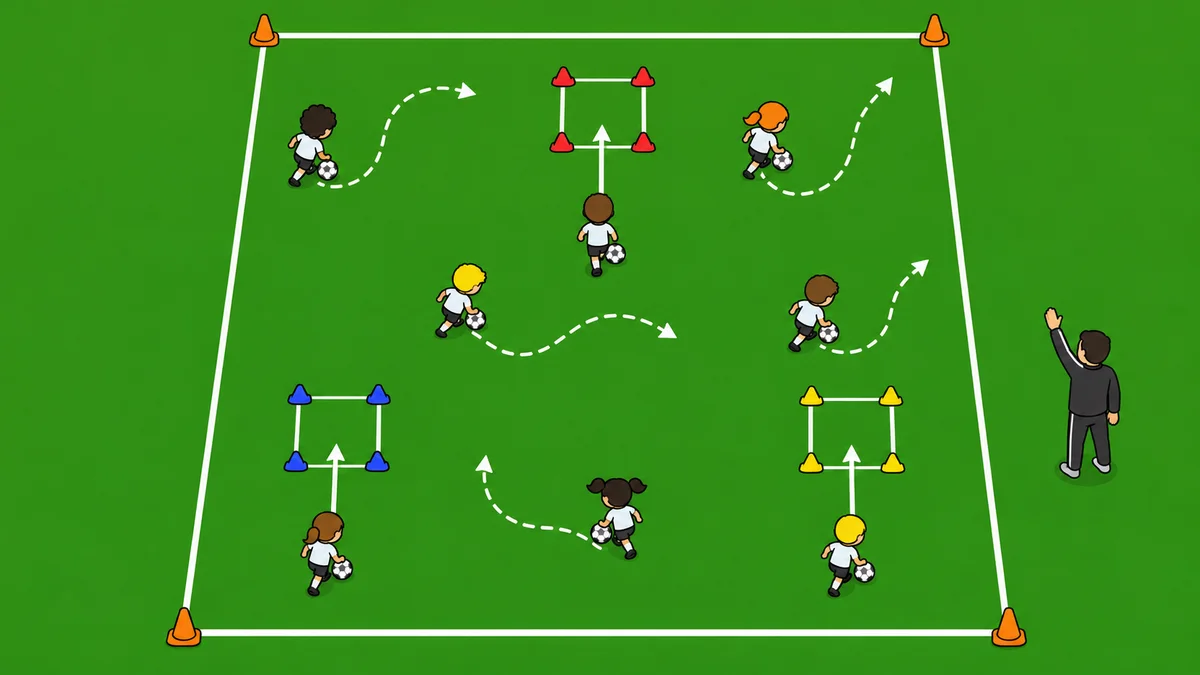
Card 1. The garages
- Duration: 5 minutes.
- Space and children: 15 x 15 metre square, 6 to 10 children.
- Equipment: one ball per child and cones to mark two or three garages of 2 x 2 metres.
- How to play: everyone dribbles freely around the square, with any part of the foot. On hearing “garage!”, each child takes their ball to a garage and stops it with the sole. On hearing “back on the road!”, they set off again. There are no winners.
- Easier: one large garage, and children may stop the ball with their hands.
- Harder: coloured garages and calls such as “red garage!”, or dribbling with the weaker foot.
- What to watch: whether the child pushes the ball far from the foot, bumps into others and understands the signal without repetition.
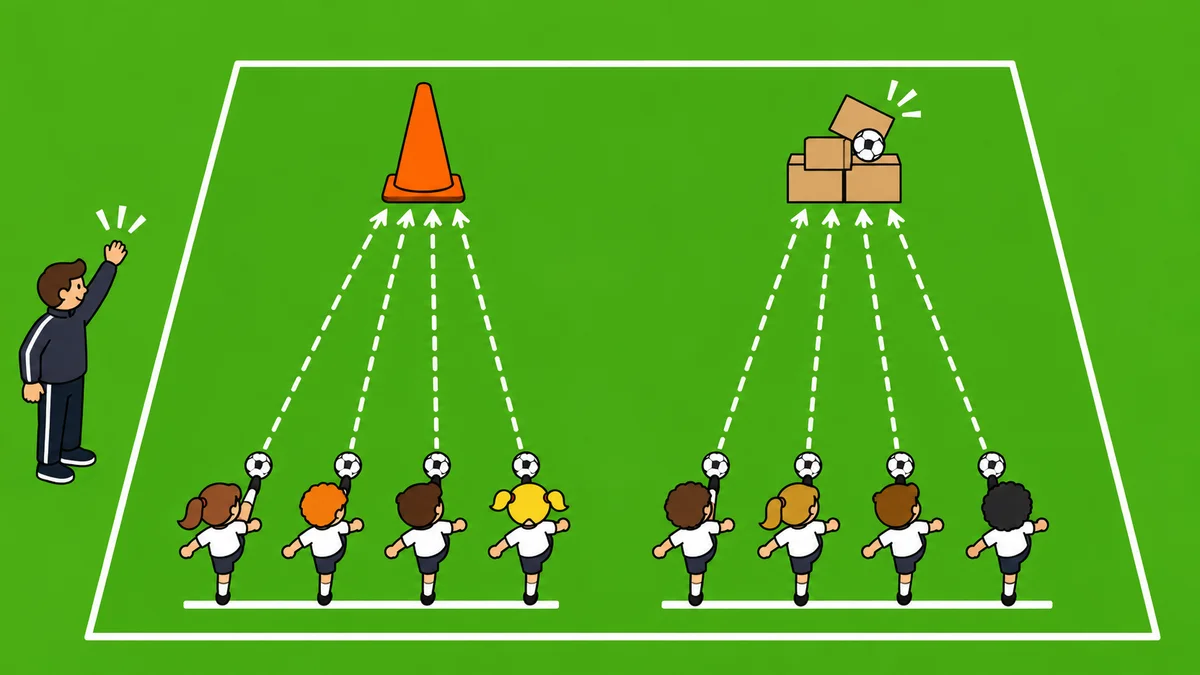
Card 2. Knock down the tower
- Duration: 6 minutes.
- Space and children: 10 x 10 metres, groups of 3 or 4 children per tower.
- Equipment: one ball per child and one or two large cones or cardboard boxes as towers.
- How to play: children stand 2 metres from the tower. On hearing “go!”, all kick at once, fetch their ball and return to the line. Nobody kicks until the next signal, so there is never a child collecting in front of another who shoots.
- Easier: 1 metre away with a stationary ball.
- Harder: 3 metres away, or three touches dribbling before kicking.
- What to watch: which foot they strike with, whether they look at the tower when kicking and whether they wait for the signal.
Ball games for 5-year-olds (3 cards)
At 5, a simple objective and some interaction between children can be added, without competing against each other. The cards follow the same format: duration, space, equipment, rules, variants and what to watch.
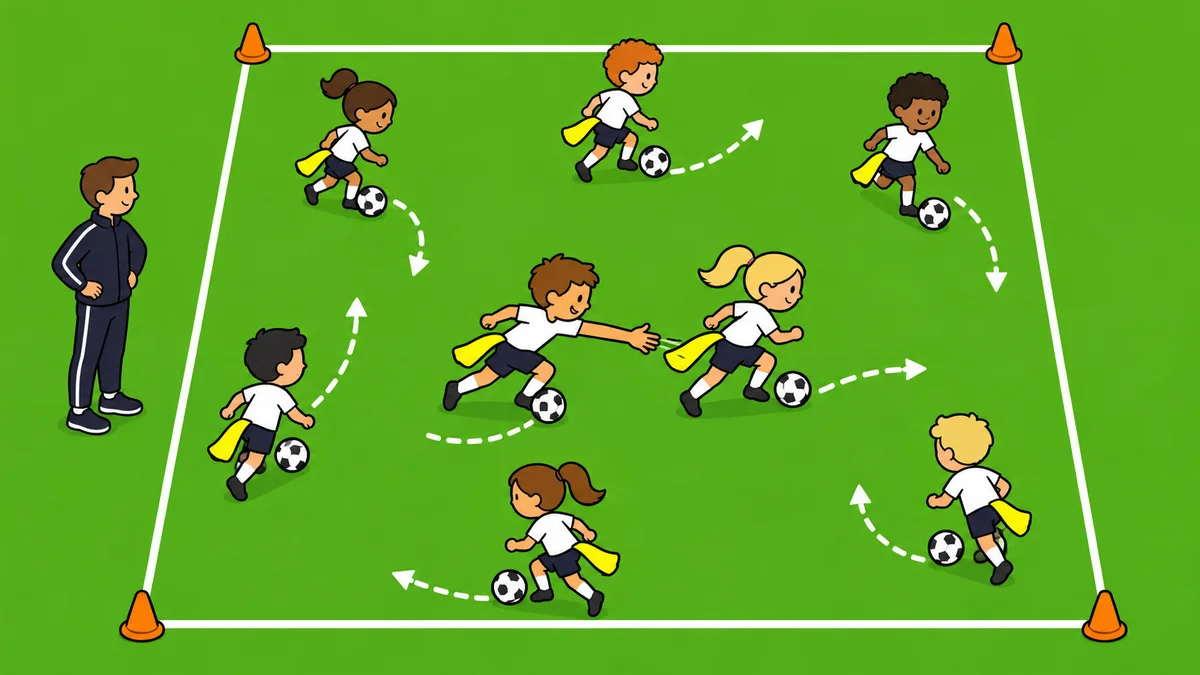
Card 3. The fox's tail
- Duration: 6 minutes.
- Space and children: 15 x 15 metre square, about 8 children.
- Equipment: one ball and one bib per child.
- How to play: each child tucks the bib into the back of their waistband as a tail. Everyone dribbles and tries to pull another child's tail by hand without losing their own ball. A child who loses the tail puts it back and carries on. Nobody leaves the game.
- Easier: only half of the children wear a tail.
- Harder: dribbling with the weaker foot, or two children wear two tails each.
- What to watch: whether they lift their heads, stick to a corner and keep control of the ball while looking for a tail.
Card 4. Three goals, three scores
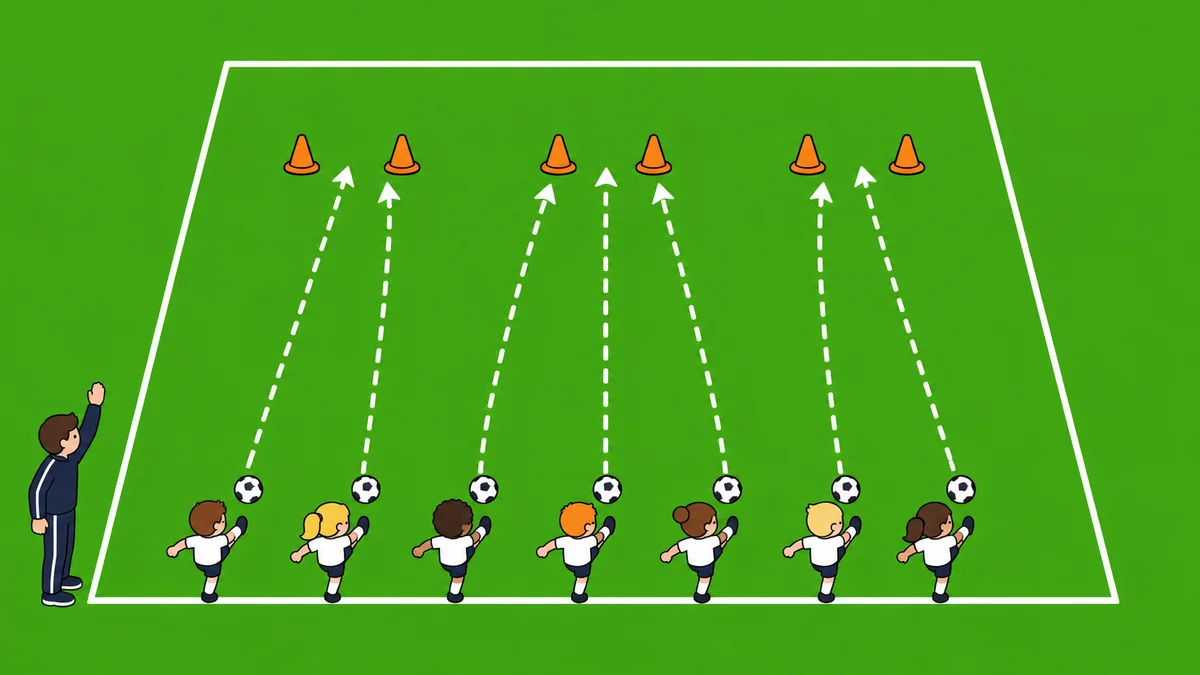
- Duration: 7 minutes.
- Space and children: 12 x 8 metres, 6 to 9 children.
- Equipment: one ball per child and six cones for three goals of 1.5 metres, in a row and 5 metres from the children.
- How to play: on hearing “go!”, all shoot at once, fetch their ball and return to the line. Each child tries to score in all three goals, one after another, and counts how many they have managed. Nobody compares their number with anyone else's.
- Easier: goals 3 metres away.
- Harder: goals 7 metres away, or shooting with the weaker foot in the last one.
- What to watch: whether they look for the gap or shoot blindly, how they react to a miss and whether they use both feet.
Card 5. Follow the coach
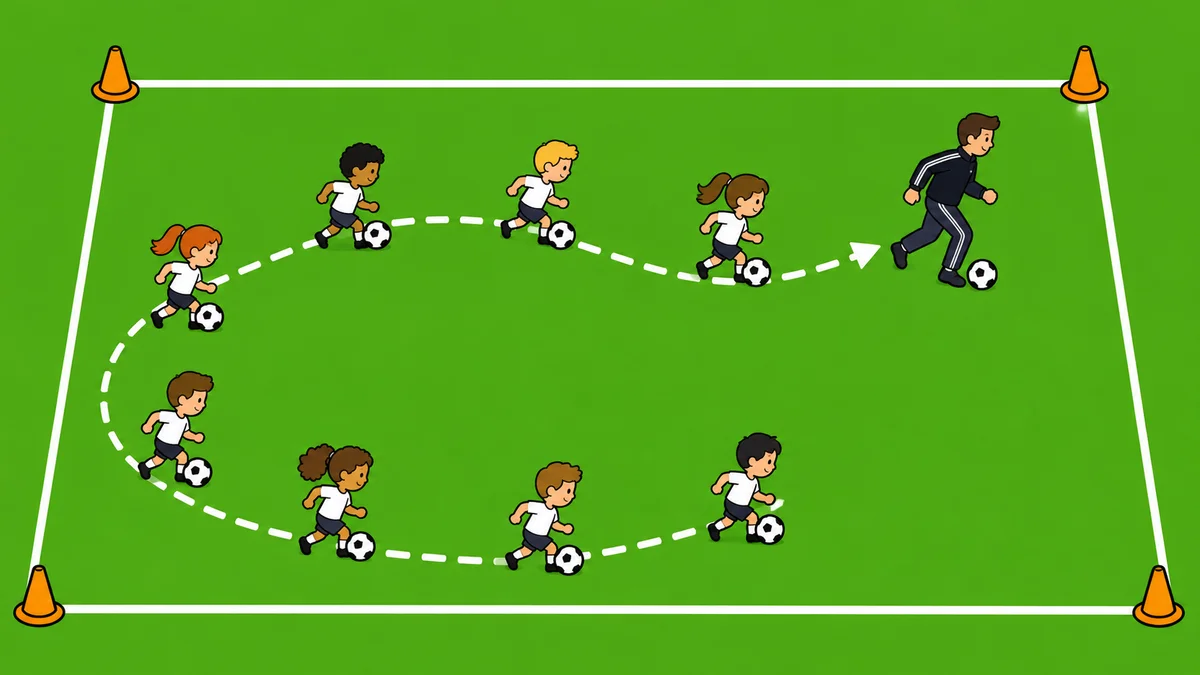
- Duration: 5 minutes.
- Space and children: 20 x 15 metres, 6 to 12 children.
- Equipment: one ball per child.
- How to play: the coach dribbles and the children follow 3 or 4 metres behind, copying what they do: slow, fast, turning, stopping with the sole, switching feet. Every 30 seconds the coach changes the move. In the second round, a child acts as leader.
- Easier: the leader does not change direction.
- Harder: two leaders who cross paths, and each child chooses whom to follow.
- What to watch: who lifts their head to look at the leader and who loses the ball on turns.
The coach's Sunday summary
Open course calls, up-to-date guides and new posts. Free, with one-click unsubscribe.
Leave your email and get the next issue:
Football games for 6-year-olds (3 cards)
At 6, the teammate and the shared goal come in. The first game is in pairs; the other two ask for more and more cooperation.
Card 6. The pairs' bridge
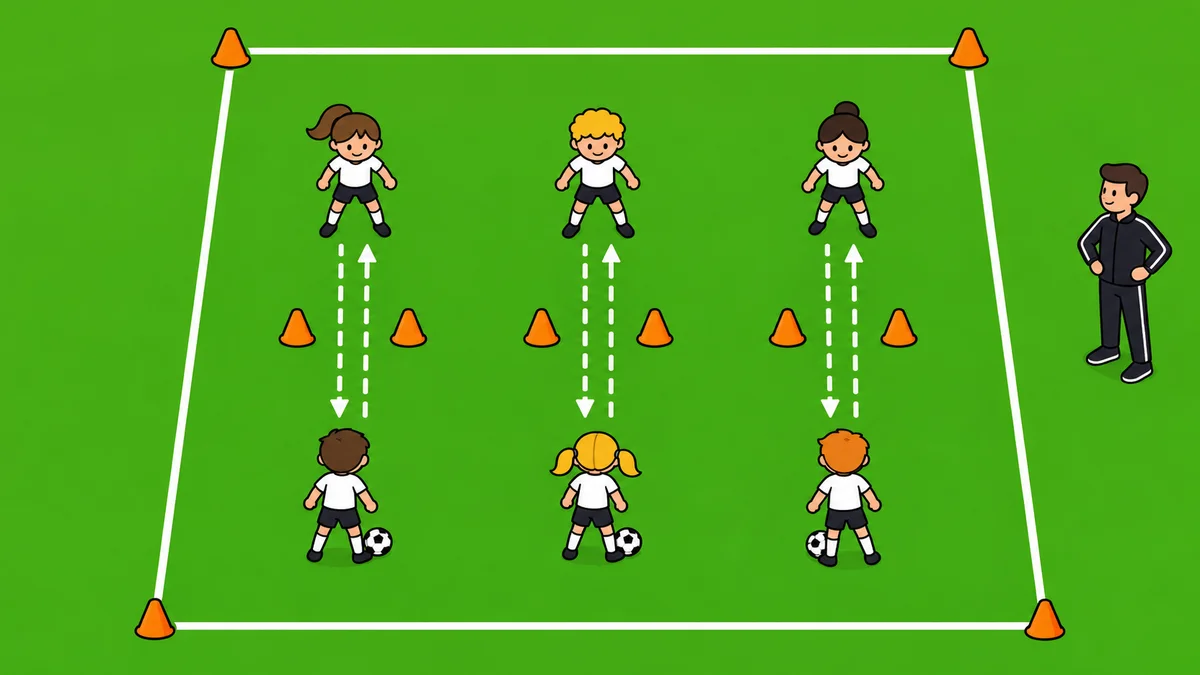
- Duration: 6 minutes.
- Space and children: 10 x 10 metres for every three pairs.
- Equipment: one ball and two cones per pair.
- How to play: the two cones form a gate of 2 metres. Children stand 3 metres from the gate, one on each side, and pass the ball through it with the inside of the foot. Each pair counts its consecutive passes and tries to beat its own number, not other pairs'. After 3 minutes the coach changes the pairs.
- Easier: a 3 metre gate and the ball may be stopped by hand.
- Harder: a 1 metre gate, each child 5 metres from it and returning first time.
- What to watch: whether they look at their partner, how they place the standing foot and how they react to misses.
Card 7. Bring the treasure home
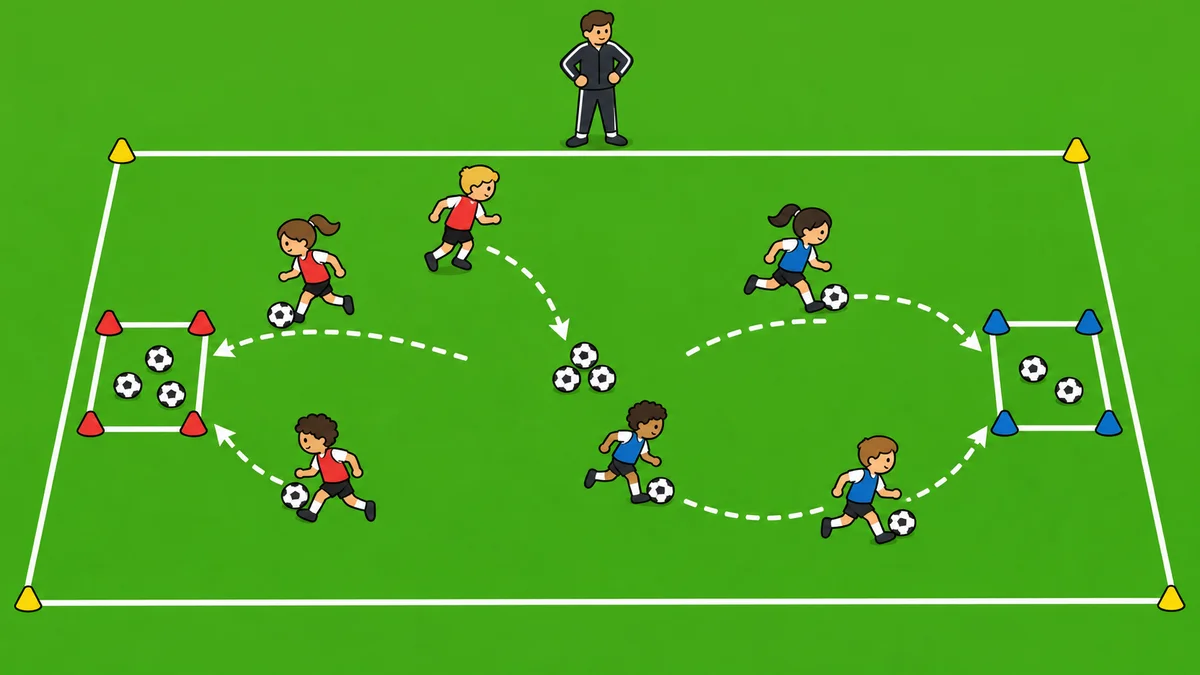
- Duration: 7 minutes.
- Space and children: 20 x 15 metres, two teams of 3 or 4 children.
- Equipment: 8 balls, bibs in two colours and cones for two homes of 3 x 3 metres, one at each end.
- How to play: the balls start in the centre. On the signal, each child dribbles one ball to their team's home, stops it inside and goes back for another. After 90 seconds the coach calls “stop!” and each team counts its balls. The challenge is to beat the previous round's number. Play three or four rounds.
- Easier: one ball per child, carried in the hands.
- Harder: homes further away, or carrying the balls with the weaker foot.
- What to watch: whether they dribble with head up, who coordinates with their team and who stays on the margins.
Card 8. Small 3 v 3 game
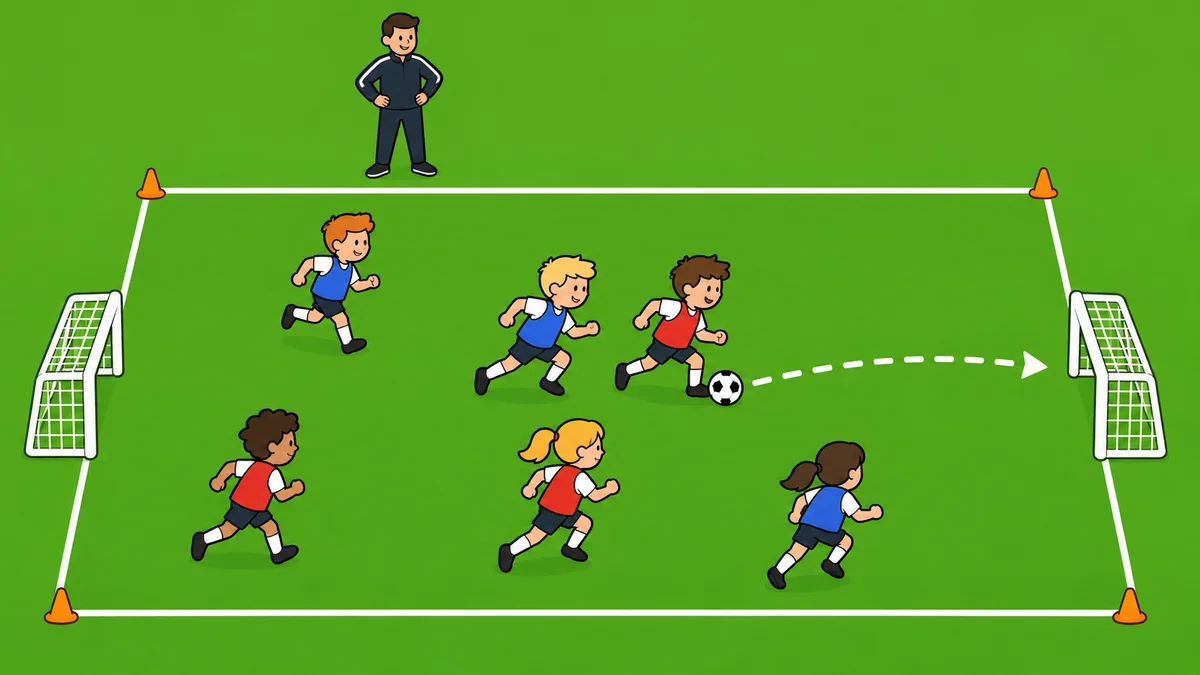
- Duration: 5 minutes.
- Space and children: 20 x 12 metres, 6 children (with 12, two pitches).
- Equipment: one ball, bibs and two small goals of 2 metres.
- How to play: no goalkeeper and no positions. After a goal, the team that conceded restarts. The coach does not announce the score. After 2 and a half minutes the teams rest and are rebuilt with other children.
- Easier: two balls in play.
- Harder: a goal counts only if another teammate has touched the ball first.
- What to watch: whether they look for the free teammate or everyone chases the ball. The latter is normal at this age and is not corrected.
Common mistakes when playing with young children
- Waiting lines. One child plays and seven watch. If there are not enough balls, reduce the group or set up two spaces.
- Eliminating the child from the game. The child who is out is the one who most needs to touch the ball. If something must be penalised, the line is replaced or the round restarts.
- Competing for points too early. At 4 and 5 it is better to count personal challenges, such as beating the previous round, than to pit children against each other.
- Correcting technique. At these ages, touching the ball many times teaches more than a remark about the standing foot. One simple cue is enough: “ball close” or “head up for a second”.
To keep the enthusiasm going throughout the session, the ideas for keeping children motivated without boredom fit these cards.
A session of about 45 minutes with three games
A session of about 45 minutes holds three cards and time to play without instructions. This outline is an approximate suggestion, not a rule of any federation. The example uses the cards for 5-year-olds:
- 10 minutes: arrival, welcome and free ball play while everyone gets there.
- 5 minutes: card 5, Follow the coach, to warm up.
- 2 minutes: water.
- 6 minutes: card 3, The fox's tail.
- 7 minutes: card 4, Three goals, three scores.
- 10 minutes: free play with small goals and no instructions.
- 5 minutes: closing at the meeting point, with one idea to remember.
With 4-year-olds, who have two cards, repeat one of them with a different variant. With 6-year-olds, swap in cards 6, 7 and 8. To see how these games fit a plan by category, there are the guides for a typical prebenjamín session and for under-7s.
What to tell families and how to play at home
A short message at the end avoids comparisons and rushing: “Today they touched the ball a lot and played together. That is what we are after at this age.” If someone asks about positions or results, the answer is that at 4, 5 and 6 you watch whether the child enjoys it, listens and goes towards the ball.
At home, with a ball and a few metres of space, three short games of a few minutes are enough:
- Garage in the hallway: dribble to a mark and stop the ball with the sole.
- Knock down the tower: kick at a cardboard box from 2 metres.
- Two-chair gate: pass the ball between the legs of two chairs, with feet or by hand if it is still hard.
Adults play with the child without correcting technique and stop while the child still wants to carry on. For harder conversations with families, there is the article on managing parents in grassroots football.
About the author

Content produced by RutaMister from practical experience, editorial review and a training-focused approach for grassroots football coaches.
Frequently asked questions
How long should a football game last with 4-year-olds?
Between 4 and 7 minutes is a reasonable guide for 4-year-olds. After that, attention drops and distractions appear. It is better to stop while the game is still enjoyable and repeat it another day than to stretch it until they get bored. The coach adjusts the time according to how the group responds.
What equipment do you need for football games with children aged 4 to 6?
A ball per child, cones or floor marks and bibs to tell groups apart are enough. Light, slightly soft balls are easier to control at these ages. When balls are short, it is better to reduce the group in each game than to leave children waiting for a turn.
Can you play ball games at home with a 5-year-old?
Yes. With a ball and a few metres of space, a family can repeat this article's home games in a few minutes: dribble to a mark, stop the ball with the sole or kick at a box. It is enough to play with the child, without correcting technique, and to stop while they still want more.
When should you start keeping score in children's football games?
At 4 and 5, play without a scoreboard. At age 6, shared challenges can appear, such as beating the previous round, rather than pitting children against each other. If two children cry about losing, the game still needs less competition. For official competition, check your own federation's category.