How to coach prebenjamín players: session plan
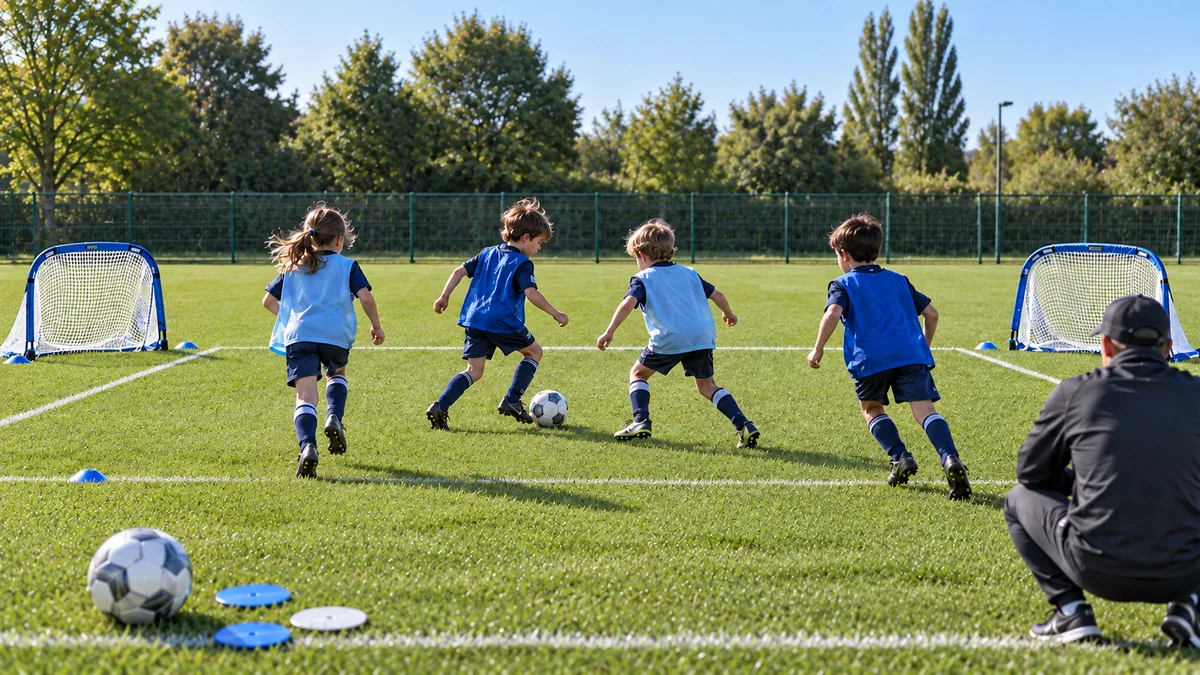
The Spanish prebenjamín bracket covers children aged 6 and 7, born in 2019 and 2020 for the 2026/27 season: in almost every federation it is the first age group with federated competition.
- Format: usually 7-a-side, with a size 3 ball depending on the federation.
- Session: 60 minutes, ball always in play.
- Frequency: 2 sessions per week plus a match.
- Goalkeeper: rotating, never fixed at this age.
- Technique: dribbling, take-ons, striking and passing; no systems.
What prebenjamín means and how it differs from minibenjamín
In almost every federation, prebenjamín is the first category with federated competition: it covers children born in 2019 and 2020, aged 6 and 7 in the 2026/27 season. Spanish grassroots football groups children in two-year birth brackets rather than by school grade — before this stage, many clubs run a school group with no league table or results (called querubín or minibenjamín, depending on the club), which we cover in coaching minibenjamín players on the first day.
The format varies by regional federation, but the usual reference is 7-a-side, with a smaller pitch, small goals and a size 3 ball. The full progression of formats by age is in grassroots football categories by age, and match duration, substitutions and offside by category are in grassroots football rules by category.
What changes from minibenjamín is not the technical demand — it stays minimal — but the framework: there is now a league table, an identified opponent, and it makes sense to give the session a fixed structure that repeats week after week. That does not mean rushing content: at alevín, three or four years later, it starts to make sense to talk about width and depth; at prebenjamín that step is still a long way off.
A 60-minute session, block by block
A prebenjamín session works with four short blocks and immediate transitions. The point is not a sophisticated drill: it is that nobody waits in a line and the ball keeps moving.
| Block | Time | Content |
|---|---|---|
| Welcome and activation with the ball | 10 min | Free dribbling, everyone touching the ball from minute one |
| Rotating small-sided games | 15 min | 2 or 3-a-side mini-matches across several mini-pitches, goalkeeper rotating from the start |
| Technical core of the day | 20 min | Dribbling, take-ons, striking or basic passing: one or two blocks at most |
| Final small-sided game | 15 min | Free play with a single instruction: attack or defend the goal |
The small-sided games block splits the group across two or three mini-pitches with matches of two or three players per side: the fewer players competing in each mini-match, the more times each child touches the ball, as Abad Robles, Fernández-Espínola and Giménez Fuentes-Guerra (2019) note in their review of the evidence on small-sided games in football.
Weekly plan: two sessions and a match
The usual microcycle at prebenjamín is two midweek sessions plus the weekend match. With a group of 6 and 7 year-olds, a third session rarely adds anything beyond fatigue or a more complicated family schedule.
- Session 1 (say, Wednesday): free play, the day's technical core and a final small-sided game. This is the fullest session.
- Session 2 (Friday): the same technical content revisited, with more play and less explanation. Nothing new is introduced.
- Match (weekend): shared minutes, a rotating goalkeeper and no complex tactical instructions from the touchline.
The jump to three weekly sessions comes with alevín, once competition and physical demands justify it; bringing it forward at prebenjamín does not speed up learning, it just cuts into rest.
The technical core at 6-7: what belongs (and what does not)
At 6-7, the body and attention span have clear limits. The technical core that works at prebenjamín is short and concrete (specific drills for this age band are in grassroots football drills by age):
- Free dribbling: carrying the ball while looking ahead, changing direction without losing it.
- Simple take-ons: losing the fear of facing an opponent, without demanding a specific move.
- Striking the ball: hitting it with the inside of the foot, accuracy before power.
- Basic passing: a short pass to a nearby teammate, receiving with simple control.
What does NOT belong at prebenjamín: systems, zonal marking, structured build-up play and, unlike alevín, not even width or depth. The only tactical idea that makes sense at this age is the simplest possible one: attack the opponent's goal when the team has the ball and defend your own when it does not. Nothing more.
The goalkeeper: just another player inside the session
Within these 60 minutes, the goalkeeper is not a separate role: in the small-sided games the goal changes hands every mini-match and in the final game it rotates every few minutes, so everyone faces real shots and everyone plays outfield. We cover the full rotation by age group here, including why we do not fix a goalkeeper until infantil.
Rotation at prebenjamín is wide: any child in the group takes a turn in goal over the weeks, not only the ones who ask for it. It is the simplest way to stop anyone getting stuck with that label from age six.
The coach's Sunday summary
Open course calls, up-to-date guides and new posts. Free, with one-click unsubscribe.
Leave your email and get the next issue:
Common coaching mistakes at prebenjamín
- Long lines: in a shooting drill with ten kids and one ball, nine are standing still. Split into more stations instead of lengthening the line.
- Chasing Saturday's result: at 6-7 the scoreline says nothing about the process. A team that loses while touching the ball a lot is doing better than one that wins on long balls.
- Over-explaining: if the instruction does not fit in one short sentence, it is too complex for this age.
- Ball-less drills: general coordination trains just as well with the ball at the foot from minute one.
- Fixing the goalkeeper: always leaving the same child in goal because he is good at it closes a door that should still be open to everyone at six.
Managing parents in the first competitive year
Prebenjamín is often the first time families see their children in a league with a table, and that changes the pressure from the sideline. Three simple agreements avoid most of the friction:
- A short meeting at the start of the season: explain that the goal is adaptation and enjoyment, not results, and introduce the official communication channel.
- No tactical shouting from the sideline: only the coach gives instructions during the match; at 6-7, two different voices at once just creates confusion.
- A delegate as the channel, not the coach: a team delegate runs the family WhatsApp group; the coach steps in only for specific football matters.
How to tell if it is working
At prebenjamín there is no statistic worth chasing. Three observable signs are enough:
- Wanting to come back: if the kids arrive asking about that week's session, it is working.
- Ball touches per child: in reduced formats with fewer players per side, each child touches the ball more often than in a match with more players per team, as the review by Abad Robles et al. (2019) on small-sided games in football notes. If a child has barely touched the ball by the end of the session, something in the group design went wrong.
- Daring to try 1v1: losing the fear of taking on an opponent, even losing the ball most of the time, matters more than any result.
If two of the three are missing, revisit the session design before the kids.
About the author

Contenido elaborado por RutaMister a partir de experiencia práctica, revisión editorial y enfoque formativo para entrenadores de fútbol base.
Frequently asked questions
How old are prebenjamín players?
Prebenjamín covers children aged 6 and 7, born in 2019 and 2020 for the 2026/27 season: age is set by calendar year of birth, not school grade. In almost every federation it is the first category with federated competition, usually played 7-a-side.
How long should a prebenjamín session last?
60 minutes is enough at 6-7: beyond that, attention drops and the session gains nothing. The key is not stretching the time, it is keeping the ball in play at all times, with no lines or waiting between drills.
How many sessions per week are ideal at prebenjamín?
Two sessions plus the weekend match is the balance that works best at this age. A third midweek session rarely adds extra learning at prebenjamín and does add fatigue and pressure on the family schedule. The jump to three sessions comes at alevín.
Should the goalkeeper be fixed at prebenjamín?
No. At prebenjamín the goalkeeper rotates across the whole group, including the kids who ask for it least, so nobody gets stuck with that label from age six. This is a RutaMister recommendation, not a federation rule: a fixed goalkeeper comes in infantil at the earliest.
What technical content is trained at prebenjamín?
Dribbling, simple take-ons, striking and short passing: a minimal core, with no systems or tactical concepts beyond attacking or defending the goal. Each session covers one or two of these, never all at once, because at 6-7 more content does not mean more learning.
Sources
- Abad Robles, Fernández-Espínola and Giménez Fuentes-Guerra (2019): Small-sided games as a teaching methodology in football
- FIFA Training Centre: Ages 4-8: An introduction to Play-Practice-Play
- FIFA Training Centre: Small-sided games (ages 4 to 8)