How to motivate kids in grassroots football without boring them
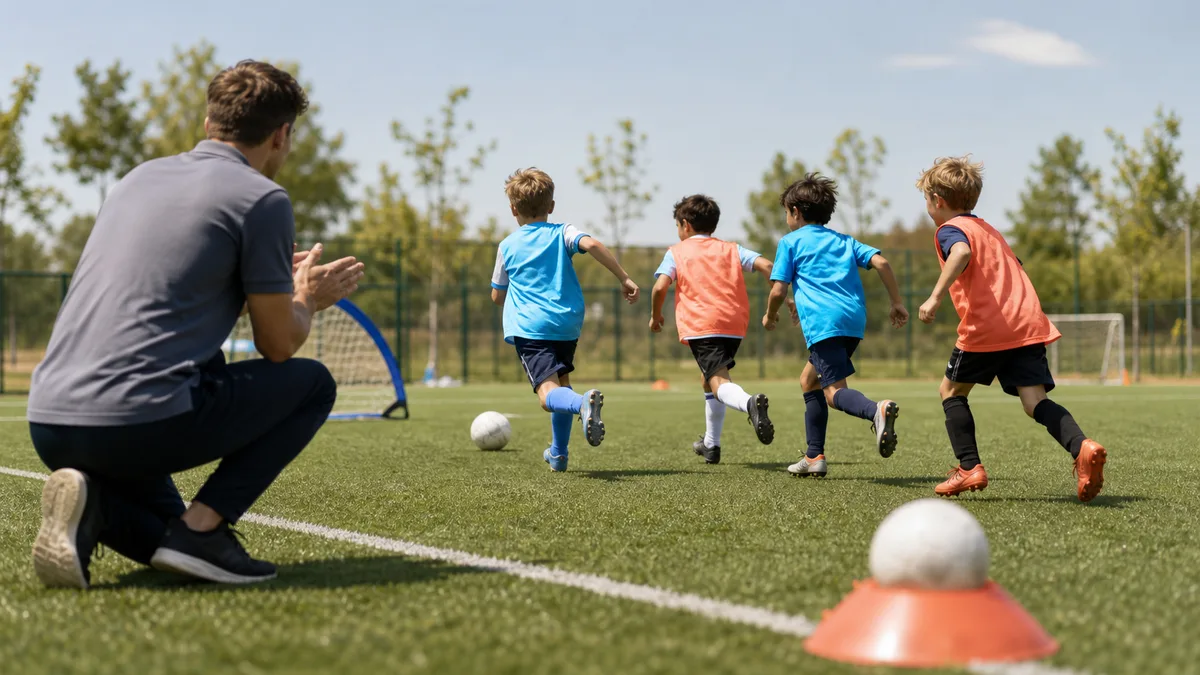
Motivation in grassroots football is not about who the child is, it is about how the session is designed: the less time spent standing in a line, the more engaging training becomes.
- Fewer lines, more ball time: replace the single line with simultaneous stations where everyone touches the ball at once.
- Small-sided games with mini-goals: multiply goals, duels and the desire to play.
- Position rotation: let kids try every role before specialising in one.
- Treat mistakes as part of the game: correct less, let them play more.
Why kids get bored in grassroots football
Boredom in grassroots football is almost never about the sport itself: it is about how the session is designed. Lines to shoot at goal, rondos where only four kids touch the ball while the rest wait, and several minutes of talking before every drill are the three most common brakes on motivation in under-8 and under-10 groups.
An 8 to 10 year old has a short attention span and a constant need to move. Every second spent standing in a line is a second their mind wanders elsewhere. The rule broken most often in grassroots football is simple: the more kids touching the ball at once, the more motivated the session.
You do not need to redesign training from scratch. Just review every drill with one question: how many kids are standing still right now? If the answer is more than half the group, that drill needs a different format before it needs different content.
Fewer lines, more ball time: active rondos and small-sided games
Replace the classic shooting line with simultaneous stations. With 12 kids, set up three groups of four, each with its own goal or space, instead of one line for all twelve. Waiting time drops from minutes to seconds and the number of ball touches multiplies.
The traditional rondo (one player in the middle, the rest passing in a circle) also breeds passivity: most of the group just passes without real pressure. It works better with two players in the middle instead of one, smaller spaces and a time limit, so possession forces quick decisions instead of becoming a low-pressure maintenance drill.
The test for any warm-up drill is the same: the ball should change feet constantly and nobody should go more than a few seconds without touching it. If a drill does not meet that bar, swap it for one with more space and fewer players per group.
Mini-goals, more goals scored
Small-sided games (3v3, 4v4, in tight spaces with several mini-goals spread across the pitch) are the drill that generates the most motivation in grassroots categories. Fewer players and more goals mean every child touches far more balls per session than in a conventional 11-a-side match.
Scoring is the most direct reward football offers, and with several mini-goals the scoreline moves fast: that keeps competitive tension alive without the result depending on one standout player. It is also the format where technical improvement shows fastest, because every child repeats receiving, dribbling and finishing many times per session.
Ball size should match the age group and whatever each federation sets: there is no single universal size for all grassroots football, so check your category's rules before buying kit.
Position rotation: let kids try everything before specialising
In under-8 to under-12 football, fixing positions makes little sense. A child who only plays centre-back for two seasons loses the chance to touch more of the ball, dribble, shoot; and the team loses the information about where each player actually performs best once it is time to specialise.
Rotation works better when explained as part of the game, not as a favour: every child spends time in goal, on the wing and through the middle across the season. The first matches in a new position are usually rough, and that is where the coach needs to hold the group's patience instead of retreating to the comfortable position.
Specialising has its moment, but it arrives later than many parents, and some coaches, assume. The later a role gets fixed, the more chances a child has of finding the position that suits them.
The coach's Sunday summary
Open course calls, up-to-date guides and new posts. Free, with one-click unsubscribe.
Leave your email and get the next issue:
Treat mistakes as part of the game, not something to correct constantly
Stopping play every time a child misplaces a pass or loses the ball is the fastest way to kill their willingness to try things. A mistake in grassroots football is not a fault to fix on the spot: it is the raw material a child uses to learn how to decide.
Correction works better afterwards, not in the heat of the moment: let play continue, note what keeps repeating, and correct it between drills or at the end of the session, with a question instead of an order: asking what other option was there teaches more than saying that is not how it is done.
A group that plays afraid of making mistakes stops attempting the dribble, the risky pass or the shot from distance: exactly the moments they enjoy most at that age. Fewer whistles and more questions after the drill is the formula that sustains motivation long term.
Parents and competitiveness: managing the sideline without killing motivation
Pressure from the sideline is one of the most common reasons a motivated child starts finding excuses to skip training. A parent shouting instructions that contradict the coach, or the scoreline becoming the only thing that matters every Sunday, change how a child experiences the game even when midweek training is well designed.
Setting clear sideline rules from day one (no technical instructions from outside the pitch, no arguing refereeing decisions in front of the kids, applauding effort as much as results) prevents most conflicts before they start. There is a dedicated guide on turning parents into allies: how to manage parents in grassroots football.
Competitiveness itself is not the problem: kids like winning and it motivates them. The problem appears when the result on Sunday matters more than what was enjoyed during the week of training, and that is where the coach, and the parents, make the difference through what they choose to celebrate out loud.
A 60-minute sample session, and when demotivation is something else
- 10 minutes, ball-based activation: simultaneous stations, one ball per child from the first minute, no waiting in line.
- 20 minutes, small-sided games: 3v3 or 4v4 with mini-goals; everyone touches the ball and everyone makes decisions.
- 20 minutes, match with rotation: positions rotated as a rule, just like in the rest of the session.
- 10 minutes, cool-down: low tempo and one open question: what did you enjoy most today?
Not every case of demotivation gets fixed with a better-designed session. If a child who used to be enthusiastic starts making excuses consistently over several weeks, it is worth looking beyond training: too many extracurricular activities, pressure over results at home or at the club, or simply a friend group that no longer overlaps with theirs.
The signal that separates ordinary boredom from something more serious is duration and pattern: occasional boredom is cured by a different session the following week; sustained refusal, especially alongside mood or sleep changes, deserves a calm conversation with the child and, if needed, with the club or a professional. It is not unusual, and it is not an alarm on its own, but it should not be ignored either.
About the author

Content produced by RutaMister from hands-on experience, editorial review and a development-first approach for grassroots football coaches.
Frequently asked questions
How do I avoid lines in grassroots football training?
Replace the single line with simultaneous stations: with 12 kids, set up 3 or 4 small groups instead of one queue for everyone. Waiting time drops from minutes to seconds and every child touches far more balls per session, which is what actually sustains motivation in under-8 and under-10 groups.
Is it bad for a child to always play the same position?
In under-8 to under-12 football, it is worth avoiding. Fixing a position too early limits ball touches and the range of decisions a child practises. Rotating through goal, wing and centre across the season delays specialisation and helps find the position where the child performs best.
How long should an under-8 or under-10 training session last?
60 minutes is a common and sufficient framework at that age. A structure that works: 10 minutes of ball-based activation, 20 of small-sided games with mini-goals, 20 of a match with position rotation, and 10 minutes of cool-down with a short chat about what was most enjoyed.
Are rondos a good drill for grassroots football?
It depends how they are set up. The classic rondo with one player in the middle breeds passivity in the rest of the group. It works better with two players in the middle, tighter spaces and a time limit, so possession forces quick decisions instead of becoming a low-pressure maintenance drill.
What do I do if parents pressure too much from the sideline?
Set clear rules from day one: no technical instructions from outside the pitch, no arguing refereeing decisions in front of the kids, and applaud effort as much as results. Communicate it in writing at the start of the season; most conflicts get prevented this way, not corrected after the fact.
How do I tell ordinary boredom apart from a burned-out child?
Occasional boredom is fixed by a different session the following week and leaves no trace outside the pitch. Sustained refusal over several weeks, together with mood or sleep changes, points to something more (pressure, activity overload) and deserves a calm conversation with the child, and with the club if needed.