Grassroots football exercises by age: from prebenjamín to cadete
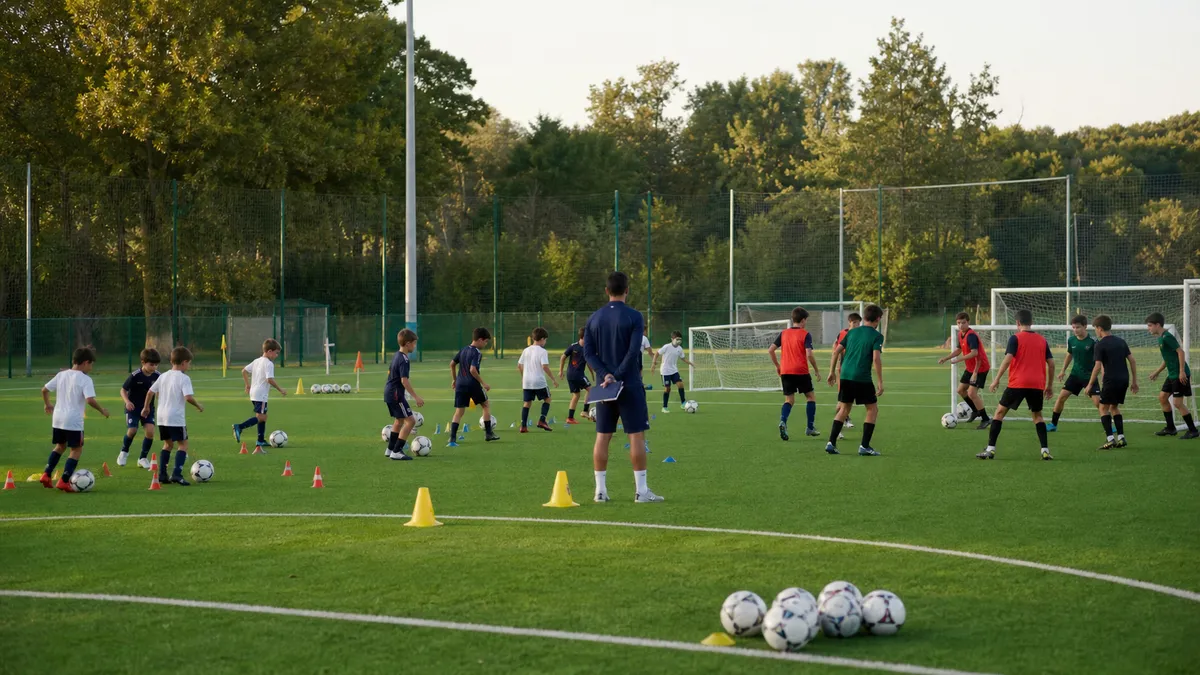
Grassroots football exercises must be adapted to age. Each age band needs different tasks — not the same ones with a smaller ball. The most useful rule: do not rush content.
- Prebenjamín (U-7/8): play and motor skills above all else.
- Benjamín (U-9/10): individual fundamentals with the ball.
- Alevín (U-11/12): first collective notions without losing individual work.
- Infantil and cadete (U-13 to U-16): system and competition start to carry weight.
- Common mistake: feeding team concepts to a benjamín delays the individual fundamentals that age really needs.
Why train by age band, not by global level
In grassroots football we tend to plan around what we want to see: clean build-up, two against one, coordinated pressing. The problem is that a seven-year-old is not near any of that, and does not need to be. Their motor, cognitive and emotional development is in another phase, and training them as a cadete (even "softened") means stealing time from what they actually need to learn at that age.
The official RFEF taxonomy splits grassroots football into five age bands: prebenjamín (6-7), benjamín (8-9), alevín (10-11), infantil (12-13) and cadete (14-15). Each one marks a shift: the pitch grows, the players grow, and the kind of tactical thinking the group can absorb grows with them. The age, format (7/8/11-a-side) and ball size for each category are in grassroots football categories by age.
Training by age does not mean lowering demand. It means choosing what to demand at each moment. Intensity can be high at seven; tactical complexity cannot. And if the group still switches off despite well-chosen tasks, see how to keep kids motivated without boring them.
Prebenjamín (6-7): play, motor skills and lots of ball time
At this age the goal is not to teach football, it is to teach players how to move with the ball in a play environment. Children need to touch the ball many times, in many positions, in different contexts. The most useful task is usually the simplest: a small pitch, one ball per player or one per pair, and clear but open rules.
Three tasks that work:
- Continuous 1 vs 1 with side switches. Two mini-goals, two queues, one ball. Whoever loses the ball goes back to the queue. Repeats basic moves: orient, dribble, beat, finish.
- Tag with the ball. Two taggers dribble a ball and tag the rest with a touch (no hands). Trains real dribbling under pressure, with no line between "fitness work" and "football".
- Four goals. Square pitch with one mini-goal on each side, teams of 2-3. You can score in any goal. Multiplies simple decisions: which goal, where there are fewer opponents.
What does not belong here: fixed positions, system, coordinated pressing, long talks. If a task needs more than two sentences to explain, it is not for this age.
Benjamín (8-9): individual fundamentals with the ball
Benjamín players already grasp more stable rules and can sustain attention for a few minutes in a row. This is the band where individual fundamentals settle: passing, dribbling, oriented control, first dribble, finishing. The ball is still the protagonist and should be present in almost every task.
Three tasks that work:
- 4 vs 1 rondos with expanding space. Start with a small rectangle and widen it as the group masters it. Works body shape before receiving and choice of the freest receiver.
- Zigzag dribbling with finish. A line of cones, dribbling alternating left and right foot, finish at a small goal with passive goalkeeper. Reinforces two-footed coordination.
- 3 vs 3 to outside goals. Tight space (20×15 m), two mini-goals per team, no fixed positions. Without forcing it, the first idea of "support" and "play to the freer teammate" appears.
What does not belong: asking for zone pressing, holding a position for the whole match, demanding a drawn system. Basic supports yes, tactical labels no.
Alevín (10-11): first collective notions
Alevín is usually the first year of "serious" fútbol-7 (in many federations it is the first year of fútbol-9). Here it makes sense to introduce first collective notions: width, depth, near support, simple transition. The player starts seeing the teammate before touching the ball.
Three tasks that work:
- 4 vs 4 possession + 2 outside floaters. The floaters force a search for support outside the block. Without forcing, the idea of playing wide and moving the ball to move the opponent appears.
- Goalkeeper build-up to 3 vs 3 + 2. The keeper plays to a centre-back; the centre-back chooses between interior or full-back. Trains the first passing line and the receiver's body orientation.
- Conditioned match: goal counts double after three passes. Rewards circulation without punishing the direct attack. Internalises the idea that passing is also attacking.
What does not belong: counter-pressing with complex labels, falling back to a midblock in five seconds, talking about "lines" as if they were system pieces. General concepts yes, tactical jargon no. For the full session at this age —75-90 minute structure, weekly plan and how to introduce width and depth— see the guide on how to coach alevín (U-12).
The coach's Sunday summary
Open course calls, up-to-date guides and new posts. Free, with one-click unsubscribe.
Leave your email and get the next issue:
Infantil (12-13): group tactics and positions
Infantil holds longer sessions, follows 30-40 second explanations and starts to think abstractly. It is time for real group tactics: defensive blocks, transitions, third-man build-up, finishing through the wing. The system begins to appear, although flexible.
Three tasks that work:
- Build-up with the third man. Centre-back + full-back + holding midfielder vs 2-3 pressers. The aim is not to build up for its own sake, but to attract the opponent and find the third man facing forward. Works as a reproducible task across the whole season.
- Counter-pressing in a reduced area. Five seconds to recover. If they do, it scores double. If not, retreat to a marked line before pressing again.
- Fast attack after recovery. In half a pitch, one team defends a rival possession. When they win the ball, eight seconds to finish using width and a vertical pass.
What does not belong: treating the group as if it were senior. The concepts are there, but they still need examples, not 20-minute whiteboard schemes.
Cadete (14-15): system, physical work and competition
Cadete is the first year where body, mind and competitive demand begin to look like senior football. Training integrates system, specific physical work and emotional management. The individual task is still present, but collective context and reading of the match weigh more.
Three tasks that work:
- System in 20-minute blocks. Tactical work in phases (defensive shape, build-up, attack, transitions) with short pauses. One task, one principle.
- Physical drills with the ball. Sets of 4×30 m with change of direction and finishing at the end. Real physical load, but connected to the match gesture. Avoid "running without the ball just because".
- Match with individual roles. Each player gets one individual tactical cue before the match (e.g. "the full-back always offers the build-up support"). Reinforces that system is not only where you stand, but also what you decide.
At this age you can already talk about high pressing, midblock, passing lines, build-up from the keeper with a numerical advantage. The big words work because the concepts are mature and competitive motivation helps. To check which licence you need to coach this category, see the UEFA level guide.
The most common mistakes when training grassroots football by age
The first is rushing content: feeding system to a benjamín because the coach comes from senior football. Result: players who can position themselves but cannot receive on the half-turn.
The second is copying elite sessions literally. A first-team counter-pressing task at Real Madrid does not translate one-to-one to twelve alevín kids who are already half an hour into a tired session. The principle can be the same, the dose cannot.
The third is not respecting cognitive rhythm: five-minute explanations to a group of prebenjamín, whiteboard tactical talks to an infantil, motor-skill games to a cadete. Each age has its own communication channel, and if the format does not fit, the content does not get through.
How to chain tasks into a real session
Once you have chosen the tasks by band, the remaining question is how to chain them within a weekly session. Common rule: activate with the ball (10-15 min), one main task with a clear objective (20-25 min), one applied task or conditioned match (15-20 min), and close. The younger the group, the more play and the fewer pauses.
The same principle applies between sessions: each day points at a concrete objective of the microcycle. The Monday session has a different logic than the Thursday one, and a benjamín should not train the same on Monday as on Friday.
If you are starting with a brand-new group, the priority of the first weeks is not teaching tactics but installing habits and observing who fits which profile. That first phase is covered in detail in the article on first-year coaching advice. And to widen your task repertoire on solid foundations, our selection of books for football coaches includes several drill and session manuals by age group.
About the author

Content produced by RutaMister from practical experience, editorial review and a training-focused approach for grassroots football coaches.
Frequently asked questions
What exercises are recommended for grassroots football?
It depends on age. Prebenjamín: ball games, dribbling and 1 vs 1. Benjamín: rondos, two-footed dribbling and 3 vs 3. Alevín: possessions with floaters, build-up from the goalkeeper. Infantil: third-man combinations, counter-pressing, fast attack. Cadete: system in blocks, physical work with the ball and matches with individual cues.
How do I train grassroots football correctly?
The basic rule is not to rush content. Each age has one dominant objective: motor skills and play at prebenjamín, individual fundamentals at benjamín, first collective notions at alevín, group tactics at infantil, system and physical work at cadete. A task that works for one category does not automatically work the same in the next band.
How long should a grassroots football session last?
From prebenjamín to alevín, roughly 60-75 minutes. At infantil and cadete, up to 90 minutes. What matters is not total duration but useful density: the younger the group, the more minutes with the ball in play and the fewer talks. A 90-minute session with 40 minutes paused does not outperform a focused 60-minute one.
What is the biggest mistake when training grassroots football by age?
Rushing content. Importing tasks and concepts that belong two or three categories higher — system at benjamín, fixed positions at prebenjamín, whiteboard talks at alevín — steals time from what that group actually needs to learn now. The typical consequence: players who line up well but cannot receive on the half-turn or resolve a 1 vs 1.
How do I adapt an exercise if I have kids of different ages in the same group?
Keep the task and tweak the rules. Same space, same primary objective, but you change variables: pitch size, touch limit, scoring rules or roles. That way the younger players work motor skills and play, and the older ones work decision and speed. If the task is good, it usually holds across two bands with small adjustments.