Parents on the sideline: 5 ways to turn them into allies
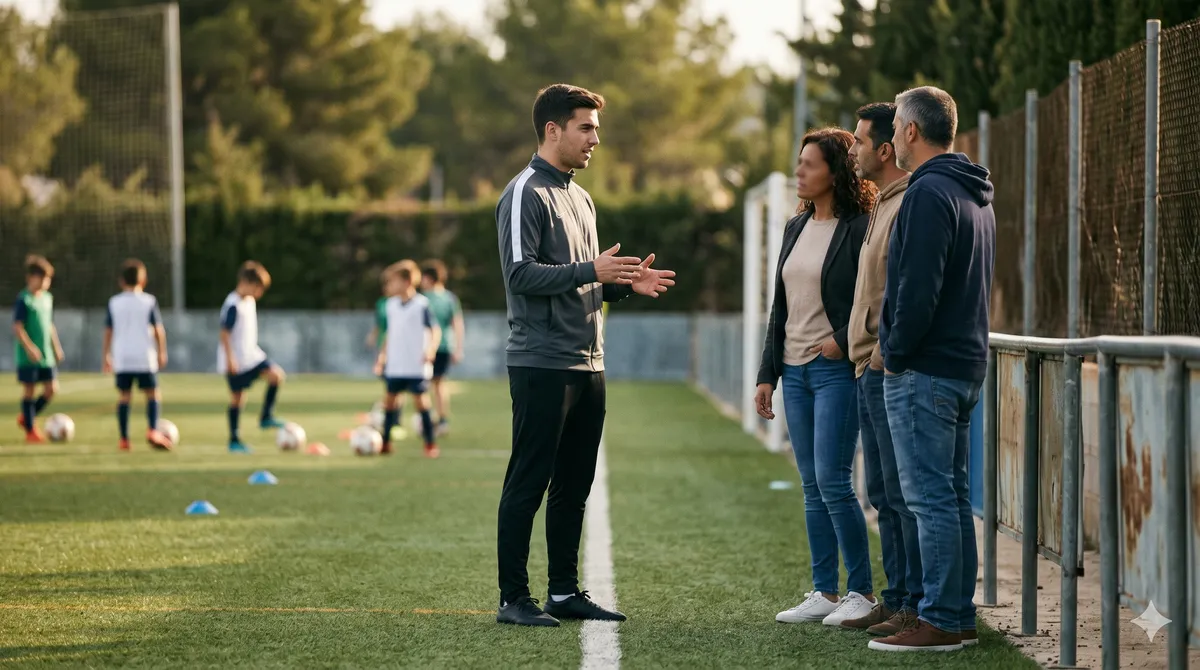
To manage parents in grassroots football, the aim is not fewer arguments but a clear framework where families, players and coach know their role and which channel each topic belongs to.
- Initial meeting with a clear script: rules, channels and expectations written down.
- Encouragement vs. instruction: during the match, families cheer; the coach instructs.
- 24-hour rule: no discussion of playing time, position or tactical decisions in the heat of the final whistle.
- Channel per topic: group chat for logistics; private conversation for individual issues.
- Consistency: the same criterion all season, no caving to one-off pressure.
1. The initial meeting prevents many fires
Do not wait for the first problem to explain how you work. A 20-minute meeting at the start of the season can save you ten tense conversations during the year. It is the highest-return time investment you will make in pre-season.
Explain season goals, attendance rules, playing-time criteria, communication channels and which topics are not discussed right after a match. You do not need to cover every nuance: you need to set the framework and make clear that one exists.
Bring the agenda printed and hand a copy to each family. It is a small gesture but it makes the message stick. And when the first conflict arises, you can point at the line where it was already on record.
20-minute script (suggested agenda):
- 0-3 min · Introduction. Who you are, your background and your commitment to the group.
- 3-6 min · Season goals. What you want players to learn, not just what you want to win.
- 6-10 min · Rules and criteria. Attendance, punctuality, minutes, call-ups, injuries.
- 10-13 min · Communication channels. What goes through WhatsApp, what in person, what by email. And what never goes in the chat.
- 13-16 min · 24-hour rule. Why it exists and how to use it.
- 16-20 min · Questions. Open the floor, listen, answer what you can and commit a date for the rest.
2. Separate encouragement from instruction
Families can encourage, support and reinforce. In-game instruction should come from the coach. Two voices giving different orders block the player: they think before deciding, look at the sideline instead of the game and lose the confidence to take risks.
A useful sentence to set the rule publicly from day one is: “from the sideline we encourage; technical corrections are handled in training”. Said to the whole group, with no names and no blame, it works better than any sanction.
If a specific family keeps shouting instructions after the general reminder, speak in private. Do not argue mid-match or in the group chat. One-to-one usually defuses the pattern without relational cost.
3. Use the 24-hour rule
Do not discuss playing time, position or tactical decisions immediately after the match. Emotions are still high for everyone —player, family and coach— and the conversation rarely helps. Whatever is said there will be remembered for weeks.
Suggest waiting 24 hours and using the channel agreed in the initial meeting. It will not remove every complaint, but it improves the tone and filters out the ones that resolved themselves after a night's sleep.
A polite reply for when a parent corners you straight after the final whistle: “I hear you and I want to talk about this properly. Let's pick it up tomorrow or Monday in cool blood and give it the time it deserves”. You can rehearse that line so you don't have to think about it.
4. Be consistent with your own criteria
Consistency does not mean everyone always plays the same minutes. It means your decisions follow explainable criteria: attendance, attitude in training, learning, group rules and match context. When a family asks why their son played less, you should be able to answer in one concrete sentence. The guide on sharing playing time between winning and developing by age has per-age criteria and the minutes sheet to build that answer before the question comes up.
If a criterion changes mid-season —say, you no longer call up players who skip training without notice— announce it. Opacity creates suspicion; explanation reduces noise. A short message in the group is enough: brief, no excuses, with the start date.
Keep a private note per player with attendances, observations and decisions you make. It is not bureaucracy: it is what lets you answer with data when a conversation gets difficult, instead of relying on selective memory.
The coach's Sunday summary
Open course calls, up-to-date guides and new posts. Free, with one-click unsubscribe.
Leave your email and get the next issue:
5. Remember it is not “a right-back” to them
For a family, it is their child. Understanding that helps you avoid reacting harshly when a conversation arrives charged with emotion. Most complaints are not attacks on the coach: they are concern channelled badly.
Empathy does not mean giving up control. It means listening without handing over the sporting direction of the group. A simple technique: repeat in your own words what they are telling you before answering. You check that you understood and, more often than not, the temperature drops on its own.
And remember this is a long game: the families with whom you keep a good framework over a season will be the first to defend you against a new difficult parent the following year. In categories with real competition like alevín, this framework is set from the first term; we ground it in how to coach alevín (U-12).
Template: first message to the parents' WhatsApp group
The first message in the parents' chat sets the tone for the whole year. Best sent the day after the initial meeting, with the framework already discussed in person. You can adapt and reuse this template every season:
Hi everyone. I'm [name], the team coach this year. Yesterday we covered the general framework in the meeting. Here is a very short recap and I'll pin it:
👉 This chat is for notices, photos and logistics questions (pitch, time, equipment).
👉 To talk about playing time, position or match decisions, better in private and with the 24-hour rule.
👉 If something urgent comes up about a player, message me directly, not the group.
See you on [day] at [time]. Thanks for the trust.
What matters about this message is not the exact wording: it is that it is written down. When someone breaks the norm six months later, you can point at this same message without reopening the debate.
What to discuss, what not to, and through which channel
One of the most common sources of friction is that each topic ends up in the wrong channel. This table works as a criterion to fix in the initial meeting and as a quick reference when something arrives through the wrong place:
| Topic | Recommended channel | When |
|---|---|---|
| Notice of training absence | WhatsApp group | Before the session |
| Logistics (pitch, time, lifts) | WhatsApp group | As it comes up |
| Injury or medical issue | Private message to coach | As soon as possible |
| Complaint about playing time or position | In-person meeting or call | +24 h after the match |
| Tactical decision in the match | In-person meeting | +24 h after the match |
| Educational concern about the player | Meeting with coordinator | Arranged appointment |
| Criticism between families | Not appropriate | Shut down at the root |
The goal is not for the table to be perfect: it is for families to know a criterion exists and that you apply it the same way to everyone.
Three difficult scenarios and how to respond
Scenario 1 · A parent shouts at the referee during the match. Do not argue in the heat of the moment in front of the players. At the end, make clear that this behaviour hurts the team and, if it repeats, you will raise it with the coordinator. The message to the kids afterwards matters: respect for the referee is non-negotiable, no matter who is shouting.
Scenario 2 · Playing-time complaint right after the match. Activate the 24-hour rule with the rehearsed line (see step 3). If they push, stay firm without raising your tone: “I'll hear you tomorrow with all the time you need”. Do not get into a minutes debate in the car park.
Scenario 3 · A family compares their child with another player. Never discuss other players with families that are not theirs. The answer is always: “I will not talk about other kids. About your son I can tell you [concrete observation] and we are going to work on [concrete aspect] over the next weeks”. Said the same way every time, it closes the topic.
If you want to dig deeper into how to set up this kind of framework from day one, pair this with how to prepare a trial session with a new team and, if you are just starting out, with first-year coaching tips.
About the author

Content produced by RutaMister from practical experience, editorial review and a training-focused approach for grassroots football coaches.
Frequently asked questions
How do I run the initial meeting with families?
Book 20 minutes in pre-season, bring the agenda printed and hand a copy to each family. Cover introduction, season goals, rules and criteria, communication channels, the 24-hour rule and a Q&A. Do not try to resolve every nuance: the goal is to set the framework and make sure families know one exists.
What basic rules should I set in the first meeting?
At minimum: how absences are communicated, criteria for playing time, which channel is used for each topic, the 24-hour rule before discussing sporting decisions and which topics are not handled in the WhatsApp group. Make clear the rules apply equally to every family and to you as the coach.
When should I speak with parents after a match?
Avoid sporting conversations immediately after the game. If the topic is playing time, position or technical decisions, apply the 24-hour rule and use the agreed communication channel. That gap reduces immediate emotion, misunderstandings and defensive answers, and filters out complaints that solve themselves after a night's sleep.
What if a parent gives instructions from the sideline?
First remind the whole family group without pointing at anyone. If it continues, speak privately and explain that duplicated instructions create confusion for the player. In grassroots football, consistency between sideline and training is essential for learning and for the child to dare to make their own decisions.
How do I handle a playing-time complaint?
Activate the 24-hour rule in the moment and schedule a private conversation the next day. Arrive with concrete data: attendances, training observations and the specific decision in the match. Stay firm on the criterion but open in the dialogue. If you can't justify the decision in one clear sentence, review your own criterion.
What if a family compares their child with another player?
Never discuss other players with families that are not theirs. The answer is always the same: “I will not talk about other kids. About your son I can tell you [concrete observation] and we are going to work on [concrete aspect] over the next weeks”. Said the same way every time, it closes the topic without conflict.
Should I allow constructive criticism from families?
Yes, as long as it comes through the agreed channel and respects the timing. Critique backed by data can help you see blind spots. What does not belong is debating the sporting direction of the group or technical decisions in the open. Listening is not giving up control: it is taking the useful information and discarding the rest.