Youth football warm-ups: ball games by age group
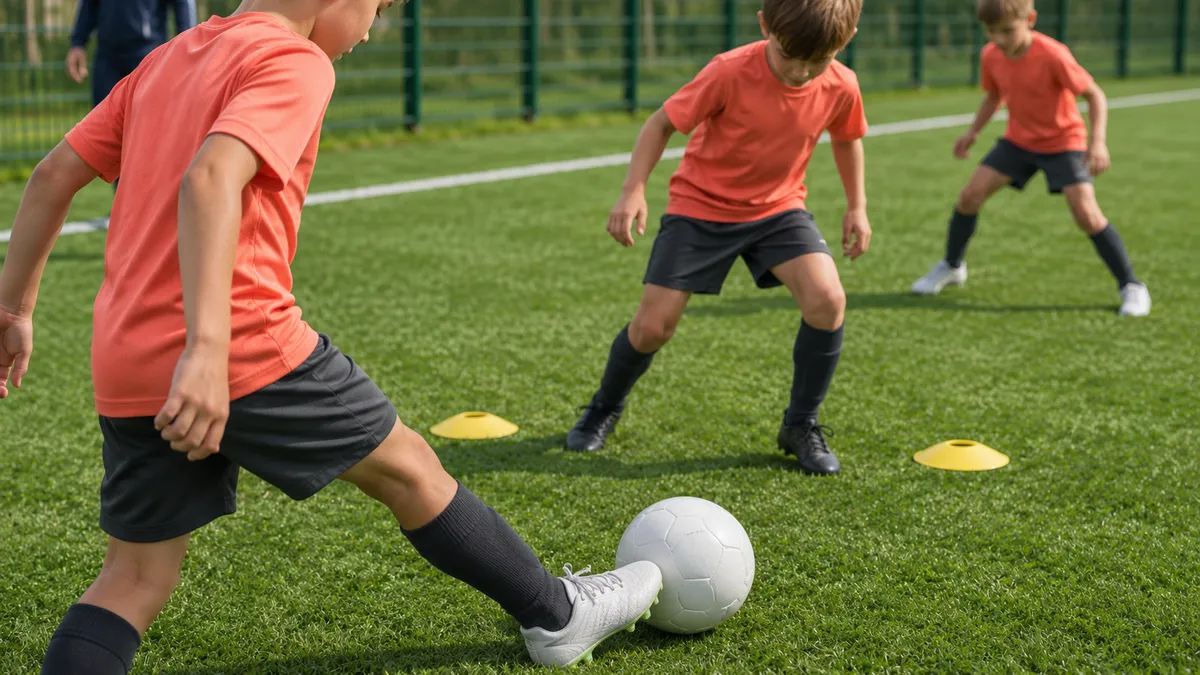
For a youth football warm-up, choose ball games that keep everyone involved and build up the pace gradually. A 10-15 minute block is a possible starting point, adjusted to the age group and session.
- Set-up: two or three short games with simple rules.
- Start: easy movement before increasing intensity.
- Aim: include passing, dribbling or movement you will practise later.
- Match day: include substitutes and allow time for goalkeeper work.
Choose a warm-up for your group
The table suggests a duration for each group, including mobility work. If the session includes a specific injury-prevention programme, allow the time that programme needs.
| Age group | Suggested time | Activity |
|---|---|---|
| Prebenjamín (6-7) | 8-10 | Chasing game, movement story |
| Benjamín (8-9) | 10-12 | Cops and robbers with a ball, passing through gates |
| Alevín (10-11) | 10-15 | 2v1 with swap, 6v6 tag |
| Infantil (12-13) | 12-15, with mobility before the ball | Gate passing with the weaker foot, 2v1 with swap |
| Cadete (14-15) | 15-20 if it includes a preventive block | Mobility and activation, then a passing game |
Begin with easy movement, continue with passing or dribbling, and finish with an action related to the session. Explain each game’s rule before starting and build up the pace gradually.
Games for prebenjamines and benjamines (ages 6-9)
Choose simple games that involve everyone. Combine two or three of the following activities, each lasting 3-5 minutes.
Chasing in seated pairs
- Set-up: 8-12 in pairs. 15x15 m. 3-4 min.
- How to play: Pairs sit spread around the area. A chaser runs after a partner, who is safe once seated beside another pair; then a player of that pair becomes the one being chased. Easier: the chaser runs with a ball in the hands. Harder: players carry or dribble a ball and swap it on the handover. Cue: change direction and find another way to move.
- What to look for: Seated players stay still so nobody trips over them. Keep the area clear of cones and bags.
Adapted from FIFA 044.
Movement story
- Set-up: Whole group, one ball each. 15x20 m. 4-5 min.
- How to play: The coach tells a story and the children do what happens in it: catch the ball with their hands before being frozen, make 5 touches without dropping it, carry it to the other goal, go round some cones. Once the group understands the game, the same tasks can be given without the story.
- What to look for: Short sentences and one action at a time. If the story drags, the group stands still.
Adapted from efdeportes 2003.
Cops and robbers with a ball
- Set-up: 10-12, two teams. Roughly a goal area for 12 players. 4-5 min.
- How to play: Everyone dribbles a ball. Cops catch robbers and roles swap when they do. Cue: surround the robber together instead of chasing alone.
- What to look for: Dribbling with the head up and chasing as a group. Stop after two minutes if the same players always run.
Adapted from efdeportes 2003.
Passing through gates
- Set-up: 2 teams of up to 4. Gate in the middle, teams 8-10 m apart. 3-4 min.
- How to play: Two teams face each other with a gate between them. The first to make ten passes through the gate wins. Easier with large gates and teams close together; harder with small gates and teams far apart. For more players, add more gates.
- What to look for: Accuracy before speed: use the inside of the foot.
Adapted from FIFA 043.
Steal the ball
- Set-up: 8-12, half with a ball. 15x15 m. 3-4 min.
- How to play: One group with a ball and another without. Everyone against everyone: whoever loses the ball can steal another.
- What to look for: Shield the ball with the body and avoid staring at it.
Adapted from efdeportes 2003.
To plan the rest of training, see the sessions for prebenjamines and benjamines.
A possible sequence for benjamines: gate passing (4 min), cops and robbers with a ball (5 min) and steal the ball (3 min). For prebenjamines: seated-pair chasing (4 min), movement story (5 min) and free play with the ball (1-2 min).
Games for alevines and infantiles (ages 10-13)
Add simple decisions: find a free teammate, move after passing or protect the ball. Adjust the space and allowed touches to how the group responds.
2v1 with swap
- Set-up: Groups of 3. 8x8 m per group. 4-5 min.
- How to play: Each group plays 2v1 and tries to keep the ball for several passes or a set time. Whoever loses the ball swaps with the defender. Groups can compete to see who lasts longest. Easier by enlarging the area; harder by shrinking it or limiting touches.
- What to look for: Offer a passing lane. The player on the ball can keep it if the defender does not approach.
Adapted from FIFA 085.
Gate passing with the weaker foot
- Set-up: 2 teams of 4. 10-15 m between teams. 4 min.
- How to play: Place a cone gate between two teams. Ask for passes with the non-dominant foot for one round. Make the gate narrower or move the teams further apart to increase the difficulty.
- What to look for: Inside of the foot, firm standing foot, look at the gate before passing.
Adapted from FIFA 043.
6v6 tag
- Set-up: 12, six with a ball and six without. A 7-a-side penalty-area sized zone. 4 min.
- How to play: Six players with a ball try to touch the six who have none. In this adaptation, tag gently with a hand, without throwing the ball or pushing. The tagged player receives the ball and becomes the chaser.
- What to look for: Head-up dribbling and changes of direction instead of straight runs.
Adapted from efdeportes 2003.
Pair passing with different surfaces
- Set-up: Pairs. 10 m apart. 2-3 min.
- How to play: Pass and control with inside, outside and sole, then 1v1 to keep possession.
- What to look for: Oriented first touch and distance to the partner.
Adapted from efdeportes 2003.
If you will be working on possession, you can choose a warm-up rondo instead of these games.
A possible sequence for alevines: 6v6 tag (4 min), gate passing (4 min) and 2v1 with swap (5 min). For infantiles, add 3-4 minutes of easy joint mobility first.
Mobility and games for infantil and cadete
You can begin with mobility work and continue with a passing game. Count both parts when planning the warm-up duration instead of adding them to an already complete block.
For planning at this stage, see the guide to cadetes, puberty and training load.
The coach's Sunday summary
Open course calls, up-to-date guides and new posts. Free, with one-click unsubscribe.
Leave your email and get the next issue:
Pre-match warm-up: a timeline for 7-a-side and 11-a-side
Before the match, agree which space is available and when the team can enter the pitch. This is a suggested sequence: include the whole squad and avoid finishing with a long wait.
| Phase | 7-a-side | 11-a-side | Content |
|---|---|---|---|
| Arrival and changing | 35-40 min before | 45-50 min before | Changing room, kit, warm clothing and boots ready. Keep warm layers on until going out. |
| Pitch with the ball | 15 min | 20 min | Mobility with the ball, pair passing, 6v6 tag or 2v1, short sprints and feints at the end. |
| Goalkeepers | Within the 15 min | Within the 20 min | Specific work apart, while the rest play a rondo. |
| Team talk | 3-5 min | 5 min | Two ideas for the match and the line-up. |
| Waiting | Under 5 min | Under 5 min | Drink and keep moving. Substitutes do some easy exercise. |
Prepare an alternative if it rains or the pitch is busy, and check that balls will be available. Adapt the set-up to the 7, 8 or 11-a-side format.
Common warm-up mistakes
- Long queues: split the group or add another playing area.
- Too many games: choose two or three and leave time for the main activity. Include mobility and any specific programme in your timing.
- Maximum intensity from the start: begin with easy movement and increase the pace gradually.
- Long explanations: demonstrate the action, give one rule and check that the group understands it.
- Too much difficulty: increase the space or allow more touches if play keeps stopping.
About the author

Content written by RutaMister from hands-on experience, editorial review and a teaching focus for youth football coaches.
Frequently asked questions
How long should a youth football warm-up last
Use 10-15 minutes as a starting point for training, then adjust it to the age group, objective and players. Two short games may be enough for younger children. Count mobility work within the total; if you include a specific injury-prevention programme, allow the time that programme requires.
Which warm-up games with the ball work for children
Try chasing games with a ball, passing through cone gates or a 2v1. Look for simple rules and frequent involvement. If the group struggles, increase the space or allow more touches. Choose two or three games that prepare actions from the session, such as dribbling, passing or moving to receive.
How do you warm up before a 7-a-side match
Plan a block with mobility, passing and gradually faster movement, plus specific goalkeeper work. Include substitutes and coordinate when the team goes onto the pitch to avoid long waits. Around 15 minutes on the pitch is a suggested starting point; adapt it to the available time and the group’s needs.
How do you avoid queues during the warm-up
Split players into pairs or small groups and prepare several identical areas. Explain where each player goes after passing or dribbling. If more players are waiting than taking part, duplicate the activity or choose another game. Have balls and cones ready before bringing the group together for the explanation.
What is FIFA 11+ Kids
FIFA 11+ Kids is a warm-up programme designed to prevent injuries in children’s football. It was evaluated in a study published in Sports Medicine, listed in the sources. The ball games in this article are separate warm-up suggestions; they do not reproduce the programme or replace its instructions.
How do you warm up without a ball
If balls are unavailable or the pitch is occupied, prepare an alternative with mobility and easy movement in a clear space. Explain the route and keep players from crossing each other’s paths. Once the pitch and equipment are available, add passing or dribbling and build up the pace gradually.
Sources
The games adapt the sources below. Ages, dimensions, group sizes and timings are RutaMister suggestions; the cited FIFA sheets do not assign age groups.
- FIFA Training Centre, Session Plan Grassroots 044: chasing in seated pairs, ball variants and questions for children.
- FIFA Training Centre, Session Plan Grassroots 043: gate passing, teams of up to 4 and difficulty progressions.
- FIFA Training Centre, Session Plan Grassroots 085: 2v1 in groups of 3, swap with the defender and variants.
- Sánchez Latorre and Donoso Barella, Fundamentos básicos del calentamiento en el fútbol base II (efdeportes no. 65, 2003): ball-based warm-ups by age group and the match warm-up. Old source, not peer reviewed.
- Campillo Almela and López Andrés, Trabajo de calentamiento previo en el fútbol (efdeportes no. 153, 2011): warm-up phases and dynamic stretching. A general football source, not specific to children.
- Rössler et al., cluster randomised trial on 11+ Kids (Sports Medicine, 2017): trial on the programme.