Coordination and dribbling drills for benjamín and alevín players: 8 cards
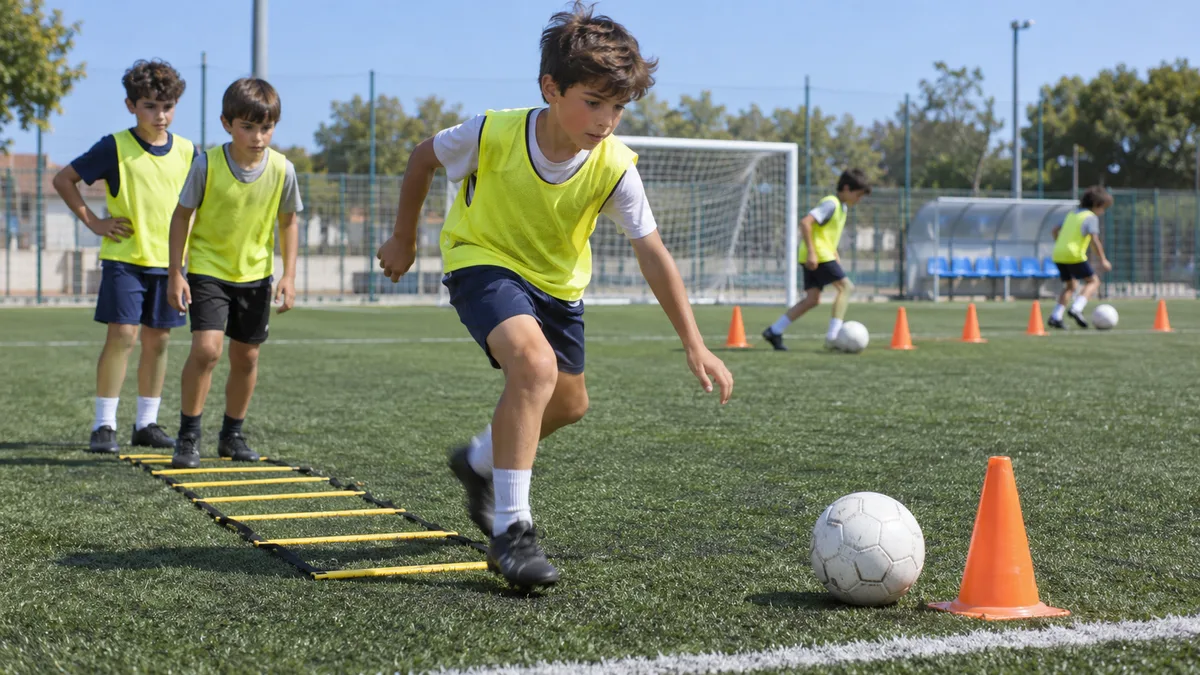
The best coordination and dribbling drills in grassroots football work together: footwork without the ball first, then with the ball, and finally dribbling. This article gathers 8 cards for benjamín and alevín players and a technical block of about 30 minutes.
- Coordination without the ball: 3 cards with ladder, hoops and changes of pace.
- Coordination with the ball: 2 cards of circuit and passing.
- Dribbling: 3 cards with head up, slalom and changes of direction.
- Duration: between 6 and 10 minutes per drill.
Why coordination and dribbling are worked on together
With benjamín and alevín players, coordination and dribbling support each other. A child who cannot coordinate feet, arms and eyes loses the ball as soon as the pace changes. A child who only dribbles in a straight line runs out of options when an opponent appears.
Coordination without the ball teaches the feet to move in order. Once the ball is added, that order is applied to one more task: looking, deciding and touching. Dribbling completes the process, because it asks the child to use those movements while controlling the ball and lifting the head.
This article does not replace a full session. To see how a technical block fits the plan for each category, there are the typical sessions for benjamín players and for alevín players, and for a general overview by age, grassroots football drills by age. “Benjamín” and “alevín” are used here as club categories: check with your federation which ages each one covers.
Equipment and set-up to avoid long queues
The equipment is simple and almost all of it can be replaced by marks on the ground:
- Coordination ladder: one per 4 children. If there is none, draw it with chalk or lay it out with ropes.
- Hoops: 8 to 10 per route. Marks or flat cones also work.
- Cones: to mark starts, turns and the slalom.
- Balls: one per child.
- Bibs or coloured cones: to give signals and form groups.
The set-up rule is that every child has something to do almost all the time. A queue of five children watching one go through the ladder is wasted time. Set up two ladders or two identical routes, with groups of 4 children at most, and send the next child when the previous one reaches the halfway point. The numbers of children and the times on each card are approximate: the coach adjusts them to the group and the space.
A short warm-up is useful before these cards. The ball games for warm-ups are a good start.
Coordination without the ball (3 cards)
These three cards work on rhythm and footwork without the ball. They all follow the same format: duration, space, equipment, rules, variants and what to watch.
Card 1. Ladder: one foot per square
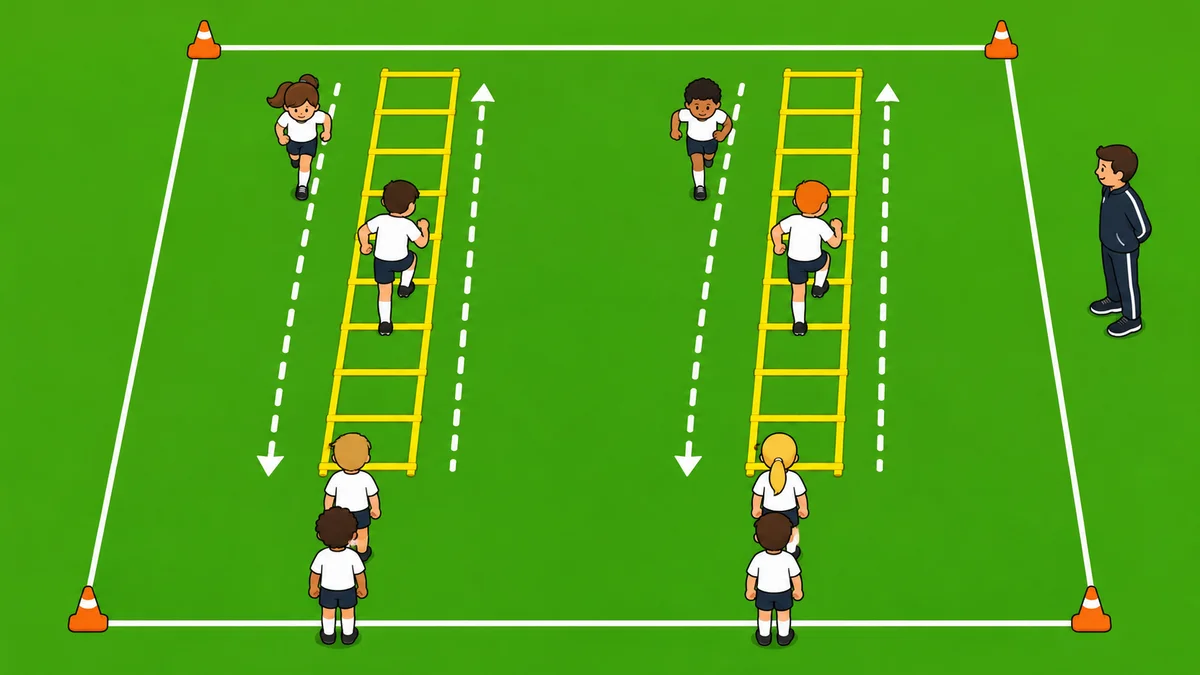
- Duration: 8 minutes.
- Space and children: a ladder of 4 to 5 metres for every 4 children, with a free lane of 2 metres alongside to jog back.
- Equipment: coordination ladders or squares drawn with chalk.
- How to play: each child goes through the ladder and jogs back along the lane. Round one, one foot per square. Round two, both feet inside each square. Round three, in and out alternately. The next child starts when the previous one passes the middle of the ladder.
- Easier: walking, with wider squares.
- Harder: faster, or looking at the coach, who shows a number with their fingers for the child to call out at the end.
- What to watch: whether the child steps inside the square without stopping, lands on the front of the foot and keeps the same rhythm from start to finish.
Card 2. Hoops on the ground
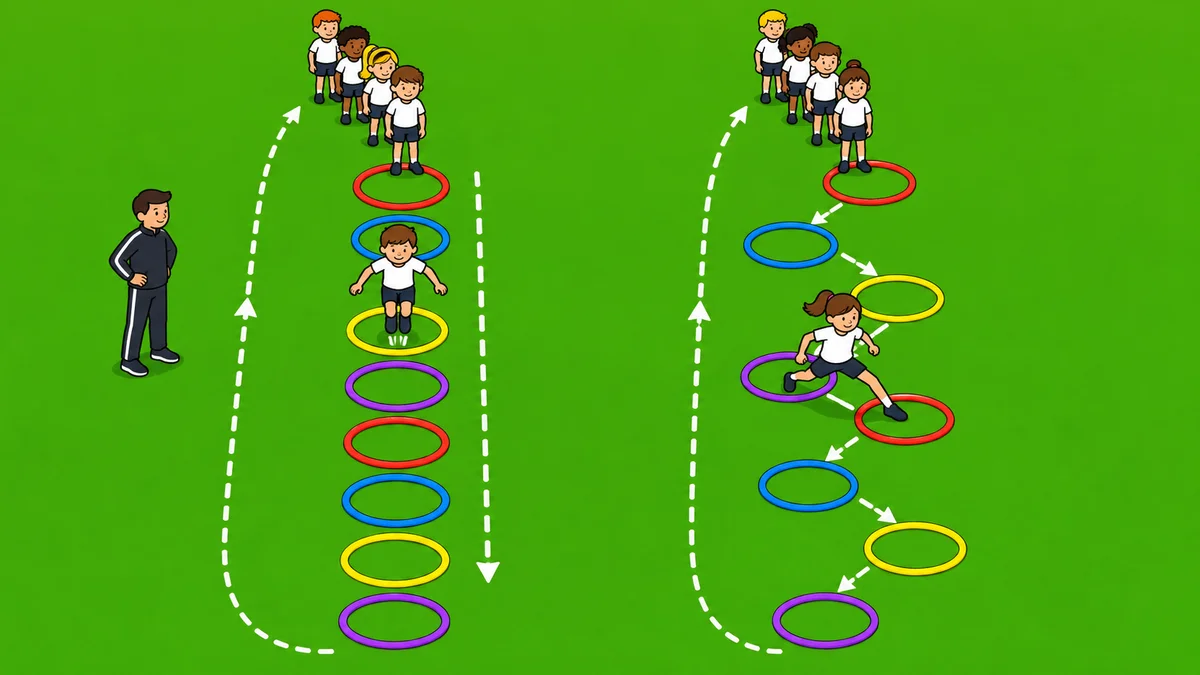
- Duration: 7 minutes.
- Space and children: 10 x 6 metres per route, groups of 4 children.
- Equipment: 8 to 10 hoops or marks on the ground per route.
- How to play: the hoops go in a line, and in a zigzag in the second round. Round one, jump with both feet into each hoop. Round two, one foot in each hoop, alternating. Round three, alternating both feet in one hoop and one foot in the next. Jog back on the outside.
- Easier: hoops very close together and walking through.
- Harder: hoops spaced further apart, or a quarter turn on each jump.
- What to watch: whether they land with slightly bent knees and land inside the hoop without stepping on its edge.
Card 3. Jumps and changes of pace
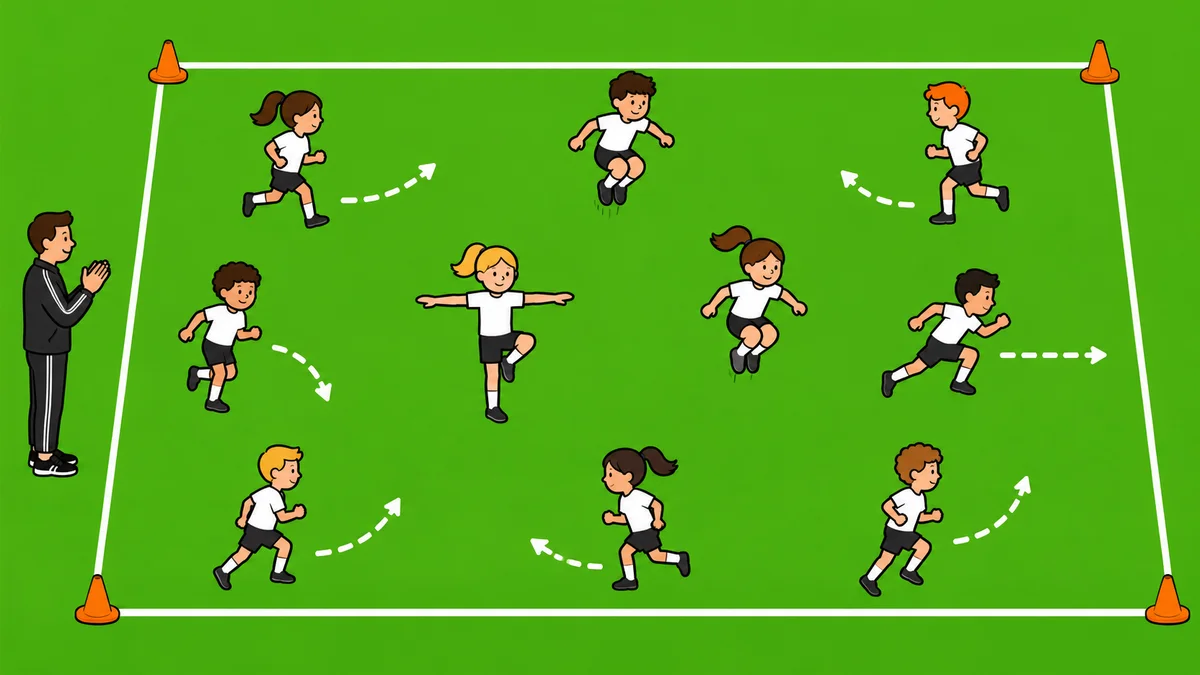
- Duration: 6 minutes.
- Space and children: 12 x 8 metres, the whole group at once, up to 12 children.
- Equipment: four cones to mark the space.
- How to play: everyone moves freely around the space, jogging. On one clap, a jump with both feet together. On two claps, stop and balance on one foot for a second. On hearing “change!”, go from a jog to a short sprint of 3 or 4 metres. The coach mixes the signals in no fixed order.
- Easier: a single signal, repeated several times.
- Harder: two signals in a row, such as jump and stop, or alternating the standing foot.
- What to watch: who reacts late to the signal, who loses balance and who bumps into others by not looking.
Coordination with the ball (2 cards)
Once the ball is added, the child keeps the footwork order from the earlier cards and adds controlling, dribbling and passing.
Card 4. Circuit with ladder and ball
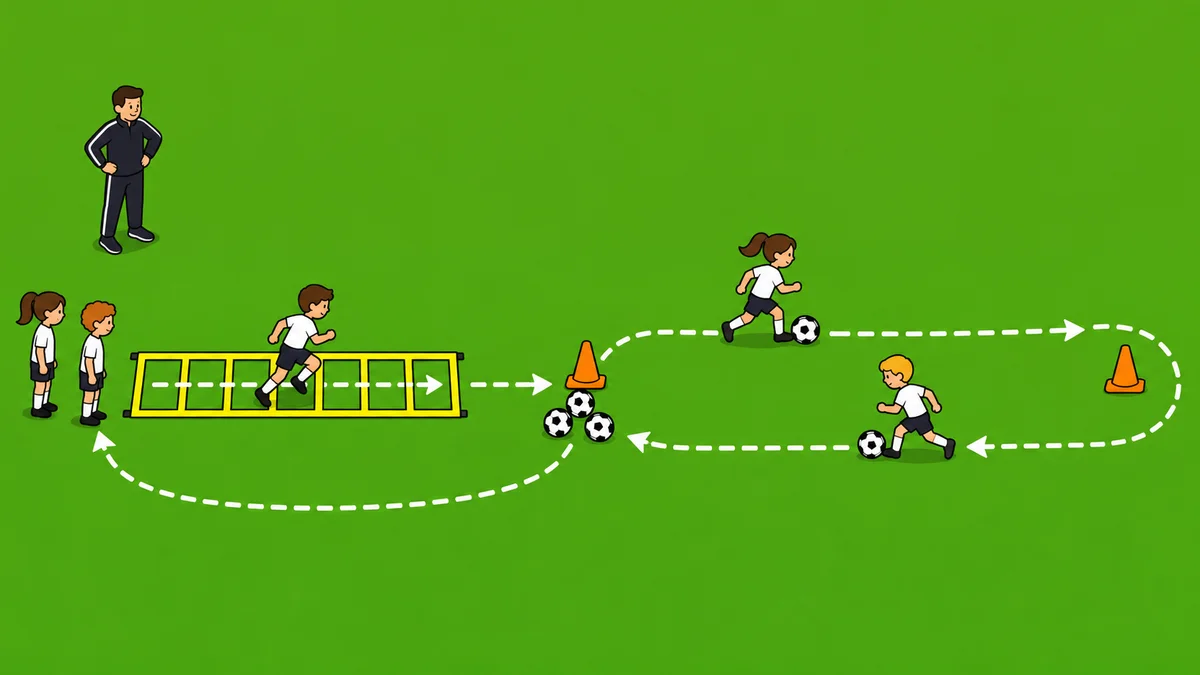
- Duration: 10 minutes.
- Space and children: 20 x 10 metres per circuit, 4 to 6 children. With a bigger group, two identical circuits.
- Equipment: one ladder, four cones and one ball per child.
- How to play: the child goes through the ladder without the ball, one foot per square. On leaving, they pick up a ball from the cone placed 2 metres further on, dribble 10 metres to a turning cone, go round it and dribble back to the ball cone. They leave the ball there for the next child and jog back to the ladder. Three laps.
- Easier: walk the ladder and dribble with any part of the foot.
- Harder: two feet per square on the ladder, and dribble out with the right foot and back with the left.
- What to watch: whether the child leaves the ladder with the ball under control, pushes it away from the foot on turns and lifts the head.
Card 5. Passing and moving
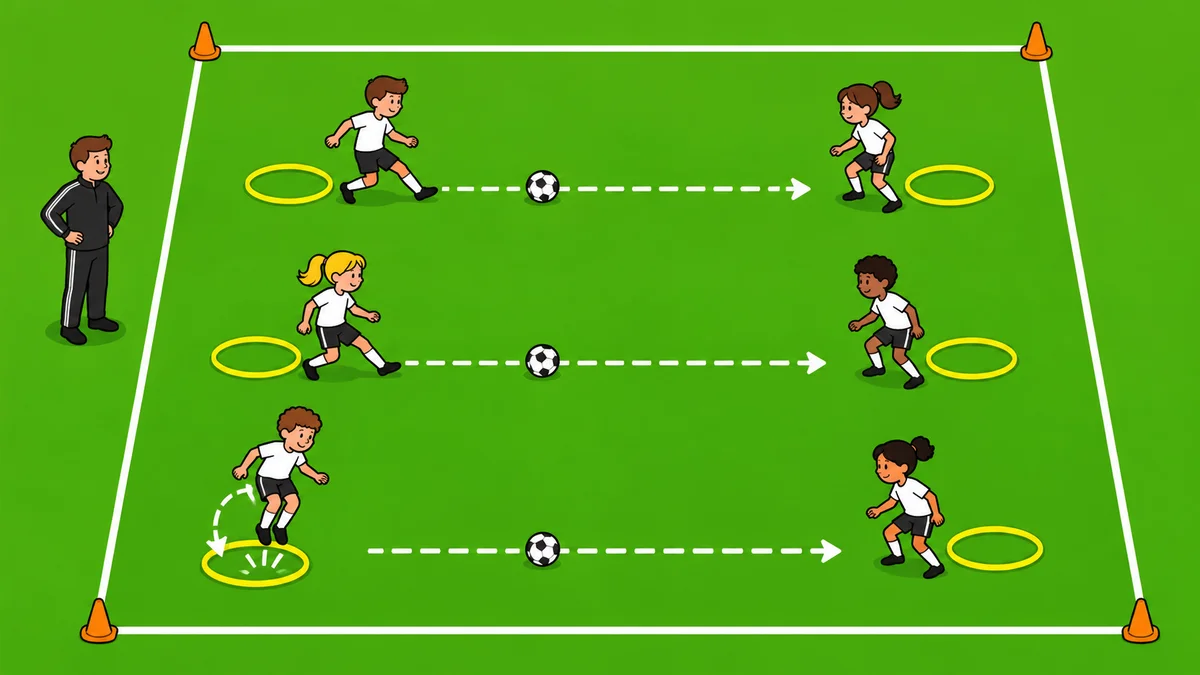
- Duration: 8 minutes.
- Space and children: 10 x 8 metres for every three pairs.
- Equipment: one ball and two hoops per pair. If there are no hoops, two marks on the ground.
- How to play: the two children stand 5 metres apart, each beside a hoop. The first passes with the inside of the foot and, after the pass, jumps with both feet into their hoop and out. The partner controls, passes and repeats the jump. Each pair counts its consecutive passes and tries to beat its own number.
- Easier: stop the ball by hand before passing.
- Harder: first-time pass, a one-footed jump, or a distance of 7 metres.
- What to watch: whether the child looks at their partner before passing, gets back into position after the jump and how they place the standing foot.
The coach's Sunday summary
Open course calls, up-to-date guides and new posts. Free, with one-click unsubscribe.
Leave your email and get the next issue:
Dribbling (3 cards)
The three dribbling cards ask the child to move with the ball close to the foot and the head up. Speed comes later.
Card 6. Free dribbling with head up
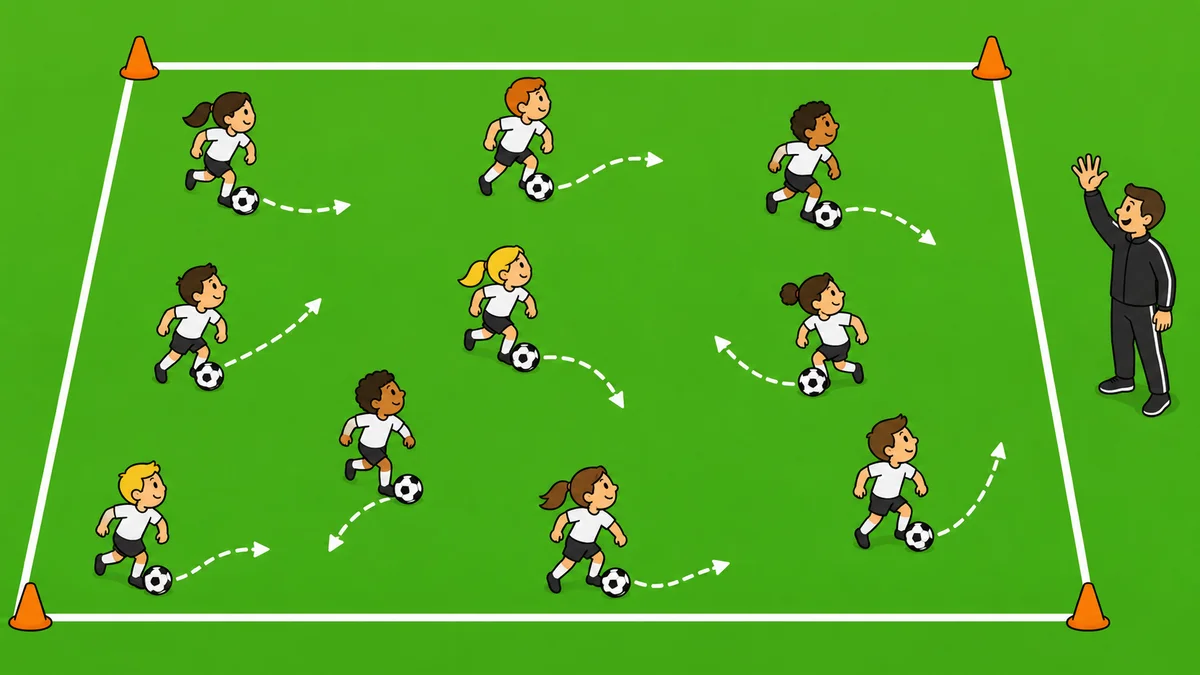
- Duration: 6 minutes.
- Space and children: 20 x 15 metre square, up to 12 children.
- Equipment: one ball per child and four cones.
- How to play: everyone dribbles around the square at a comfortable pace without colliding. From one side, the coach raises a hand with a number of fingers and the children call it out without stopping the ball. Every 90 seconds, the part of the foot changes: inside, outside, sole.
- Easier: the coach shows a bib colour instead of fingers.
- Harder: a smaller space with the same number of children, or dribbling only with the weaker foot.
- What to watch: how many children answer without losing the ball, who always looks down and who dribbles far from the foot.
Card 7. Slalom with both feet
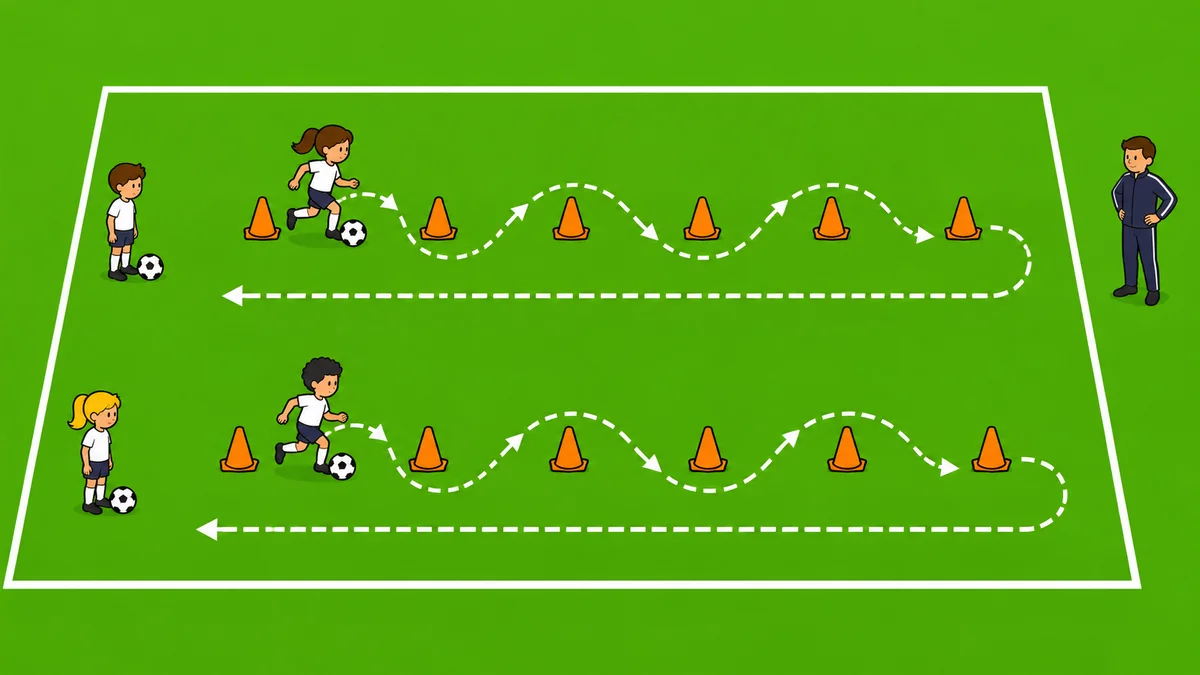
- Duration: 8 minutes.
- Space and children: a row of 6 cones 2 metres apart for every 4 children.
- Equipment: 6 cones and one ball per child.
- How to play: the child dribbles between the cones and returns in a straight line along the side. Round one, right foot only. Round two, left foot only. Round three, one touch with each foot between cones. The next child starts when the previous one passes the third cone.
- Easier: cones 3 metres apart and dribbling without speed.
- Harder: cones 1 metre apart, or going round each cone with the outside of the foot.
- What to watch: whether the ball hits the cones, whether the child uses the weaker foot with confidence and lifts the head between two cones.
Card 8. Dribbling with change of direction and signal
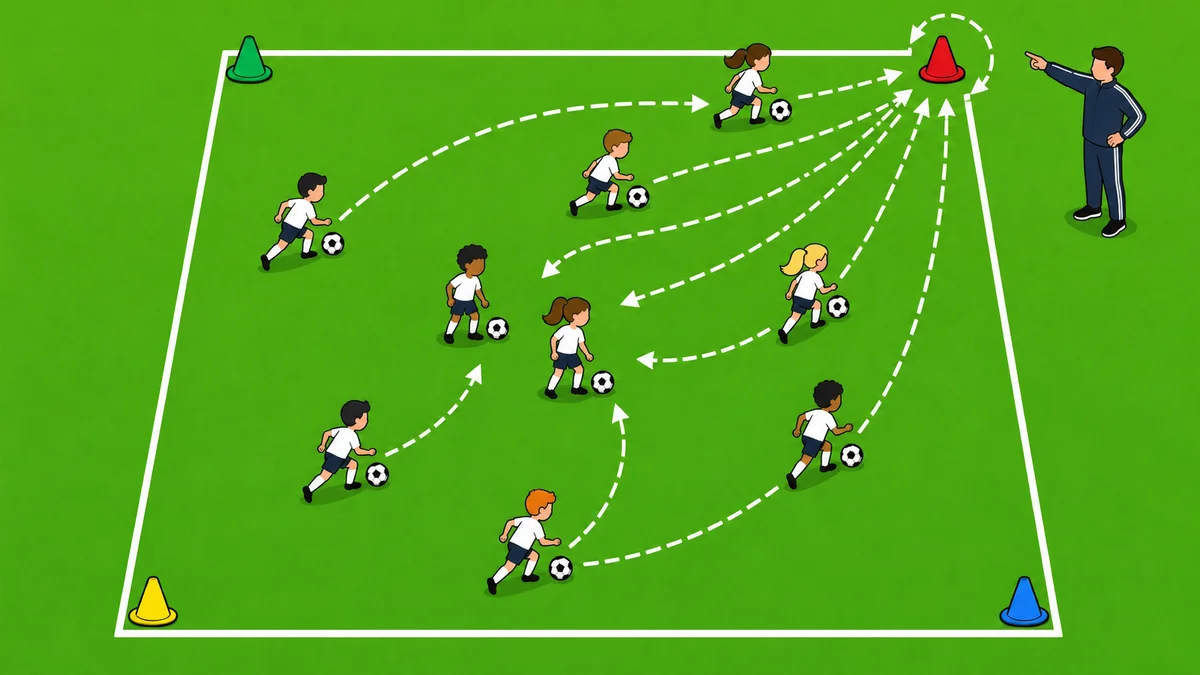
- Duration: 7 minutes.
- Space and children: 15 x 15 metre square, up to 10 children.
- Equipment: one ball per child and four cones of different colours, one in each corner.
- How to play: everyone dribbles around the square. When the coach calls a colour, each child dribbles towards the cone of that colour, goes round it and returns to the centre. On hearing “change!”, they turn 180 degrees and carry on with the other foot.
- Easier: one call per round and no change of foot.
- Harder: two calls in a row, such as “red then blue”, or dribbling faster on the straight section.
- What to watch: whether the child hears the call and decides before turning, how they shield the ball on the turn and whether they use both feet.
How to adapt each card for benjamín and alevín players
The same card works for both categories if what is asked of the children changes. This suggestion is approximate and not a rule of any federation: check with your federation which ages each category covers and adjust to the group's level.
- Ladder and hoops (cards 1 and 2): for benjamín players, one foot per square at a calm pace. For alevín players, two feet per square, in and out, and more speed.
- Jumps and changes of pace (card 3): for benjamín players, one signal at a time. For alevín players, two signals in a row.
- Circuit and passing (cards 4 and 5): for benjamín players, dribbling with any part of the foot and a pass after stopping it. For alevín players, first-time passes and dribbling with the foot the coach names.
- Dribbling (cards 6, 7 and 8): for benjamín players, cones further apart and one call per round. For alevín players, cones closer together, double calls and more speed.
For younger children, the typical prebenjamín session has simpler games.
Common mistakes in coordination and dribbling work
- Waiting queues. Four children watching while one works spend most of the time standing still. Set up two routes or reduce the group per station.
- Correcting too much. A remark every few seconds confuses the child. One cue per round is enough: “head up” or “ball close”.
- Demanding speed before control. If the child loses the ball when going fast, lower the speed and raise it once the ball is under control.
- Not alternating feet. Many children do every pass with their stronger foot. Name the foot for each round and share the time.
When a card gets boring, changing the variant is usually enough. More ideas in the article on keeping children motivated without boredom.
A technical block of about 30 minutes with three cards
Three cards are enough for a technical block of about 30 minutes inside the session, moving from coordination to dribbling. This outline is an approximate suggestion, not a rule of any federation:
- 2 minutes: set-up and a one-sentence explanation per card.
- 7 minutes: card 2, hoops on the ground.
- 2 minutes: water and change of equipment.
- 10 minutes: card 4, circuit with ladder and ball.
- 2 minutes: water and change of equipment.
- 7 minutes: card 8, dribbling with change of direction and signal.
With alevín players, card 2 can be swapped for card 1 and the difficulty of each card raised as in the previous section. In the following weeks, rotate through the other cards so the block does not repeat exactly.
About the author

Content produced by RutaMister from practical experience, editorial review and a training-focused approach for grassroots football coaches.
Frequently asked questions
How long should a coordination drill last in grassroots football?
Between 5 and 10 minutes per drill is a useful guide for benjamín and alevín players. After that, attention drops and the movements lose quality. When that happens, it helps to switch card or variant. The coach adjusts the duration according to how the group responds that day.
Do you need a coordination ladder to train coordination?
No. A coordination ladder helps, but one can be drawn with chalk, laid out with ropes or marked with flat cones. Hoops can also be replaced by marks on the ground. What matters is that each child has their own space and repeats the movement many times without long waits for a turn.
How many balls do you need for a ball circuit?
Ideally one ball per child. If balls are short, form pairs that take turns on each pass, so each child waits seconds and not minutes. With large groups, it is better to set up two identical circuits than one long one, so that no waiting queues form.
How do you work on dribbling with both feet in children?
Split the time between the two feet explicitly: one pass with the right, another with the left and another alternating. In the slalom you can ask for one touch with each foot between cones. Start slowly and raise the speed once the child controls the ball with the weaker foot.