How to coach benjamines (U9): a model session
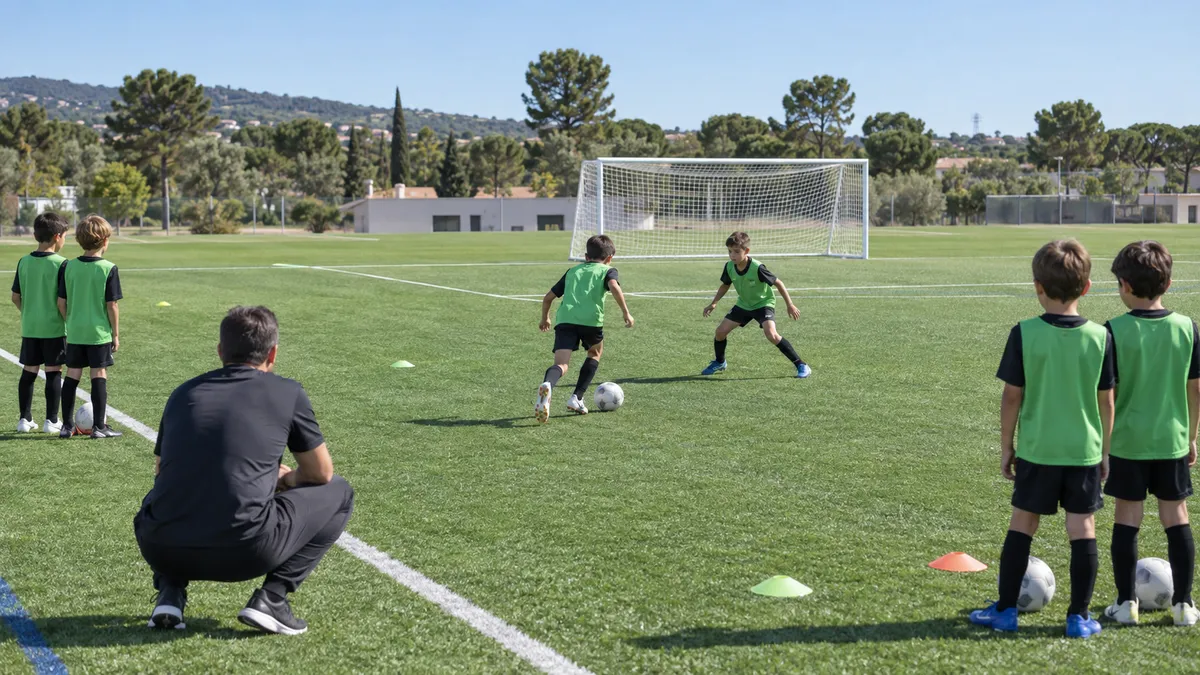
Benjamín is the Spanish category for 8- and 9-year-olds, born in 2017 and 2018 in the 2026/27 season: the step between the free play of prebenjamín and the first team concepts of alevín.
- Format: 7-a-side in Madrid, 8-a-side in the Valencia region and much of Spain.
- Ball: size 4 under RFFM rules.
- Model session: 60-75 minutes, ball always in play.
- Frequency: 2 sessions a week plus the match.
- Content: 1v1, receiving and passing, and first ideas of positioning, no formation.
What benjamín is and how it differs from prebenjamín
Benjamín covers players born in 2017 and 2018, children aged 8 and 9 in the 2026/27 season. It comes after prebenjamín, where sessions revolve almost entirely around free play, and before alevín, where talking about width and depth starts to make sense. The full age table is in our guide to youth football categories by age.
The format depends on the regional federation: the RFFM (Madrid) plays benjamín as 7-a-side and the FFCV (Valencia region) as 8-a-side, like much of Spain; pitch and squad differences are covered in 7-a-side vs 8-a-side vs 11-a-side. In Madrid, the RFFM 2026/27 rules set 50-minute matches (2×25) and a size 4 ball, up from the size 3 used in prebenjamín.
The rule change coaches notice most on the pitch is offside. It does not exist in RFFM prebenjamín; in benjamín it appears in a reduced form, only inside a zone near the goal: 13 metres under the RFFM and 12 metres under the FFCV and the FCF (Catalonia). Other differences by category are in youth football rules by category.
The 60-75 minute model session, block by block
The benjamín session grows compared with prebenjamín, but keeps the basic rule: nobody waits in a queue. We suggest four blocks with short transitions:
| Block | Time | Content |
|---|---|---|
| Warm-up with the ball | 10 min | Dribbling with both feet, changes of direction and handling games for the whole group |
| Small-sided games | 15-20 min | 1v1 and 3v3 with small goals, rotating opponents and goalkeeper |
| Technical core | 15-20 min | Receiving and passing, or 1v1, with opposition as soon as the technique works |
| Conditioned game | 20-25 min | A match in the competition format with a single focus for the session |
In 60 minutes the group works well if blocks follow each other without long pauses; 75 minutes leaves room for one more 1v1 task or a longer final game. Beyond that, at 8-9 attention fades before the legs do.
The small-sided block concentrates the most learning: the fewer players in each mini-game, the more often each child touches the ball, as Abad Robles, Fernández-Espínola and Giménez Fuentes-Guerra (2019) note in their review of small-sided games in football.
Weekly plan: two sessions and a match
The microcycle that works best in benjamín is two midweek sessions plus the weekend match, the same pattern as prebenjamín:
- Session 1 (for example, Tuesday or Wednesday): the fullest one. It introduces the technical content of the week and carries it into the conditioned game.
- Session 2 (Thursday or Friday): the same content revisited with more play and less talk. Nothing new is introduced.
- Match: minutes shared out, rotating goalkeeper and at most one instruction from the touchline.
A third weekly session makes more sense in alevín, when technical and competitive demands justify it. For more tasks at this age, see our youth football drills by age.
The technical core at 8-9: what fits
Benjamín players can hold attention for several minutes in a row and follow stable rules. This is the age to settle the individual fundamentals that alevín will take for granted:
- Dribbling with both feet: changes of direction and pace, including with the weaker foot.
- Receiving and passing: stopping the ball with the inside of the foot and passing to a nearby teammate; the directional first touch comes later, in alevín.
- Attacking 1v1: taking players on without fear, even if the ball is lost often.
- Defending 1v1: not diving in, staying with the opponent and waiting for the mistake.
- Shooting: small goals and short distances, accuracy before power.
The practical rule: one or two of these per session. Covering all five in one evening leaves children with many instructions and none of them settled.
First ideas of positioning, without a formation
Benjamín brings the first collective problem of youth football: everyone chases the ball. It is not solved with a formation or fixed positions, but with two or three ideas an 8-year-old understands in one sentence: "if your teammate has the ball, move away so they can pass to you" and "if the other team has it, head back towards your goal".
The best tools are the rules of the task, not the explanation: a 3v3 where a goal only counts if everyone has crossed halfway, or a game with a zone on each wing where someone must always be waiting. Children learn to spread out because the task asks them to.
Reduced offside is taught the same way: a conditioned game with the offside zone marked with cones and the offence called, not a whiteboard. What does not fit in benjamín: formations, zonal marking, shifting as a block or structured build-up. Width and depth as concepts arrive in alevín.
The coach's Sunday summary
Open course calls, up-to-date guides and new posts. Free, with one-click unsubscribe.
Leave your email and get the next issue:
The goalkeeper keeps rotating
In benjamín the goalkeeper is still not a fixed position. We suggest a broad rotation: the whole group takes turns in goal over the weeks, including the children who ask least, and the rotation starts to narrow in alevín. The full progression by category is in how to coach goalkeepers in youth football without a specialist.
Handling games (catching, throwing, falling) go into the warm-up for the whole group, not only for whoever is in goal that day. That way nobody reaches the match without having caught a ball that week.
Competing without obsessing over the score
Benjamín already has a league, a table and a referee, and the scoreline starts to weigh in the dressing room and in the stands. Some federations offset this with participation rules: under the FFCV, every player listed on the referee's match sheet must play in benjamín, and under the FCF each player must play at least two full periods of the 7-a-side match.
Within the team the principle is the same even if your federation does not require it: minutes for everyone and no starter or substitute labels. A team that loses while keeping the ball and daring to go 1v1 is doing better than one that wins with long balls to its three fastest players.
With families, three agreements at the start of the season are enough: a short meeting explaining that the goal is learning, no tactical instructions from the stands during matches and a team manager who runs the parents' messaging group instead of the coach.
Common mistakes and how to tell it is working
- Bringing in a formation: drawing a 2-3-1 on the board for 8-year-olds takes time from the individual fundamentals they need now.
- Fixing positions: the child who always plays at the back stops dribbling and taking players on.
- Queues: if more children are waiting than playing in a shooting drill, split into more stations.
- Correcting every action: in the final game, note two corrections for next session and let them play.
- Chasing Saturday's result: changing the session to win the next match is the costliest mistake in the medium term.
Three observable signs are enough to know whether the season is on track:
- Wanting to come back: high attendance without reminders.
- Using the weaker foot: by December children use it to dribble and pass without being asked.
- A spread-out team: matches no longer show a cluster of seven children around the ball.
If two of the three are missing, review the session design before blaming the children.
About the author

Content produced by RutaMister from practical experience, editorial review and a developmental approach for grassroots football coaches.
Frequently asked questions
How old is a benjamín player in Spanish football?
Benjamín covers children aged 8 and 9, born in 2017 and 2018 in the 2026/27 season. Age is set by calendar year of birth, not school year. It is played as 7-a-side in Madrid and as 8-a-side in the Valencia region and much of Spain.
How long should a benjamín training session last?
Between 60 and 75 minutes. That is enough for a warm-up, small-sided games, a technical core and a final game before attention drops. More than extending the session, what matters is that the ball is always in play and no child spends minutes waiting in a queue.
What ball size is used in benjamín?
Under the RFFM, the benjamín ball is size 4, 63.5 to 66 centimetres and 350 to 390 grams, according to its 2026/27 7-a-side rules. Prebenjamín uses size 3. Other federations set the measurement in centimetres and grams instead, so it is worth checking your own federation's circular.
Is there offside in benjamín?
Yes, in a reduced form: it is only penalised inside a zone near the goal, 13 metres under the RFFM and 12 metres under the FFCV and the FCF. It does not exist in RFFM prebenjamín. It is taught best with the zone marked in a conditioned game rather than explained on a whiteboard.
Should you coach tactics to benjamín players?
Only very basic ideas of positioning: moving away from the teammate on the ball and heading back towards your own goal after losing it. No formations, zonal marking or fixed positions. These ideas are taught through task rules, and width and depth as concepts arrive in alevín.
Sources
- RFFM: 7-a-side and 5-a-side Competition Rules, 2026/2027 season (Spanish)
- FFCV: Circular on 8-a-side Alevín, Benjamín and Prebenjamín competitions, 2025/2026 season (Spanish)
- FFCV: 8-a-side Laws of the Game (Spanish)
- FCF: 7-a-side Laws of the Game (Catalan)
- Abad Robles, Fernández-Espínola and Giménez Fuentes-Guerra (2019): Small-sided games as a teaching methodology in football (Spanish)