How to coach U-12 football: session template and weekly plan
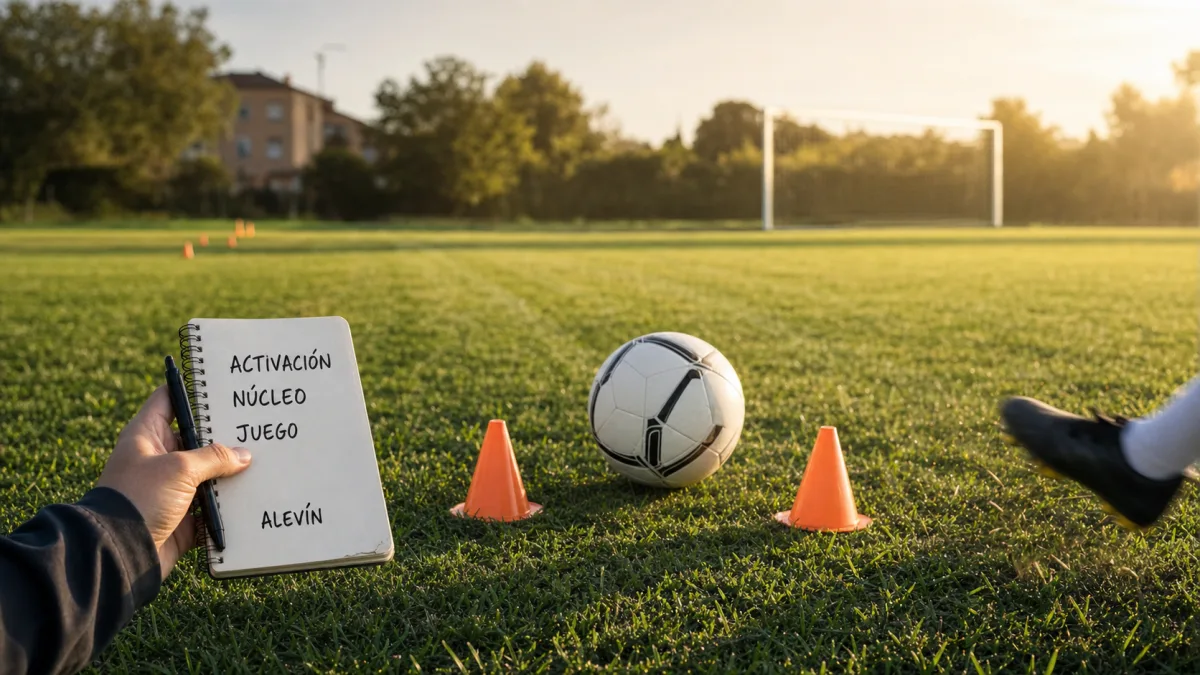
The Spanish alevín bracket (10-11 year-olds, U-12) is the toughest age for a new coach: there is real competition, kids start asking for technical challenges and collective concepts begin to make sense.
- Duration: 75-90 minute sessions, no less.
- Frequency: 3 sessions per week + match.
- Technical core: dribbling, passing, oriented control, 1v1 attack and defence.
- First tactics: width and depth, not systems.
- Golden rule: the ball is in play over 75% of the time.
Why U-12 is the toughest age for a new coach
This is the frontier. Up to benjamín (U-10) the dominant goal was play: lots of touches, lots of smiles, little correction. At alevín (U-12), kids start asking for specific technical challenges ("teach me to cross", "fix my shot") and competition really matters: there is a league table, there is a referee and there are parents watching the result.
That forces the coach to balance two things at once: keep developing individual technique with room for mistakes and, at the same time, introduce the first collective concepts without killing spontaneity. Getting the order wrong — starting with tactics to "win on Saturday" — is the single most common mistake we see.
Session template (75-90 minutes)
Three clear blocks with short transitions. This structure works in 8-a-side (the dominant format for alevín in Spain), 7-a-side (Madrid and some regional federations) and 11-a-side (second-year alevín in some autonomous communities), adjusting dimensions only:
| Block | Time | Goal |
|---|---|---|
| Activation with ball | 10-15 min | Joint mobility + dribbling / possession / light technical circuit |
| Technical-tactical core | 35-45 min | Analytical drill + game-based task with real opposition |
| Final game | 20-25 min | Conditioned or free small-sided game. Relaxed close. |
Shorter sessions (60 min) are fine in tricky conditions (late changing room, rain), but not as a rule. Below 75 minutes alevín kids do not consolidate either the new technique or the day's concept.
The goalkeeper trains with the group: include the goalkeeper in possession drills and positional games from minute one, and reserve 10 minutes of the technical block for specific blocking and basic positioning work. Without that reservation, the goalkeeper goes invisible for the whole session.
Weekly plan: three sessions and a match
The standard microcycle is three midweek sessions plus the match on Saturday or Sunday. A distribution that works:
- Monday (post-match): lighter session, focused on individual technique and play. Take feedback from the match without long corrections. We cover this specific session in the Monday session.
- Wednesday (main): the most demanding session. Introduce the week's tactical concept, main duel or build-up task, final game.
- Friday (pre-match): reminder of the concept, set pieces and light play. Do not introduce anything new.
If you only get two sessions (some regional clubs), compress the plan into Wednesday and Friday. With four, add a goalkeeper-specific session or individual work.
For age-specific drills, see grassroots football drills by age, which covers what does and does not work at 10-11.
Technical core: what alevín really needs
Careful: alevín is not "bigger benjamín". There is a technical core that works at 10-11 and that needs to be ordered:
- Dribbling with change of pace and direction: alevín kids have the coordination for sharp changes.
- Short and medium passing, inside and instep: accuracy before power.
- Oriented control: receiving already facing where the play continues. The big technical jump of the bracket.
- 1v1 attacking: dribbling, beating the full-back. Alevín is the best age to lose the fear of the duel.
- 1v1 defending: stance, patience, forcing the strong side. Almost always under-trained.
- Shooting: accuracy before power. Use reduced goals and a defined zone.
Practical rule: each session works two of these six blocks, no more. More is noise and kids do not consolidate.
The coach's Sunday summary
Open course calls, up-to-date guides and new posts. Free, with one-click unsubscribe.
Leave your email and get the next issue:
First tactical concepts: width and depth
Here is where alevín differs from benjamín. At 10-11 it makes sense to talk about width (wingers hugging the touchline) and depth (striker stretching the defensive line). These two concepts cover 80% of the useful tactics at this age.
How to explain them without jargon: width is "if the ball is central, wingers stay wide; if the ball is wide, the opposite winger drifts central". Depth is "there must always be someone past the ball pushing towards goal".
What does NOT belong in alevín: zonal pressing, full-block sliding, structured build-ups with three preset solutions. Those are infantil and cadete content, covered in future pieces on progression by age.
Why width and depth now: at infantil (U-14) the kids jump to 11-a-side — a full pitch of about 100×60 m, size 4 or 5 ball depending on the federation, full-size goals and offside as a decisive factor. Wide occupation and pushing the defensive line are the concepts that make sense once the space multiplies. Training them now is preparing the ground so that jump does not arrive cold.
Common coaching mistakes at U-12
- Over-coaching: correcting every pass in the final game kills flow. Better to note two corrections for the next session.
- Ignoring substitutes: the kid who comes on for the last 5 minutes checks out. Mandatory rotations during the week and guaranteed minutes on match days.
- Mixing up result and process: if the team wins 6-0 on long balls, the result is a lie. If it loses 1-0 creating 6 chances, you are on track.
- Talking more than they play: if your pre-match talk lasts longer than the hydration break, cut it. Three clear ideas and on the pitch.
- Not coordinating with the academy lead: alevín is the age that decides which kids stay in the club's top team. That decision is not just yours: align with the coordinator from the first term.
Managing parents: three rules for the first term
Family pressure is as hard to manage as the session itself. Three agreements at the start of the season save trouble all year:
- Initial 30-minute meeting: before the league starts, gather the families and lay out the season's goals (development, not result), the guaranteed-minutes format and the official communication channel. Do not skip this meeting no matter how tempting.
- No coaching from the stands: no one shouts tactical instructions during the match — only the coach does. Agree it on day one and remind anyone who steps out of line, without drama.
- Delegate's channel, not the coach's: the WhatsApp group with the families is managed by a team delegate. The coach only steps in for specific football matters. Mixing the personal channel with the family group burns the coach out within weeks.
How to tell if it is working
Three simple indicators, all observable without statistics:
- Voluntary attendance: if Wednesday sessions hit 90% without reminders, you are doing well.
- Execution speed: by season's end, possession drills should run 30-40% faster than in September.
- Playing under pressure: the team receives a high press and solves it without a long ball in 5-7 seconds. The metric that best predicts a healthy step up to infantil.
If two of the three are flat, revisit your planning. If all three are flat, the problem is most likely not the kids: it is the plan.
About the author

Contenido elaborado por RutaMister a partir de experiencia práctica, revisión editorial y enfoque formativo para entrenadores de fútbol base.
Frequently asked questions
How long should an U-12 session last?
Between 75 and 90 minutes as a rule. Below 75 there is no time to consolidate new technique plus the day's concept, and kids do not maximise 60 minutes the way they do at benjamín. Above 90 cognitive performance drops and the session becomes discipline rather than learning.
How many sessions per week are ideal?
Three sessions plus a match is the balance with the best return without overload: lighter Monday after the game, demanding Wednesday with the week's concept and short Friday before the match. With two sessions you can run the team, but the room to fix mistakes drops by half, especially in the second term.
When do I introduce the first tactical concepts at U-12?
From the third or fourth week of pre-season, once the group is settled. Start with width and depth only; leave systems, zonal pressing and structured build-ups for infantil. Practical rule: one new tactical concept per month, no more, and always reinforced in the pre-match session.
How do I manage substitutes at U-12?
With guaranteed minutes: every kid in the squad plays at least a quarter of the match barring injury or sanction. In training, rotate at random so no child fixes a "starter" or "sub" identity until the second half of the season. At 10-11, losing a kid because he feels left out is irreversible.
Which is the best age within U-12?
11 year-olds (second-year alevín) are the sweet spot: coordination is already mature, tactical understanding is emerging and motivation is intact. The first year (10) usually needs more patience with motor coordination. If you coach a mixed group, plan tasks with two levels of demand inside the same exercise.