Coaching goalkeepers in grassroots football without a goalkeeper coach
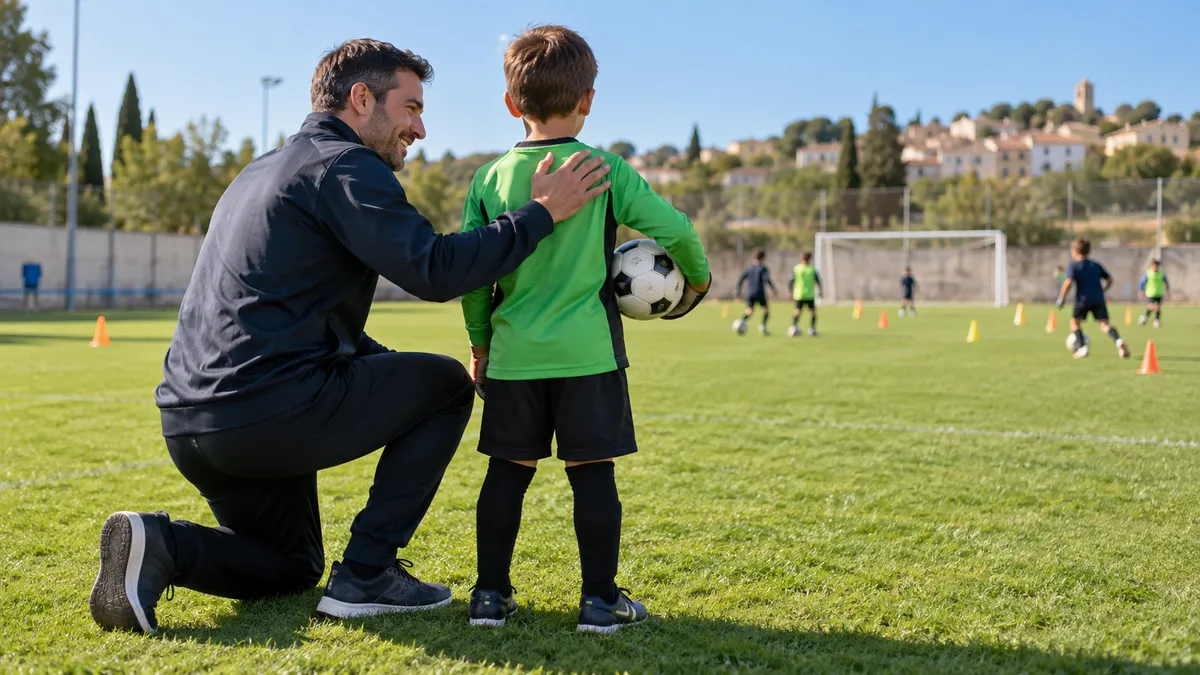
Without a goalkeeper coach at the club, the goalkeeper's training does not disappear: the outfield coach organises it inside their own sessions, by age group, with concrete tasks.
- Prebenjamín-alevín: rotating goalkeeper, hand games for everyone, no compulsory gloves.
- Infantil-cadete: specific blocks of 10-15 minutes inside the group session, never apart.
- Juvenil: a session with a teammate, video review and coordination with the coaching staff if he asks to specialise.
- Sign to refer out: technical stagnation, recurring discomfort or the jump to 11-a-side.
- Official pathway: Nacional C Goalkeeper and UEFA Goalkeeper B/A if the club wants to train its own specialist.
Why the outfield coach cannot hand the goalkeeper off to no one
At a club with no specialist, the goalkeeper only trains differently if someone actively decides so. It is not a budget problem — nobody is hiring a goalkeeper coach for the under-12 B team at a neighbourhood club. It is a planning problem: what the goalkeeper does in each block of the session, with which teammates and which ball.
The outfield coach who takes this on does not need to become a specialist. They need to decide, age group by age group, how much integrated time and how much specific time the goalkeeper gets, and keep it up week after week even when nobody asks for it. That balance shifts with age: it is not the same at prebenjamín as at cadete, and that progression is exactly what we lay out next.
Prebenjamín, benjamín and alevín: the goalkeeper is just another player
At prebenjamín (ages 6-7) and benjamín (8-9), played in 7-a-side or 8-a-side, our approach is not to fix a goalkeeper. We rotate the whole group through goal, including the kids who ask for it least, so nobody gets stuck with that label from age six.
Hand games — catching, throwing, covering the body — go into the warm-up for the whole group, not just whoever is in goal that session. Gloves are not compulsory at this age: we would rather a child lose the fear of the ball with bare hands before adding an accessory that also makes it harder to grip small objects. The ball is size 3, the same one the rest of the team uses.
At alevín (ages 10-11, 8-a-side in most regional federations and 7-a-side in Madrid) we keep the same idea with a small shift: rotation gets wider rather than strict — two or three kids volunteer more than the rest — but we still do not fix anyone in goal. The ball moves up to size 4. It is the last age group where we suggest leaving the decision open.
We cover how to apply this from day one in the first day of minibenjamines: if the whole group takes a turn in goal during the first weeks, it becomes far easier afterwards to see who actually wants to stay there, without us deciding for them.
Infantil and cadete: the first specific movements inside the group session
At infantil (ages 12-13) the jump to 11-a-side raises the demands on a goalkeeper: a bigger box, longer shots, a size 4 or 5 ball depending on the federation. This is where we start fixing a goalkeeper — not by rule, this is a RutaMister suggestion — with short blocks of specific work, 10 to 15 minutes, inside the group session, never apart from it.
In those blocks we work on catching (collecting low and mid-height balls cleanly, without spilling them), the side-fall with arm support, and playing with the feet under pressure from an opponent, since in 11-a-side the goalkeeper takes part in building play from the back. Coming off the line for 1v1s — when to close down, when to hold — also belongs at cadete (ages 14-15, size 5 ball), along with the goalkeeper joining the attacking phase when the opponent presses high.
The underlying idea matches the methodology described on efdeportes.com: keeping the goalkeeper integrated throughout the whole training session, with the rest of the group, instead of isolating him in a corner of the pitch with a ball and a cone. The specific blocks sit inside the cadete session, they do not replace it.
Juvenil: when the kid asks to specialise and the club has no specialist
At juvenil (ages 16-18) it is common for the player to ask to specialise, especially after a couple of seasons between the posts. Without a specialist at the club, the sensible answer is not to promise what we cannot deliver: it is to organise what is actually within reach.
A weekly session with a positional teammate — another goalkeeper from the club, even from a different age group — works on 1v1s and situations that do not repeat often enough in the full-group session. Filming ten minutes of a match and reviewing positioning and starting position costs little and pays off well at this age. One-off goalkeeper clinics, when the club or the regional federation runs them, cover what the weekly session cannot reach.
Coordinating with the rest of the coaching staff — an assistant, a fitness coach if there is one — stops the goalkeeper carrying the upper-body strength work or the shoulder-and-wrist prevention his position needs entirely alone. No specialist is required to share that load among people already at the club.
The coach's Sunday summary
Open course calls, up-to-date guides and new posts. Free, with one-click unsubscribe.
Leave your email and get the next issue:
Concrete tasks by session block
Here is how we spread the goalkeeper's work across a normal session, without pulling him out of the shared group in any block:
| Block | What the goalkeeper does | Instruction | Duration |
|---|---|---|---|
| Joint warm-up | Activates with the group, no isolation | Hand and foot games, wrist and shoulder mobility | 10-12 min |
| Rondo or possession with the goalkeeper as support | Joins as a floater inside the rondo | One touch only when receiving with their back to the opponent | 10 min |
| Finishing against a real goalkeeper | Faces real shots, never a cone or an empty goal | Sets up before the shot arrives, does not react late | 15 min |
| Small-sided game with build-up from the back | Takes part in circulation, not just clearances | Looks for the free teammate before going long | 15-20 min |
| Cool-down | Joins the group for the close, does not leave early | Shoulder, wrist and hip stretching alongside the rest | 5-8 min |
No block takes the goalkeeper off the shared pitch: only the instruction changes, not the space.
Signs it is time to bring in a specialist or a goalkeeper academy
Some signs are worth taking seriously because they go beyond what an outfield coach can cover with common sense. The first is technical stagnation: if the kid has gone two or three seasons without progressing in catching or positioning despite the integrated work, he probably needs specialist eyes.
The second is recurring discomfort in the hands, wrists or shoulder. No diagnosis is needed to decide: if the complaints repeat session after session, the priority is a physiotherapist or a fitness coach, not more repetitions of the same movement.
The third is explicit interest from the player or the family in specialising seriously, beyond passing curiosity. The fourth arrives with the jump to 11-a-side at infantil: the technical jump is big enough to justify at least a one-off outside assessment.
The official pathway: if the club wants to train its own goalkeeper coach
If the club decides to go a step further and train its own goalkeeper coach, the route runs through the RFEF: we cover the full pathway here — Nacional C de Porteros with an active outfield UEFA C, then UEFA Goalkeeper B and UEFA Goalkeeper A with an active outfield UEFA B, the last two taught at Las Rozas.
Regional federations run the Nacional C goalkeeper course every season: as of September 2026, for example, Extremadura offers it for €275 with pre-registration open until March 2027, and Álava has even run a free edition. Current deadlines are in our course-calls table.
About the author

Contenido elaborado por RutaMister a partir de experiencia práctica, revisión editorial y enfoque formativo para entrenadores de fútbol base.
Frequently asked questions
At what age should a goalkeeper start to specialise?
There is no official age. Our suggestion at RutaMister is not to fix a goalkeeper before alevín, and to save the first short specific blocks — 10 to 15 minutes, integrated into the session — for infantil. Before that age, hand work belongs to the whole group, not only to whoever is in goal that day.
Is it compulsory to rotate the goalkeeper in 7-a-side and 8-a-side football?
No federation rule requires rotating the goalkeeper in 7-a-side or 8-a-side football: the decision belongs to the club and the coach. We recommend wide rotation at prebenjamín and benjamín, so nobody gets stuck with the label from year one, and narrowing it gradually through alevín.
What gloves does a grassroots goalkeeper need, and from what age?
Gloves are not compulsory at prebenjamín or benjamín: we would rather the child lose the fear of the ball with bare hands first. Once he starts using them, size should match the hand, not the age. The real priority, more than the glove itself, is that hard-hit balls stop feeling scary.
What do I do if my club wants to train its own goalkeeper coach?
The route is the Nacional C Goalkeeper Specialist diploma, requiring an active outfield UEFA C, followed by UEFA Goalkeeper B and A with an active outfield UEFA B. We cover the full pathway in this guide and the open calls at /convocatorias.
Sources
- efdeportes.com: Global methodology for goalkeeper training in grassroots football
- Academia RFEF (Álava): Nacional C goalkeeper-training specialisation (free 2026/27 edition)
- Academia RFEF (Extremadura): Nacional C goalkeeper-training specialisation (€275, 2026/27)