Grassroots football preseason: the 3-4 week plan
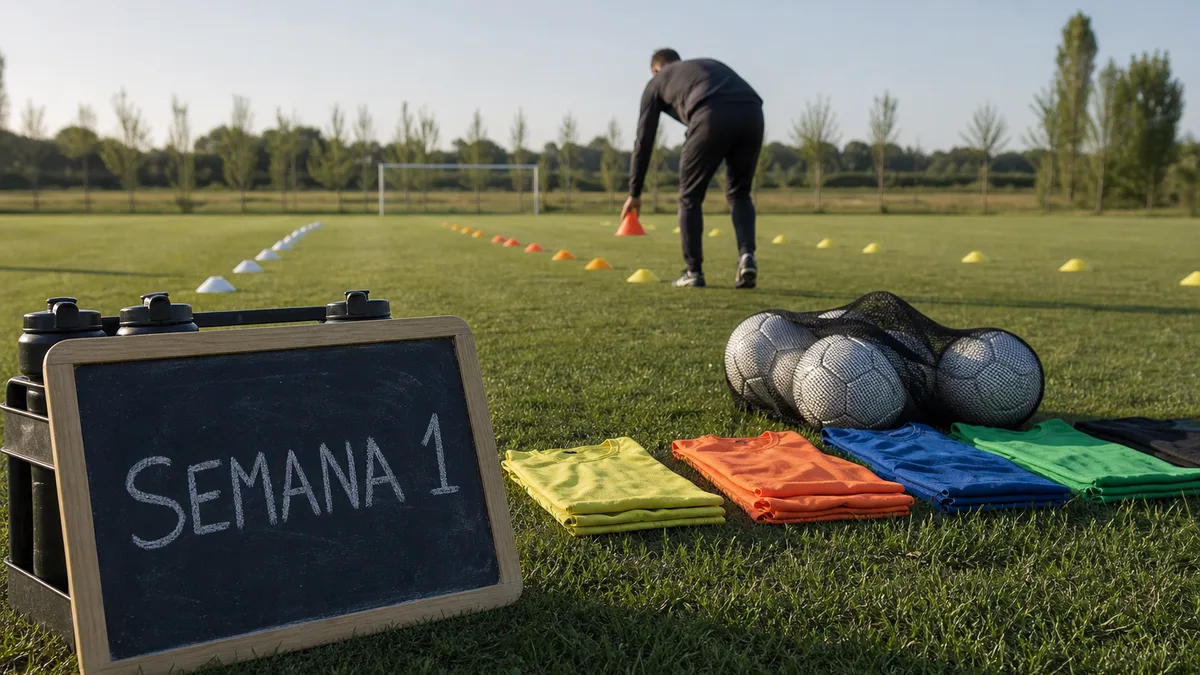
Grassroots football preseason is planned from less to more: ball from day one and physical load that grows gradually, never all at once. A 3-4 week plan avoids overload injuries and prepares the group better than forcing intensity from the first session.
- Week 1: welcome, habits and lots of ball time.
- Week 2: raise technical volume and bring in the first collective work.
- Weeks 3-4: friendlies and load adjustment before the first match.
- By age: the plan adapts, it is not copied the same from prebenjamín to juvenil.
Why preseason needs a plan, not just fitness work
Many grassroots teams start preseason as if they were a senior team: long continuous-running sets, fitness tests and an eleven-a-side match as soon as they arrive. The problem is that a group of children or teenagers does not need to "get fit" before touching the ball — they need to reconnect with the ball from minute one, and raise physical demand gradually around that technical base.
A 3-4 week plan that goes from less to more solves two things at once: it lowers the risk of overload injury after the holidays, and it gives you time to see who has grown, who has changed and who needs more attention before competition starts. The rule that orders the whole plan is simple: each week raise physical demand a little and tactical complexity a little, never both at once.
That plan is not the same for a prebenjamín as for a juvenil, but the logic of progression — ball from day 1, load that grows gradually — holds for every age.
The first day: organisation, rules and equipment
The first session sets the tone for the whole season. Before thinking about drills, settle three things: how you will split the group (by age, by level, or mixed if the squad is small), what basic rules you will communicate (punctuality, equipment, behaviour), and what gear you need ready.
Minimum equipment for the first day:
- Enough balls so no more than two or three players share one.
- Bibs in at least two colours to split groups quickly.
- Cones or discs to mark spaces without wasting time.
- A basic first-aid kit and water on hand.
It is worth communicating the first day's rules to families too, not just to the group, so you do not depend on a child repeating them correctly at home. The guide on how to manage parents in grassroots football has a useful script for that first meeting: what information to share, which channel to use, and what to leave out of the conversation with families.
Spend the first 10-15 minutes introducing yourself, explaining the season's plan and playing something with the ball — not on a long speech. The sooner they touch the ball, the better preseason starts.
Week 1: welcome, habits and lots of ball time
The first week is not about performance, it is about habit. The goal is for the group to get back into the training routine, reconnect with the ball after the holidays, and for you as the coach to observe without correcting too much yet.
Physical load is low-to-medium: ball games, short runs built into the technical tasks themselves, no isolated continuous-running sets. Ball density should be high: the more touches per player and per minute, the better the week starts.
If the group arrives unmotivated or scattered after summer, do not force technical demand from day one. The guide on how to keep kids motivated without boring them has concrete ideas to re-engage the group in these first sessions without resorting to talks or punishment.
Week 2: raise the technical volume and bring in the first collective work
In the second week you can step it up: more repetitions of technical work, slightly more demanding tasks, and the first collective notions if the group's age already allows them. The progression is still gradual, not a jump.
The criterion for choosing tasks this week is the same as the rest of the year: it depends on age. What suits a benjamín is not what suits a cadete, either in volume or complexity. The guide on grassroots football exercises by age gathers concrete tasks by band that fit well into this phase of preseason.
This is also the moment to introduce, if the age allows it, the season's first conditioned matches — simple rules that force a behaviour (for example, a goal only counting after a minimum number of passes) without talking about system yet.
The coach's Sunday summary
Open course calls, up-to-date guides and new posts. Free, with one-click unsubscribe.
Leave your email and get the next issue:
Weeks 3 and 4: friendlies and the road to the first match
From the third week it is worth adding the first friendly, once the load has risen enough to handle a full match without overload. The friendly is not about winning, it is about watching the team compete and adjusting what is still missing before the first official match.
In the fourth week, if the calendar allows it, add a second friendly and the final adjustment: less volume, more targeted intensity, and a session leading into the first match similar to the one you will use every week during the season. The Monday session explains that logic of adjusting load to what the weekend brought — the same logic you need to design the last session before the league starts.
If the team arrives at the first match after 3-4 weeks of orderly progression, no special closing session is needed: the last preseason session can already look like any normal session during the season, just with slightly less volume to arrive fresh. From there, preseason becomes the first block of a longer journey: how to plan the full season in blocks and microcycles picks up right where this plan ends.
Adapting the plan by age band: from prebenjamín to juvenil
The 3-4 week, less-to-more skeleton works for any age, but the content of each week changes a lot between a prebenjamín and a juvenil. It is not about applying the same plan with a smaller ball.
- Prebenjamín and benjamín: almost everything with the ball and in play format; preseason barely differs from the rest of the season beyond reconnecting after summer.
- Alevín and infantil: you can already raise technical volume a little and bring in collective tasks from week 2 onward.
- Cadete and juvenil: here more specific physical work integrated with the ball makes sense, and friendlies can start a little earlier.
The detail of format, pitch and ball size by category — which also shapes how much preseason can demand — is in the guide on grassroots football categories by age. Without aiming to be exhaustive by band, the general idea holds: the younger the group, the less preseason differs from the rest of the year.
What NOT to do in grassroots football preseason
The most repeated mistake is copying a senior team's preseason: long continuous-running sets, fitness work without the ball, and endurance tests on day one. At development ages, that approach does not prepare better — it just tires and bores the group without building anything technical.
In early categories (prebenjamín to alevín, and even infantil), avoid ball-less physical work as an isolated block. If you need to work capacity, build it into ball tasks instead: dribbling with pace changes, chasing games, technical circuits with real physical demand that is not separated from the match gesture.
Also avoid double sessions for children, even if the club's calendar allows it. Doubling training sessions in preseason at grassroots ages does not speed up learning, and it does raise the risk of overload and of the group arriving burnt out before real competition starts.
About the author

Content produced by RutaMister from practical experience, editorial review and a training-focused approach for grassroots football coaches.
Frequently asked questions
How long should grassroots football preseason last?
Between 3 and 4 weeks is usually enough for grassroots categories, compared with the 5-6 weeks typical in senior football. What matters is not length but order: raising physical and tactical demand gradually, with the ball present from day one, instead of piling all the load at the start.
How many sessions a week should preseason have?
It depends on age and on the sessions the group normally has during the season: usually the same number as in-season, without adding extra sessions just because it is preseason. Extra sessions raise load without giving time to absorb it, and at young ages that can cause more fatigue than real benefit.
Can you do continuous running in grassroots football preseason?
At development ages, it is better avoided as an isolated block. Physical capacity can be trained just as well inside ball tasks: dribbling with pace changes, chasing games or demanding technical circuits. Continuous running without the ball is boring, does not improve game understanding, and adds nothing tactical.
When should you play the first preseason friendly?
Usually from the third week, once load has risen enough to handle a full match without risk of overload. The friendly is there to watch the team compete and adjust specific details, not to chase a result or to force a system just yet.
What equipment do I need for the first day of preseason?
The basics: enough balls so no more than two or three players share one, bibs in at least two colours to split groups quickly, cones or discs to mark spaces, and a first-aid kit on hand. That is plenty to organise the first day without wasting time.