How to plan the grassroots football season: blocks, goals and microcycles
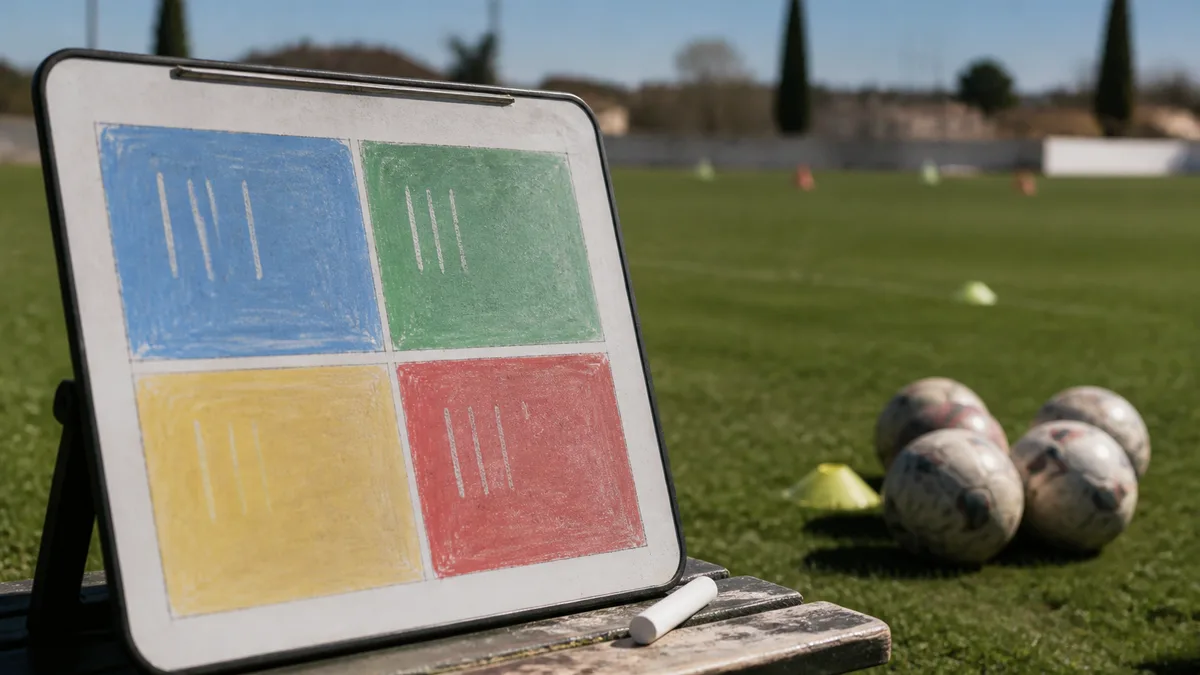
Planning a grassroots football season means splitting the year into blocks, each with its own goal, instead of copying preseason for nine months or improvising week by week.
- Calendar: preseason in August-September, league from September to May or June, with breaks at Christmas and Easter.
- Blocks: four natural stretches, each with its own technical-tactical goal matched to the group's age.
- Load: set by age and by the club's 2-3 weekly sessions, not by a senior team's calendar.
- Review: a real checkpoint in December and a season close in June, not just the last result.
Why preseason and the weekly session are not enough
Preseason gets you to the first match, and the weekly microcycle solves one week of training. Between those two scales sits the real gap: what the team builds between September and June, and in what order. Without that map, every week looks like the last one out of inertia, not because it follows a plan.
This article covers that middle scale: the blocks of a full season, with their goal and how to review them. For the concrete start of the first weeks, the guide on grassroots football preseason already covers that stretch week by week; this article picks up where that phase ends.
Spain's real grassroots calendar: from August to June
The grassroots season follows a stable pattern across most regional federations: preseason in August and the first weeks of September, a regular league from September to May or June depending on category and competition, and two long breaks at Christmas and Easter that cut the year into natural stretches.
Those breaks are not a problem for planning, they are the structure already sitting in front of you. Instead of treating the season as one uniform nine-month block, it helps to think in the stretches the calendar itself already marks. The Christmas break is the big border splitting the season into two halves; the Easter break is a minor cut inside the final stretch, useful for breathing and adjusting, but it does not force a change of block.
The exact competition format and calendar vary by category and regional federation, but the logic of the breaks repeats across almost the whole map.
Block periodisation adapted to grassroots, not to a senior team
Classic professional periodisation splits the season into macrocycles and mesocycles designed for teams training five or six days a week, with recovery protocols and a target competitive peak. That model cannot be copied as-is at grassroots level: with 2-3 weekly sessions and players still growing, there is no room for form peaks or for load that piles up across several sessions in a row.
What does work is adapting the underlying idea — splitting the season into blocks with their own goal, each roughly matching a school term — to the real rhythm of a grassroots club. Four blocks, built on the calendar from the section above:
- Block 1 (August-September): contains preseason as a sub-phase — already detailed week by week in the guide linked above — plus the league start: technical base and group habits.
- Block 2 (October-December): consolidating the season's main concept, up to the Christmas break.
- Block 3 (January-March): picks back up after the holidays, adjusts what the first checkpoint showed and steps up a level.
- Block 4 (April-June): closing, consolidation and final review before summer.
Load inside each block is limited by age, not by the competitive calendar: a cadete in the middle of a growth spurt needs a much more cautious load progression than a juvenil, even if both play the same league in the same months.
Goals per block, by category
The same block means different things depending on the group's age. It makes no sense to set the same quarterly goal for a prebenjamín as for a cadete, even if they share the calendar.
- Prebenjamín and benjamín: the goal barely changes from block to block: relationship with the ball, free play and habits. Periodisation here is more about observing than demanding.
- Alevín and infantil: each block can add one simple tactical idea on top of the last, such as space occupation or first collective notions, without dropping the technical focus.
- Cadete and juvenil: here a more defined block goal makes sense — a system, a pattern of play — and a somewhat more specific physical progression, tuned to each player's maturity status rather than their birth year: late developers are exactly where that nuance decides the season.
The detail of which task fits which age band, block by block, is in the guide on grassroots football exercises by age; the goal here is to set what to build in each stretch, not the exact drill for each session.
The coach's Sunday summary
Open course calls, up-to-date guides and new posts. Free, with one-click unsubscribe.
Leave your email and get the next issue:
How weekly microcycles fit inside each block
The block sets the goal for the stretch; the week is where that goal actually gets trained. Each weekly microcycle inside a block should add one more layer to the same idea, instead of jumping topic every week.
The concrete mechanics of a week — which session fits Monday depending on the weekend result, how load splits across sessions — is worked out in the guide on the Monday session and the weekly microcycle. This article stays at the annual scale, which block is active and what goal it chases; that guide solves the specific week inside that block.
A useful trick: when planning each block, decide its goal first and only then assign which microcycle introduces the idea, which consolidates it and which tests it in a match. Planning the week before the block usually ends in a jumble of loose topics with no thread connecting them.
Review: what to check in December and what to check in June
December is the first real checkpoint, not a close. Before the Christmas break it is worth reviewing, block by block and player by player, whether the goal of blocks 1 and 2 was met: not just results, but what each player has improved since September and what to adjust in block 3.
June is a real close. Three things are worth checking: whether block 4's goal and the season's overall goal were met, which players have changed physical or developmental level over the year — especially relevant in cadete and juvenil — and what to carry into designing block 1 of the following season.
Avoid drawing conclusions from a single match, in December or in June. One bad result on a given day says little about whether the block met its goal; the useful question is whether the group progressed on what that block was aiming for, not whether it won last weekend.
Common mistakes when planning the grassroots season
The most repeated mistake is copying a senior team's logic: chasing a form peak for one specific match, adding load-and-deload microcycles designed for adults, or treating every week as if something had to be won. In grassroots football almost no single match justifies that approach, and the cost on children and teenagers is high.
The second mistake is leaving no margin for the club's reality: a pitch shared with other teams, sessions cancelled for rain, last-minute schedule changes, players missing for exams. A block plan that allows no lost weeks breaks at the first setback. It is better to leave one buffer week per block with no new goal, built to absorb these disruptions without derailing the whole plan.
The third mistake is setting the block's goal on the whiteboard and never reviewing it. A block that is never checked at the two checkpoints — December closes the first half and June the second — is just an intention, not a plan.
About the author

Content produced by RutaMister from practical experience, editorial review and a training-focused approach for grassroots football coaches.
Frequently asked questions
How is the grassroots football season divided?
Into blocks that follow the real calendar: August-September (preseason and league start), October-December (up to the Christmas break), January-March (after the holidays) and April-June (season close). Each block has its own technical-tactical goal, matched to the group's age, not a copy of a senior team's plan.
How many weekly sessions fit a grassroots periodisation plan?
Usually 2-3 weekly sessions, the same number the club already uses during the year. Senior-team periodisation assumes 5-6 sessions and recovery protocols that do not exist in grassroots football, so the block adapts to the real training volume, not the other way round.
What should I check at the December checkpoint?
Review, block by block and player by player, whether the August-to-December goal was met: what each player has improved since September, beyond match results. That review shows what to adjust in the January-to-March block before picking back up after the Christmas break.
What should I check at the June close?
Three things: whether the last block's goal and the full season's goal were met, which players have changed physical or developmental level over the year — key in cadete and juvenil — and what to carry into designing the first block of next season.
Can senior-team periodisation be applied to grassroots football?
Not without adapting it. A senior team periodises to reach a form peak for specific matches, with 5-6 weekly sessions. In grassroots football load is limited by age and there are only 2-3 sessions, so each block's goal is developmental, not competitive.