How to coach cadete football: puberty, load management and injury prevention
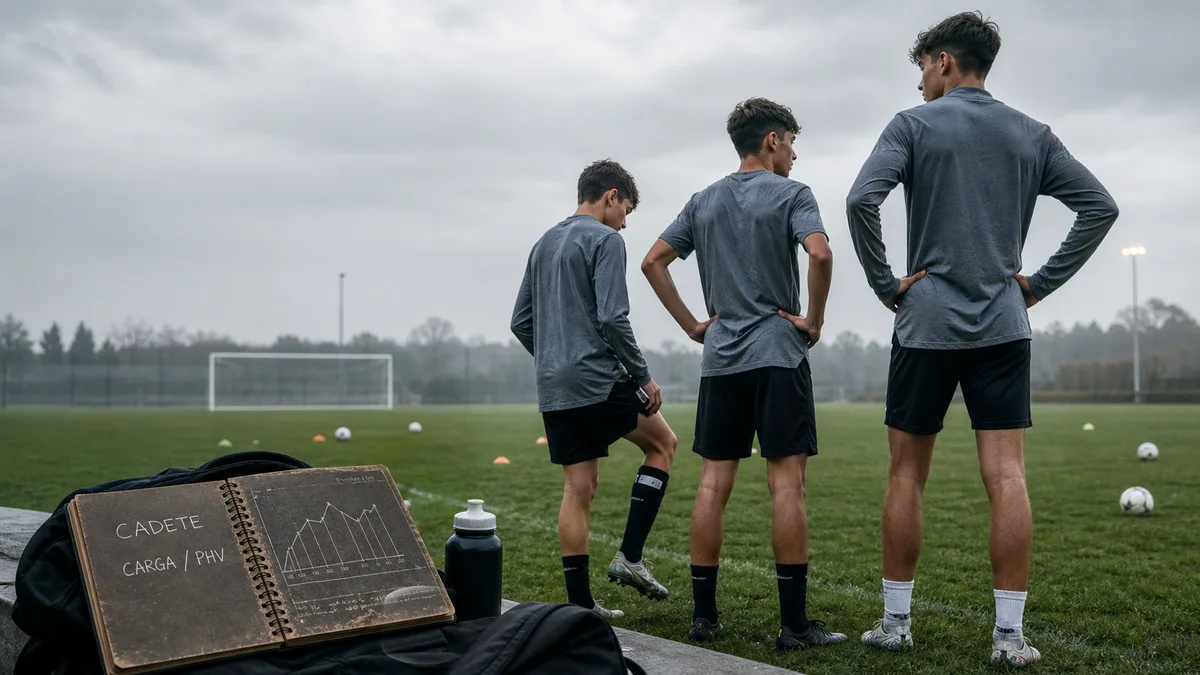
The Spanish cadete bracket (14-15 year-olds, 11-a-side) is the age where almost every player is going through, or has just passed, their growth spurt, and that reorders the coach's priorities: first do no harm, then improve.
- Age and format: 14-15 years, 11-a-side, size 5 ball.
- Peak height velocity (PHV): arrives around age 14 on average, with maturity gaps of up to 2-3 years inside the same dressing room.
- Injuries: risk spikes around the growth spurt; late maturers are the most exposed.
- Load: plan by maturity, not just by date of birth.
- Golden rule: first do not break them, then make them better.
Why cadete is the trickiest age to manage
At cadete, the coach's biggest challenge is not tactical, it is biological. Players are 14 or 15 on paper, but their maturational age can differ by two or three years inside the same dressing room. One is 1.80 m and already shaving; another, born the same year, has not started growing yet.
That spread conditions everything: how much load each one tolerates, injury risk, how many minutes they can play and even what you can demand of them technically. Coaching everyone the same way, the most common mistake, overloads the one who is growing and frustrates the one lagging behind.
It is the flip side of the alevín age (U-12), where the body is still homogeneous and the focus was technical. At cadete, with the jump already made to 11-a-side (size 5 ball and full offside, as the grassroots categories by age guide sets out), the number one priority becomes not breaking the player during the growth spurt.
Peak height velocity (PHV): what it is and why it changes everything
Peak height velocity (PHV) is the moment in puberty when the body grows fastest: a boy can gain 8 to 10 cm in a single year. In male footballers it arrives around age 14 on average, a study of 170 academy players placed it at 14.4 years (Bult et al., 2018), right in the middle of the cadete bracket.
The problem is that bones grow before tendons and muscles do. For months the player has longer levers but the same motor control as before: he becomes temporarily more uncoordinated, loses striking accuracy and trips over his own body. It is not that he "got worse"; he is rebuilding his body map.
For the coach this means two things. One: lower the fine technical demands during the spurt and be patient. Two: the same spurt that disrupts coordination is the one that spikes injury risk, so the PHV window is also the window of maximum caution with load.
Up to 2-3 years of maturity difference in the same dressing room
Two cadete players born the same year can be up to 2 or 3 years apart in biological age: in the Dutch study cited above, the spread within a single team reached 3.1 years. One has already passed PHV and has an almost adult body; another has not started and still has a child's build.
This creates a perception trap. The early maturer runs faster, hits harder and wins duels: he looks like the better player. The late maturer, smaller and less powerful, has to solve with technique and game reading, and is often the one hiding the most real talent. Confusing maturity with talent makes clubs release exactly the players with the most upside.
Professional academies use bio-banding: grouping players by maturity rather than birth year alone (Science for Sport). At a modest club you cannot reorganise the leagues, but you can factor it in when assigning tasks, duels and minutes: do not systematically pit the one who has not grown against the one who is already built like a wall.
Load management: planning around the growth spurt
Managing load at cadete is, above all, about individualising. A kid's total load is not just what he does with you: it adds up club training, the weekend match, PE at school, the regional select team if he gets called up and playground football. A cadete can rack up six or seven sessions a week with nobody keeping count.
Practical rules that work without expensive kit:
- Spot who is growing: ask about knee or heel pain, watch who has shot up and who moves "in fits and starts". That group goes into caution mode.
- Control volume, not just intensity: during PHV, cut jumping, shooting and maximal sprint reps before you cut the odd high-intensity moment. Overuse, not isolated effort, is what injures.
- Protect one or two impact-free days: make sure every player has at least one day a week without running or jumping, counting everything he does outside the club.
- Talk to family and school: if a kid plays for two teams or also competes with a select side, coordinate so someone tracks the total.
No technology needed: a two-minute chat at the start of the session ("how are the knees?, did you sleep?, did you have an exam or a school match?") gives more useful information than any GPS.
The coach's Sunday summary
Open course calls, up-to-date guides and new posts. Free, with one-click unsubscribe.
Leave your email and get the next issue:
Injury prevention: the typical growth-spurt injuries
During the growth spurt the weak point is not the muscle but the growth cartilage (the physis and the apophyses), more fragile than the tendon pulling on it. Hence the two signature cadete injuries, both from repetitive traction:
- Osgood-Schlatter disease: pain and swelling below the kneecap, at the tibial tuberosity where the patellar tendon pulls. Very common in boys aged 12 to 15.
- Sever's disease: heel pain at the calcaneal apophysis where the Achilles tendon pulls. It shows up with repeated jumping and running.
Both are traction apophysitis: the bone grows fast, the tendon stays tight and pulls on the cartilage until it inflames (OrthoInfo, AAOS). You do not "play through pain": if a cadete limps or clutches his knee when he jumps, you reduce load, you do not tell him to push on.
The figure that demands attention: the late maturer is the most exposed to overuse injuries around PHV. In a follow-up of academy players, late maturers suffered 3.97 overuse injuries per 1,000 hours in the PHV year, against 1.56 for early maturers (van der Sluis et al., 2015). Prioritise preventive warm-ups, mobility and volume control for them.
Session template for cadete (11-a-side)
A cadete session runs around 90 minutes and, unlike alevín, includes a formal preventive block. Four parts:
| Block | Time | Goal |
|---|---|---|
| Preventive warm-up | 15-20 min | Mobility, core and hip activation, light eccentric work (FIFA 11+ style) |
| Technical-tactical | 35-40 min | Task with opposition: build-up, pressing, finishing. Real 11-a-side |
| Competitive | 20-25 min | Small-sided or conditioned game around the day's concept |
| Cool-down | 5-10 min | Gentle stretching and short feedback |
The preventive warm-up stops being optional at cadete: FIFA 11+ style programmes (strength, balance and eccentric control of hamstrings and quadriceps) reduce injuries in adolescents and do not steal useful time, because they also warm the players up for the session.
Adjust the demand inside the same drill: give the one in full spurt more technical volume and less jumping and maximal sprinting; for the one who has passed it, ramp up power load progressively. To vary tasks by level, the logic in grassroots football drills by age still applies.
The late maturer: minutes, patience and not releasing
Cadete is one of the big academy filters, and that is where the costliest mistake happens: releasing the small kid for not performing today. Because the early maturer dominates physically, he hogs minutes and praise; the late maturer is let go just when his body has not yet played its cards.
Many late maturers, once they complete their development a year or two later, overtake the early maturer because they had to learn to play with their head and their feet, not their body. Releasing them at 14 mortgages the team of the future.
What you can do even if you do not run club policy:
- Guarantee minutes to the late maturer even if he "does not win duels": he needs them so he does not check out.
- Value the process, not just physical output: reward the good decision and the oriented control as much as the power goal.
- Explain it to the family: help them understand that being behind in the growth spurt is not being behind in talent.
Common coaching mistakes at cadete
- Coaching everyone the same: applying the same load to the one growing and the one who is not overloads the first and bores the second.
- Confusing size with talent: promoting the tall kid and releasing the small one is the bias that has thrown away the most good players.
- Making them play through pain: normalising knee or heel pain turns a growth niggle into a months-long injury.
- Not adding up external load: ignoring school, the select team or the second squad is planning blind.
- Skipping the preventive warm-up: cutting the 15 minutes of prevention to "make the most" of the session is the most expensive saving in grassroots football.
- Tactics only: obsessing over the system while the team breaks down physically is winning the whiteboard and losing the season.
About the author

Contenido elaborado por RutaMister a partir de experiencia práctica, revisión editorial y enfoque formativo para entrenadores de fútbol base.
Frequently asked questions
At what age does the growth spurt hit cadete players?
On average around age 14 in boys, right in the cadete bracket: a study of academy players placed it at 14.4 years. The individual range is wide, from 12 to 16, and within one team there can be 2 or 3 years of maturity difference. Plan by maturity, not just age.
How do I prevent growth-spurt injuries like Osgood-Schlatter?
Control the volume of jumps, sprints and shots for anyone who is growing, include a FIFA 11+ style preventive warm-up and never let a player play with knee or heel pain. Osgood-Schlatter and Sever's disease are overuse inflammations of the cartilage: cutting load in time avoids months on the sidelines.
Should I train the one who has grown and the one who has not the same way?
No. The player in full peak height velocity needs less jumping and sprinting volume and more technical patience, because he is temporarily uncoordinated and more injury-prone. The one who has passed it can take on more strength load. Adjust the demand inside the same drill, with two levels by maturity.
Is the biggest player at cadete the most talented one?
Not necessarily. Many of the biggest are just early maturers: they perform today on physicality, not on football. The small one is often a late maturer who solves with technique and reading, and frequently hides more upside. Confusing size with talent means releasing at 14 players who break through at 16.
How long should a cadete session be and how many per week?
Around 90 minutes, with three sessions plus a match as the standard microcycle. The novelty versus younger ages is reserving 15-20 minutes for a formal preventive warm-up. And watching total load: between club, school and possible select teams, a cadete can rack up six or seven weekly sessions with nobody tracking it.