How to coach U-14 football: from 8-a-side to 11-a-side
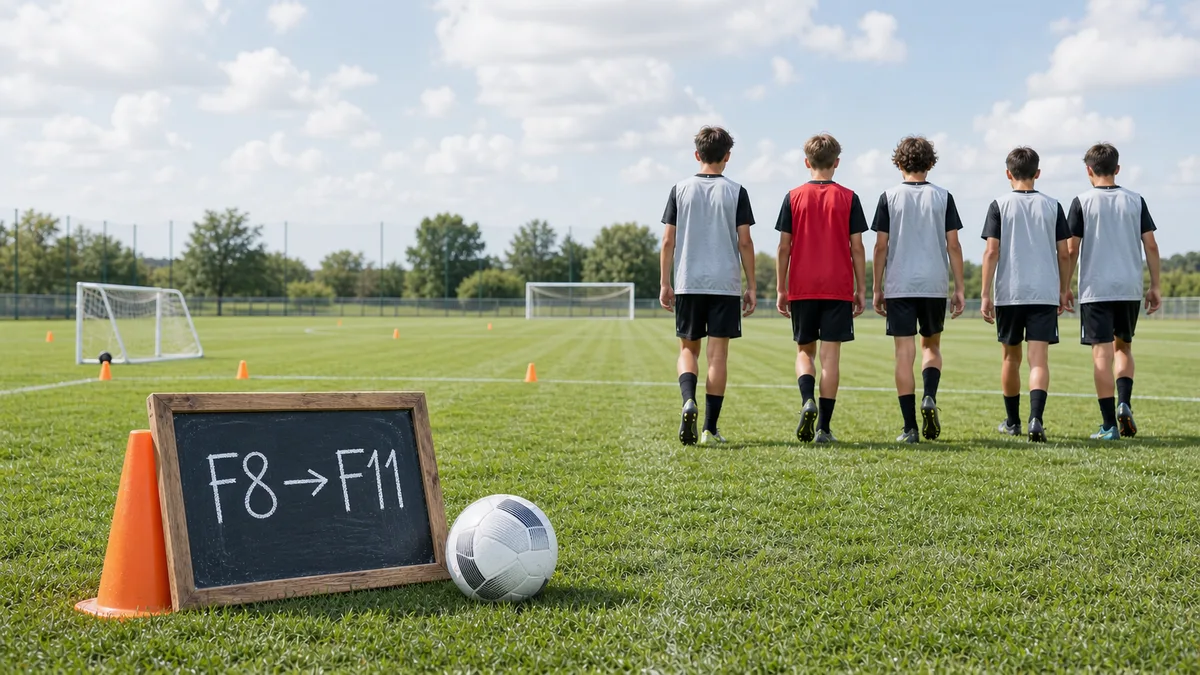
Coaching infantil (U-14) means managing the biggest step in grassroots football: from small-sided play to 11-a-side, with a full pitch, decisive offside and bodies deep in puberty.
- Category: 12-13 year-olds, already 11-a-side across most of Spain.
- Ball: size 4 or 5 depending on the federation.
- Tactical priority: occupying width and depth on a full pitch.
- Physical: more ground to cover, loads adapted to the growth spurt.
- Without dropping technique: the classic mistake is sacrificing it for the system.
What changes at infantil
Infantil is not "bigger alevín". It is the category where, across most of Spain, the jump from 8-a-side to 11-a-side happens, and that change alters almost everything at once: more teammates to coordinate, a pitch that almost doubles, full offside across the whole opponent's half and bodies entering puberty.
The category groups 12 and 13 year-olds by birth year. The ball moves to size 4 or 5 depending on the federation, many keep size 4 in the first year and switch to size 5 in the second, and the exact format is set by each regional body. Before planning the season, review which age and format maps to each category and confirm it in the competition rules.
Much of the work at infantil is cashing in what was planted earlier. The width and depth introduced in how to coach alevín (U-12) stop being a theoretical preview: on the full pitch they are the only way to keep eleven players from swarming around the ball.
The full pitch: new physical demands
The first reality check is physical. In 11-a-side the pitch grows from the ~50-65 metres of the small-sided format to a field of 90 to 120 metres long (dimensions set by each federation, close to the 105×68 standard). The player covers far more ground and matches are longer than at alevín: the exact duration is set by each regional body.
At the same time, this is the age of the growth spurt. The peak of growth around ages 12-14 brings temporary loss of coordination, changing limb leverage and a higher risk of overload injury. A kid who was neat on the ball can turn clumsy for months: he has not lost quality, his body has changed size.
The practical consequence: physical work enters the plan, but carefully. Bodyweight strength, mobility, coordination and short-distance speed pay off more than long pure-endurance runs, which at this age neither belong nor help.
Session template (90 minutes)
The session grows compared with alevín to make room for the new tactical load of the eleven. Three blocks, short transitions and the ball in play most of the time:
| Block | Time | Goal |
|---|---|---|
| Activation with ball | 15-20 min | Mobility + possession or technical circuit. Goalkeeper included. |
| Technical-tactical core | 40-50 min | Task by lines or game-phase task with real opposition, over wide space |
| Final game | 20-25 min | Match on a full pitch or conditioned (for example, with an offside rule) |
The key difference from alevín is the working space: tasks are done in wide zones, not in 20-metre squares. If you train 11-a-side in a small-sided space, the player never learns to read the real distances of Saturday.
The goalkeeper is now a specialist position: reserve specific work on playing with the feet, sweeping and closing angles in a full-size goal. At infantil, a goalkeeper who only stops shots falls short for 11-a-side.
Weekly microcycle: three sessions and a match
The layout is still three midweek sessions plus a match, as in the earlier categories, but each session weighs more:
- Post-match (Monday or Tuesday): recovery and technique. Review the match without long corrections or physical punishment.
- Main session: the most demanding. The week's tactical concept (a single game phase) and the main task by lines.
- Pre-match: reminder of the concept, set pieces, which matter more on a big pitch, and light play. Introduce nothing new.
With only two sessions, concentrate the concept in the main one and reinforce it before the match. With four, add work by lines (defence, midfield, attack) or individual sessions for the kids who have grown the most.
The coach's Sunday summary
Open course calls, up-to-date guides and new posts. Free, with one-click unsubscribe.
Leave your email and get the next issue:
The new tactical core of 11-a-side
11-a-side introduces concepts that did not exist, or were secondary, in the small-sided format:
- Real occupation of width and depth: with eleven players and a full pitch, opening the field stops being advice and becomes mandatory.
- Play by lines and between the lines: three clear lines appear (defence, midfield, attack) that must be coordinated.
- Full offside: the last line becomes a tool (stepping up to catch opponents offside) and a risk.
- Defensive shifting: moving the block according to where the ball is, impossible to train properly in 7-a-side.
- Transitions over a long pitch: winning the ball and attacking 60 metres of space, or sprinting back to recover shape.
Mind the order: one concept per week, not five at once. The most common mistake is trying to install all of 11-a-side in September. Prioritise occupying space and understanding offside; fine shifting and structured build-ups mature over the year and at cadete.
Do not drop technique for the system
The big pitch tempts you to turn training into a tactics board and to solve matches with long balls. That is the big infantil mistake: technique is still the base, and at 12-13 there is still huge room to improve it.
Keep a block of technique applied to the eleven in every session: long passing and switches of play (new because of the pitch size), oriented control under pressure, dribbling to gain metres and striking with both feet. The difference from alevín is that technique is now trained almost always with opposition and on the move, not in isolation.
For concrete age-specific ideas, grassroots football drills by age details which tasks pay off in the 12-13 band and which fall short.
Managing the growth spurt and motivation
Infantil is a drop-out age. The growth spurt, the first serious comparisons with teammates and, in many clubs, the cut towards performance teams all coincide. A late developer can look worse than he is purely because of size.
Three decisions that help: do not lock in positions or hierarchies too early, give minutes to the later maturers too, and be clear with families that growth rate does not predict future level. Managing the families matters as much as at alevín, with a new nuance: here the pressure to "make it" appears.
Watch the loads of the kids who shoot up suddenly: knee and heel complaints, typical of growth, call for lowering volume, not pushing harder. Losing a kid to an avoidable injury at 13 is the worst possible outcome of the season.
Common coaching mistakes at infantil
- Installing all of 11-a-side in September: setting up lines, shifting, structured build-up and offside at once overloads the group. One concept per week.
- Sacrificing technique for the result: winning on long balls on a big pitch hides that the team cannot play. The result lies just as it does at alevín.
- Ignoring maturation: treating the kid who is already 1.75 m the same as the one who has not hit his spurt breeds unfairness and injuries.
- Copying a professional team's session: elite academy videos rarely fit two hours a week and a mixed group.
- Forgetting the goalkeeper: in 11-a-side the goalkeeper needs specific work on playing with the feet and on a full-size goal from day one.
About the author

Contenido elaborado por RutaMister a partir de experiencia práctica, revisión editorial y enfoque formativo para entrenadores de fútbol base.
Frequently asked questions
At what age do you coach the infantil category?
The infantil category groups 12 and 13 year-olds by birth year, and it is where most Spanish federations make the jump to 11-a-side. Some keep 8-a-side in the first year, so it is worth confirming the format in your regional federation's competition rules before you plan the season.
What ball size is used at infantil?
It depends on the federation. The usual rule: size 4 in first-year infantil (age 12) and size 5 in the second year (13) or at cadete, though many regional federations use size 5 from the start. Never assume a universal size-5 ball: check your competition circular.
What is the hardest part of coaching the jump to 11-a-side?
The space. In 11-a-side the pitch almost doubles and the player who dominated small-sided football gets lost: late to cover, not holding width, and meeting full offside for the first time. The first term's job is teaching players to read and occupy that new space without dropping technique.
Should physical training change at infantil?
Yes, but carefully. The bigger pitch demands more endurance and speed, yet this is the age of the growth spurt: temporary loss of coordination and higher injury risk appear. Prioritise bodyweight strength, mobility and progressive loading; skip long pure-endurance runs and never overload the kids who are growing fast.
How many sessions a week does an infantil team need?
The usual setup is three sessions plus a match, as at alevín, but with slightly longer sessions (90 minutes) because of the tactical load of 11-a-side. With four sessions you can add work by lines or individual physical work. Fewer than three leaves little room to settle the full-pitch concepts.