How to coach juvenil (U19) players: from youth football to senior
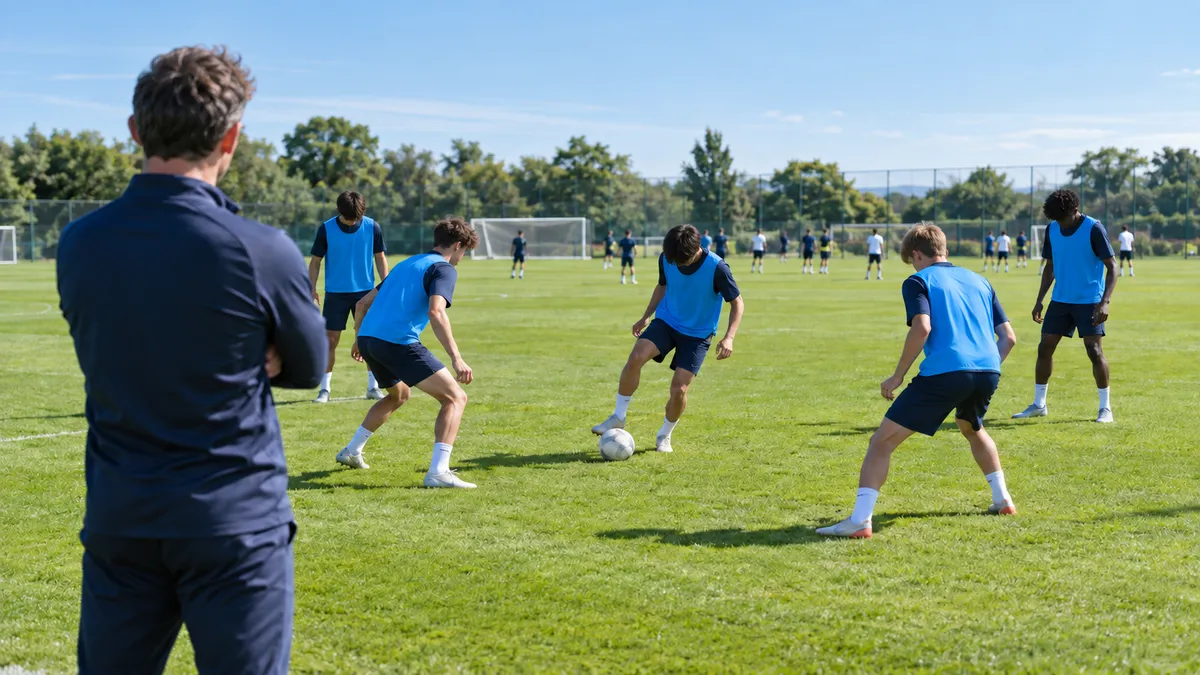
Juvenil is the Spanish category for players aged 16 to 18, born between 2008 and 2010 in the 2026/27 season: the last youth category and the gateway to senior football.
- Format: full 11-a-side, size 5 ball.
- Model session: about 90 minutes, with injury prevention and positional work.
- Frequency: 3 or 4 sessions a week plus the match.
- Head coach licence: UEFA A in División de Honor, UEFA B in Liga Nacional; regional juvenil is set by each federation.
- Goal: prepare the step up to senior, not just win the league.
What juvenil is and what makes it different
Juvenil is the only Spanish youth category that groups three birth years: in the 2026/27 season, players born in 2008, 2009 and 2010. Every other category, from prebenjamín to cadete, covers just two; the full table is in our guide to youth football categories by age.
It is played as full 11-a-side with a size 5 ball, just like senior football. What changes compared with cadete is not so much the body (most players are past their growth spurt) as the context: final school exams or vocational courses, first jobs, players already training with the first team and others thinking about quitting.
That mix means coaching the 16-year-old who has just come up from cadete alongside the 18-year-old who will be competing against adults in a few months. The aim of this stage is for the older player to reach senior football ready, without the younger one losing minutes or progression.
A model session of about 90 minutes
The juvenil session already looks like a senior one, but keeps the injury-prevention block that starts in cadete. We suggest this structure:
| Block | Time | Content |
|---|---|---|
| Warm-up and prevention | 15-20 min | Mobility, preventive strength (hamstrings, adductors, core) and an activation rondo |
| Positional play or possession | 20-25 min | A task built on the week's game idea, with real opposition |
| Unit or positional block | 15-20 min | Defence, midfield and attack separately; goalkeepers with their own work |
| Conditioned game | 20-25 min | Eleven against eleven or a reduced format with the session's tactical focus |
The prevention block is not cut even though the group is no longer mid-growth spurt: at this age, muscle injuries from volume and speed replace growth-related ones, and strength work remains the best protection.
The week and the load with three birth years
The usual juvenil microcycle is three or four sessions plus the match, depending on the division and the club. Organising it by days from the match, as we explain in how to plan the season and the microcycle, makes it easier to place the hardest session far from the weekend.
The difficulty is that each player's real load does not depend only on the team plan:
- The player moving up to the first team: if they train Tuesday and Thursday with the seniors, those count as full sessions; coordinate with the senior staff so the hard session is not doubled.
- The first-year player: just up from cadete, they may still be a year or two behind the third-years physically; avoid pairing them against each other systematically in duels and contact tasks.
- Exams and work: during exam periods attendance drops and sleep gets worse; better to lower the volume that week than lose players to injury or burnout.
A short conversation at the start of each session (how they slept, whether they trained with another team, any niggles) gives more useful information than any load spreadsheet.
Positional specialisation without pigeonholing
In juvenil it makes sense for each player to master the tasks of their position: the full-back who knows when to push on, the holding midfielder who opens their body before receiving, the centre-back who protects the space behind. The unit block of the session exists for that.
What should stay open is a second position. A juvenil who can only play in one place has fewer chances of senior minutes, where coaches value versatility. Occasionally moving a player to a neighbouring role (full-back to winger, holding midfielder to centre-back) broadens their reading of the game without delaying specialisation.
The goalkeeper is the clearest case: in juvenil they need specific work almost every day. If the club has no goalkeeper coach, how to coach goalkeepers in youth football without a specialist explains how to organise it with a teammate, video and coordination with the staff.
The coach's Sunday summary
Open course calls, up-to-date guides and new posts. Free, with one-click unsubscribe.
Leave your email and get the next issue:
Competing in juvenil: three levels and the licence each requires
Men's juvenil football in Spain has three competition levels, each with a different minimum licence for the head coach. The two national divisions are set by article 88 of the RFEF General Regulations (Circular 34, 2025/26 season); regional juvenil is decided by each regional federation:
| Level | Minimum head coach licence |
|---|---|
| División de Honor Juvenil | UEFA A or UEFA Youth Elite A |
| Liga Nacional Juvenil | UEFA B or UEFA Youth B |
| Regional juvenil | Set by the regional federation |
In regional juvenil the difference between federations is real. For 2026/27, the FFCV (Valencia region) requires UEFA B in Lliga Comunitat Juvenil and 1ª FFCV Juvenil, and UEFA C in 2ª and 3ª FFCV Juvenil; the FNF (Navarre) requires UEFA C across its regional juvenil. Details are in the guides for the Valencia region and Navarre, and the overall map in what each UEFA licence lets you coach.
The level also changes the match. In the Liga Nacional Juvenil, which the RFEF runs in 17 regional groups, each team may make at most five substitutions from seven substitutes, in three stoppages and with no re-entry: substitutes' minutes have to be planned before the match, not improvised from the touchline.
The step up to the first team
The move to senior football does not start the day a player turns 19. It starts when a second- or third-year juvenil trains once or twice a week with the first team and returns to their category at the weekend. That dual role is the best preparation a club can offer, but it needs coordination: who decides the load, who gives them minutes and what happens when both matches clash.
How minutes are shared out changes too. In juvenil, sporting criteria weigh more than in any earlier category, but substitutes still need real minutes; the criteria for striking that balance are in squad selection and minutes: winning or developing.
Then there is the third-year player who will not move up. Telling them clearly and in good time, and helping them find a senior team at their level, is part of the juvenil coach's job. Many players who quit at 18 do so not for lack of ability, but because they see no path after juvenil.
Common mistakes and how to tell it is working
- Coaching a mini senior team: copying the first team's volume and intensity without the prevention block ends in muscle injuries.
- Treating all three birth years the same: the first-year player needs minutes and progression, not just to keep up with the older ones.
- Pigeonholing too early: a single position narrows the player's options in senior football.
- Not coordinating with the first team: the player who trains with both teams piles up load nobody tracks.
- Staying silent about the future: not talking to third-years about what comes next pushes them to quit.
Three signs are enough to know whether the season is on track:
- Players moving up: how many juveniles train with or debut for the first team by the end of the season.
- Continuity: how many third-years are still playing football the following season, at your club or another.
- Muscle injuries: if they fall compared with last season, the load and prevention work are doing their job.
If all three signs point the wrong way, the problem usually lies in the planning, not in the quality of the squad.
About the author

Content produced by RutaMister from practical experience, editorial review and a developmental approach for grassroots football coaches.
Frequently asked questions
What age is a juvenil player in Spanish football?
Juvenil covers players aged 16 to 18, born between 2008 and 2010 in the 2026/27 season. It is the only youth category with three birth years and the last one before senior football. It is played as full 11-a-side with a size 5 ball.
What licence do I need to coach a juvenil team in Spain?
It depends on the division: UEFA A to be head coach in División de Honor Juvenil and UEFA B in Liga Nacional Juvenil, under article 88 of the RFEF General Regulations. In regional juvenil each federation decides: the FNF requires UEFA C, and the FFCV UEFA B or C depending on the division.
How many training sessions a week does a juvenil team do?
Usually three or four sessions of about 90 minutes plus the weekend match, depending on the division and the club's resources. What the player does elsewhere has to be added: if they train with the first team, those sessions count towards their weekly load.
How many substitutions are allowed in the Liga Nacional Juvenil?
At most five substitutions from seven substitutes, in three stoppages and with no re-entry, under the RFEF rules for the 2026/27 season. In regional juvenil each federation sets its own substitution rules, so check that federation's circular before planning your substitutes' minutes.
How do you prepare a juvenil player for the first team?
By integrating them gradually: training once or twice a week with the seniors and playing at the weekend in their own category, with the load coordinated between both coaching staffs. Mastering a second position also helps, because in senior football versatility opens up more minutes.
Sources
- RFEF: Circular 34, RFEF General Regulations (art. 88, coaches' competences) (Spanish)
- RFEF: Liga Nacional Juvenil rules, 2026/27 season (Spanish)
- FFCV: Coaching qualifications required by competition, 2026/27 season (Spanish)
- FNF: Navarre Coaches' Committee Circular no. 1: minimum qualifications, 2026/27 season (Spanish)