Playing time: win or develop in grassroots football, a guide by age
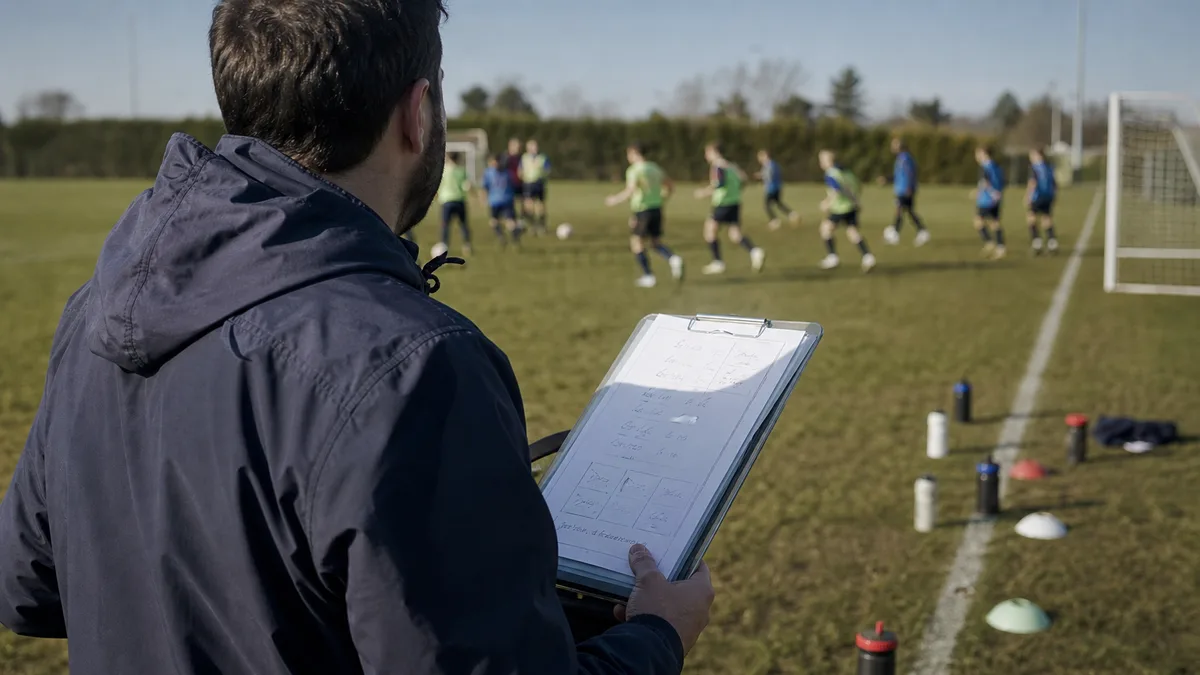
Sharing playing time is not one choice between winning and developing: the right answer changes with age, and in some regions it is even set by regulation.
- Under-8 to under-12: minutes shared among all players called up, barring injury or suspension.
- Under-14 to under-18: results carry more weight, but bench players still need real minutes weekly.
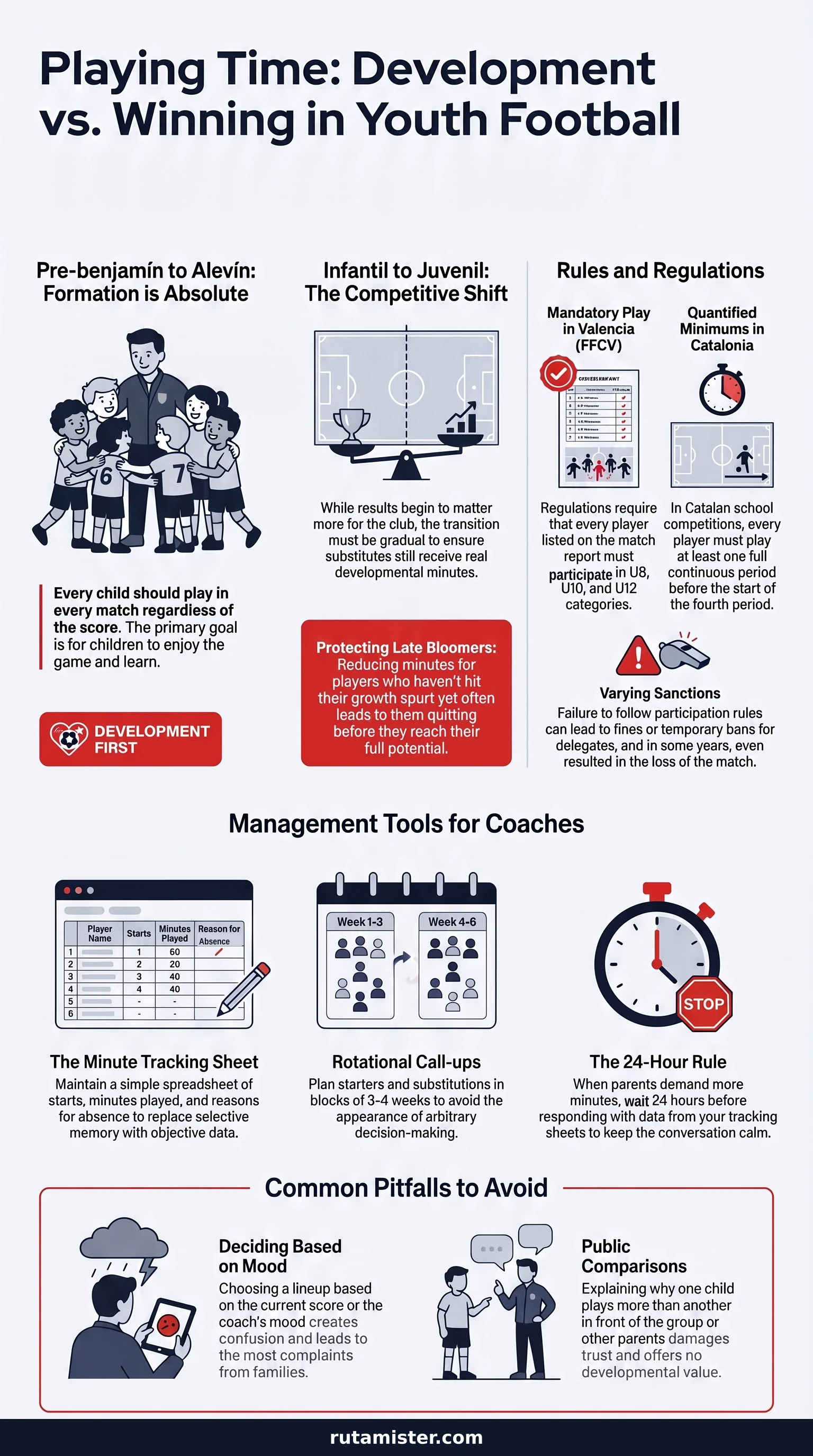
- Regulation: the Valencian federation (FFCV) requires every registered player to take part in under-8 to under-12 football.
- Tool: a minutes log per player keeps the criterion off memory or favouritism.
- Communication: explaining it at the kick-off meeting prevents more complaints than any post-match justification.
The wrong question: it is not win or develop, it is how much each one weighs
Framed as a binary choice, the dilemma has no answer: any fixed response for the whole formative stage is wrong for some age group. The useful question is not "win or develop" but "how much weight does each criterion carry at this specific age band", because that weight shifts in a predictable way as players grow.
Getting the order wrong is costly in both directions. Fielding only the best players in the youngest categories breaks the club's base: the ones left on the bench at 7 or 8 years old tend to quit, and the club loses its pipeline before real competition even justifies it. Sharing minutes blindly in the older youth categories, with no sporting criterion at all, holds back a player who is already competing for a spot on a federated first team or trying to be noticed by a bigger club.
This article works through it in order: age-band criteria first, then what some regional regulations set out on minimum playing time, and finally the practical systems —a minutes log, a rotating squad list— to apply the criterion without it depending on Sunday's mood.
Under-8 to under-12: development always wins
In these youngest categories there is no real debate. The goal of a grassroots club at this stage is to keep children in the game, make sure they enjoy it and learn, not to rack up wins in a league that in most regions does not even keep an official table at these ages. No Sunday result justifies leaving a 7 or 8 year old on the bench for the whole match.
Some regional federations turn this into an explicit rule, not just a recommendation. The Valencian Community Football Federation (FFCV) states in its 8-a-side competition circular that "in every under-12, under-10 and under-8 competition, every player registered on the match sheet must take part in the game", and treats non-compliance as a regulatory infringement (FFCV 8-a-side competition circular, in Spanish).
In Catalonia, the Jocs Esportius Escolars —the regional government's school sports competition, distinct from the Catalan federation's own federated league— go further and set a concrete minimum: before the fourth period starts, every player registered on the match sheet must already have played one full, uninterrupted period, across under-8, under-10 and under-12 seven-a-side football (seven-a-side regulations, Jocs Esportius Escolars de Catalunya, in Catalan). It is not a nationwide rule in Spain —each region sets its own— but where it exists, it always points the same way.
In practice, this becomes simple rules like the one already applied by many under-12 (alevín) teams: guaranteed minutes, every player called up plays at least a quarter of the match barring injury or suspension, with random rotations in training so nobody settles into a fixed "starter" or "substitute" identity too early. The full age-band framework, with pitch size and squad numbers per category, is in the guide on grassroots football categories by age.
Under-14, under-16 and under-18: the balance shifts, it does not disappear
From under-14 onward, real competition begins, with promotion and relegation that matter to the club, and the "same minutes for everyone" argument loses ground without disappearing completely. Nor does it always disappear from the rulebook: the FFCV, for instance, keeps mandatory participation for every player listed on the match sheet in its Primera and Segunda Regional divisions at under-14 and under-16 level too (2025/26 competition circular). The shift should be gradual —a switch flipped from 0 to 100 in a single season is a mistake— not an abrupt jump from one year to the next.
The costliest mistake at this stage is writing off late developers just when results start to weigh on the club's conversation. A player who has not yet had their growth spurt loses physical duels they would win a year later, and if they go without minutes during that stretch, they usually quit before finishing their development. The guide on coaching under-16s through puberty covers in detail how to manage that maturity gap without sacrificing anyone.
In the oldest youth category, with players already thinking about stepping up to a higher federated team or closing out their formative years, sporting criteria can carry more weight than at any earlier stage. Even so, a substitute with no real minutes for months is a de facto exit from the development project, and it deserves to be an explicit, discussed decision, not something that happens by default because nobody reviews it.
What the regulations say, and do not say, about minimum minutes
There is no single nationwide rule from the Spanish federation (RFEF) requiring minutes to be shared across the whole country: each regional federation writes its own competition rules for 8-a-side and 7-a-side football, and not all of them regulate the matter the same way or with the same strength. Some, as shown above, require mandatory participation or a minimum amount of playing time; others leave the criterion entirely up to the club.
Where a rule exists, two different patterns coexist: the FFCV's binary requirement (play or do not play, with no minute count) and the Jocs Esportius Escolars de Catalunya's quantified minimum (at least one full period before the fourth). The FFCV itself tried the quantified model: until the 2023/24 season its Iniciació level required every listed player to play at least two full periods out of four, and the 2024/25 circular expressly removed that four-period format. Both approaches solve the same problem —stopping a child from spending an entire season on the bench— from different angles.
The practical advice is simple: check the current competition rules for your regional federation before the season starts, because these rules are reviewed every year and can change from one circular to the next. Where the infringement exists, the sanction usually falls on the club or the team delegate, not only the coach: at the FFCV, recent Competition Committee rulings have meant a small fine and a temporary suspension for the delegate, without forfeiting the match — but it was not always so: until the 2021/22 season the breach was treated as fielding an ineligible player, with the match awarded to the opponent, and that doctrine was applied on appeal. The consequence can change from one season to the next, so it is worth knowing it firsthand rather than through changing-room rumour.
The coach's Sunday summary
Open course calls, up-to-date guides and new posts. Free, with one-click unsubscribe.
Leave your email and get the next issue:
The minutes log and the rotating squad list: systems that work
A minutes log is a simple per-player record: call-ups, starts, minutes played per match and the reason for any absence (injury, suspension, tactical decision). No software is needed: a spreadsheet, or even a notebook updated after every match, is enough if it is filled in consistently, without exceptions. It does two things at once — lets you decide with data instead of selective memory, and lets you answer with a concrete figure when a family asks why their child played less.
A rotating squad list applies the same principle to picking starters: instead of fixing a first-choice eleven and only touching it for injuries, you plan ahead which players start and which come on across a three- or four-week block, leaving room to adjust for form or attitude in training without relying on improvisation every Saturday. Announced with reasonable notice, it stops the lineup looking arbitrary even when it changes from match to match.
Writing it down is the same principle already at work when documenting decisions at a trial day: a criterion that only exists in the coach's head gets forgotten, contradicts itself from one week to the next, and does not hold up in a difficult conversation. A written criterion, even a brief one, does.
Communicating it well: players, families and the coaching staff
Players get the explanation in language suited to their age: in the youngest categories, "everyone plays here" said once and backed up with facts is enough; with older youth players, a short one-to-one conversation about what is expected of each one works better than a general speech to the whole group.
With families, the criterion is explained once, calmly, and held all season: the guide on managing parents in grassroots football covers the script for the season kick-off meeting and the 24-hour rule for discussing playing time without the conversation turning into a heated conflict. Applying that same framework to playing time prevents most complaints before they arise.
The rest of the coaching staff —assistant coach, team delegate— needs to know the criterion in the same detail as the head coach, because two different answers from two voices in the club to the same question from a family damage trust more than any unpopular decision. The guide on what a grassroots football coach should be like covers where technical authority ends and other club roles begin.
Common mistakes when sharing playing time
- Having no explicit criterion. Deciding every Sunday based on mood or the scoreline is what generates the most complaints, because nobody can anticipate or understand the decision.
- Fixing the approach forever. A criterion designed for under-12 should not be copied unchanged into under-16: it needs updating every season, not every club.
- Caving to a one-off parent's pressure. Changing a criterion for a single complaint breaks consistency with the rest of the group and invites more requests.
- Comparing players in public. Explaining why one player gets more minutes than another in front of the group or other families harms both and adds nothing that could not be said in private.
- Keeping no written record. Without a minutes log, any discussion turns into a question of memory, and selective memory always favours whoever is using it.
About the author

Content produced by RutaMister from practical experience, editorial review and a training-focused approach for grassroots football coaches.
Frequently asked questions
At what age can I start prioritising results over sharing minutes?
There is no single switch, but the shift starts at under-14 and is complete by under-16 and under-18, gradually. In under-8, under-10 and under-12, development takes full priority. The change should be progressive, explained to players and families, never a sudden decision from one season to the next.
Is it mandatory for every player called up to play in 8-a-side football?
It depends on the region. The FFCV requires by circular that every player registered on the match sheet takes part in under-12, under-10 and under-8 football. There is no single nationwide rule from the Spanish federation: each regional federation sets its own competition rules, so check the current rules for yours every season.
How do I keep a minutes log without it becoming a burden?
With a simple spreadsheet per player: call-up, starter or substitute, minutes played and the reason if absent. Filling it in for five minutes after each match is enough if done consistently. The goal is not perfect precision, but having real data on hand when a decision needs justifying.
What do I do if a parent demands more minutes for their child?
Listen without caving in the heat of the moment, and apply the 24-hour rule before answering in detail. Come with data from the minutes log, not memory. Stay firm on the criterion explained at the kick-off meeting: changing it under one-off pressure breaks consistency with the rest of the group.
How many minimum minutes should I give a substitute in under-12 or under-14?
In under-12, many teams use a quarter of the match as a reference minimum for every player called up, barring injury or suspension. In under-14 there is no universal figure, but keeping real minutes every week —not just token ones— stops a substitute from quitting the development project.