How to organise a trial day in grassroots football
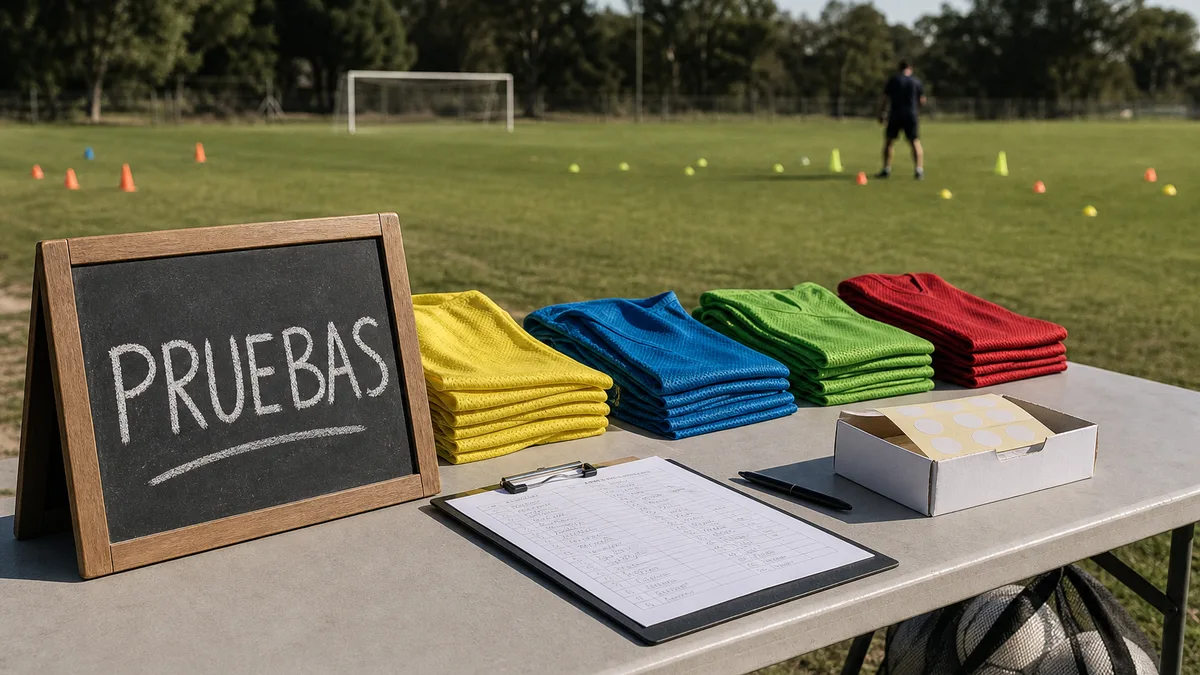
Organising a grassroots football trial day takes more logistics than talent-spotting: age groups, helpers and a clear station script make the difference between chaos and a day that is actually useful for deciding with judgement.
- Before: a clear announcement, age groups and helpers assigned to stations.
- During: short rotations with small-sided games, not an isolated fitness test.
- What to look for: attitude and relationship with the ball in young children; more specific criteria in older ones.
- At the end: written records and respectful communication of who continues and who does not.
Why a grassroots trial day needs a script, not just a field full of children
Every August and September, many modest clubs run an open trial day or scouting session to fill out their squads before competition starts. The problem is rarely a lack of interested children — it is the lack of a script: if the club improvises on the fly, the day fills up with queues, helpers with no clear task, and decisions made from memory at the end of the day.
A well-organised trial day looks more like a small logistics operation than an ordinary training session. It needs advance notice, defined age groups, helpers with an assigned role and a station script that leaves real time to observe. This day usually falls within the start of preseason, so it is worth placing it on the calendar before fixing the rest of the first weeks' plan.
This article covers the three parts of that day: the preparation before families arrive, the script for the day itself, and the most delicate part — communicating who continues and who does not with respect for children and parents.
Before the day: calling players, age groups and helpers
The call for the trial should go out with enough notice: at least two or three weeks beforehand, with date, time, venue, what to bring (sportswear, water, suitable footwear) and which age group each slot targets. The clearer that information, the less confusion on the day.
Always group by age band, never by total group size or scheduling convenience. Mixing different categories in the same station complicates both observation and safety: an alevín and a cadete do not compete on equal physical terms. The detail of pitch format, ball size and number of players per category is in the guide on grassroots football categories by age, worth keeping at hand when designing the slots.
Plan for one helper per 10-12 children as a reasonable reference, plus one at the reception table to log attendance and basic details. Before the day, assign each helper which station they run and what they should note down — do not improvise roles once the group is already on the pitch.
Equipment and logistics: what to have ready
Equipment determines whether the observation is reliable or a failed attempt. The most important thing is a system to identify each child without knowing their name: numbered bibs or stick-on numbers that can be noted quickly on a sheet, grouped by colour according to station or age group.
Add enough balls so each station runs without excessive sharing, cones or discs to mark out each rotation's space, water and some shade for waiting periods, and a basic first-aid kit on hand. If the number of families is high, it is also worth marking where parents wait — away from the touchlines, so as not to interfere with observation or the children's activity.
Before families arrive, gather the helpers for 15-20 minutes to run through the day's script, the criteria for each station and who notes what. That run-through avoids doubts halfway through the day, when there is no longer time to resolve them calmly.
The day's script: stations, small-sided games and timing
The structure that works best combines a block of short technical stations with small-sided games, never an isolated fitness test or a skills exam. With groups of 10-14 children per slot and 12-15 minute rotations, one helper can observe calmly without losing track of anyone.
A typical script for an hour and a half: 10 minutes of welcome and warm-up with the ball, two or three rotating technical stations (dribbling, passing, control) of 12-15 minutes each, and a final block of 30-40 minutes of small-sided games where the relationship between players shows best. The guide on grassroots football exercises by age has concrete tasks by band that fit well into these stations.
The fewer children per group in the final small-sided game, the better the observation: 3-a-side or 4-a-side matches show much more of each player than a 7-a-side where half the group barely touches the ball. If the number of registrations forces bigger matches, it is better to shorten each one and rotate players than to force long matches with few touches per child.
The coach's Sunday summary
Open course calls, up-to-date guides and new posts. Free, with one-click unsubscribe.
Leave your email and get the next issue:
What to look for by age band
What is worth observing changes a lot by age, and mixing up the criteria between bands is the most common mistake in a trial day.
- Prebenjamín and benjamín: almost nothing observed should depend on the result of the small-sided game. What matters is attitude — whether the child joins in, relates to the group, enjoys it — and their basic relationship with the ball: whether they seek it out, dare to try things, are not afraid of contact with play. At this age, ruling someone out for technical level makes little sense.
- Alevín and infantil: you can already look a bit more at game understanding — whether they occupy space, look for teammates, react well to losing the ball — without dropping the weight given to attitude and coachability, that is, whether they respond well to a specific instruction.
- Cadete and juvenil: here more specific criteria by position and a more demanding technical-tactical level do fit, though attitude should still carry weight: a player with room to improve but a good attitude usually contributes more in the medium term than one with talent but hard to coach.
At any age band, avoid drawing conclusions from a single isolated gesture. One bad touch or a moment of distraction says nothing on its own; what matters is the tendency that repeats across the full rotation.
Criteria and recording decisions
Writing things down, even briefly, is what separates a real criterion from a last-minute impression. The guide on how to prepare a trial session with a new team explains how to design an observation sheet to follow a single group calmly; in a scouting trial day, the logic is the same but adapted to many children at once, with a short row per shirt number and two or three codes instead of an extensive box per player.
A minimum format per station: shirt number, an attitude code (for example, +/–/=), an indicative level code if age justifies it, and a free box for anything striking. Each helper fills in only their own station; at the end of the day, someone centralises the sheets before any decision is made.
Let at least one day pass before closing final decisions. First impressions taken in the heat of the moment, especially at the end of a long day, tend to overrate whoever stood out at a specific moment and underrate whoever had a quiet but consistent day.
The human side: communicating who continues and who does not, with respect
In the earliest categories — prebenjamín, benjamín and much of alevín — the normal and desirable outcome is that there is no real rejection: if the club has places, the entry bar should be minimal, and the trial mainly serves to organise groups, not to select. Ruling someone out by level only makes sense, if at all, from categories with federated teams and genuinely limited places.
When a rejection is necessary, the first rule is never to do it in public or in front of other children. The result is communicated to the parent or guardian, in private, never to the child directly and even less with the group around. A brief, honest message — thanking them for taking part and clearly explaining, without detours or false hope, that there is no place this time — avoids the damage of a badly handled rejection.
The guide on how to manage parents in grassroots football has broader guidance on tone and channel for these delicate conversations. Whatever the decision, always close with a concrete alternative if one exists — another group, another category, a waiting list — rather than leaving the door shut without further explanation.
About the author

Content produced by RutaMister from practical experience, editorial review and a training-focused approach for grassroots football coaches.
Frequently asked questions
How far in advance should a trial day be announced?
Two or three weeks in advance is recommended, with date, time, venue and the age group for each slot clearly stated. The earlier the announcement goes out, the more time families have to organise, and the less confusion on the day. Use the club's usual channels: website, social media and direct contact with local schools.
How many children should be called per group?
Between 10 and 14 children per slot works well with one helper per station: it allows calm observation without losing track of anyone. If more children register, it is better to add slots or helpers than to enlarge the group, because observation quality drops fast beyond that size.
Should young children be rejected at a trial day?
In early categories — prebenjamín, benjamín and much of alevín — the normal outcome is no real rejection if the club has places: the trial organises groups rather than selecting players. Ruling someone out for technical level only makes sense from categories with federated teams and genuinely limited places, not before.
How do you communicate a rejection without causing harm?
Never in public or in front of other children: the result goes to the parent or guardian, in private. A brief, honest message that thanks them for taking part and clearly explains there is no place this time avoids the damage of a badly handled rejection. If an alternative exists — another group, a waiting list — always offer it.
What should you look for in the small-sided games at a trial day?
It depends on age: in young categories, attitude and relationship with the ball, not the result. In older categories, alongside attitude, more specific criteria on game understanding and technical-tactical level also apply. At any age, avoid drawing conclusions from one isolated gesture; what matters is the repeated tendency.