How to prepare a trial session with a new team
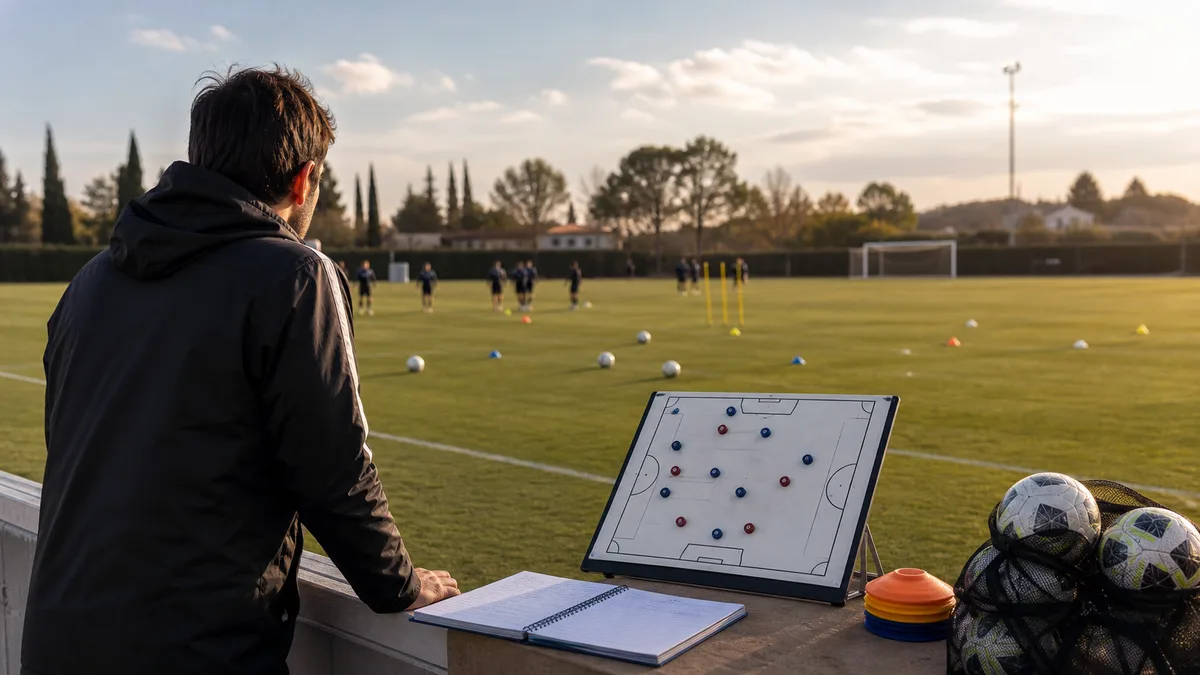
A trial session is not about impressing with complexity. It is about understanding the group, showing judgement and leaving the coordinator with a clear sense of how you work.
- Length: a 60-75 minute session.
- Structure: activation, main task, conditioned game and closing.
- Observation focus: two specific things you want to observe, not ten.
- Kit bag: basics and a notes sheet.
- Mindset: show judgement, not a show: the coordinator wants to see how you decide, not how many drills you know.
Before the day: gather the information
The part that most affects the outcome of a trial is not the session: it is what you know before you set foot on the pitch. A 10-minute call with the coordinator saves you a lot of adjustments on the fly.
Minimum to confirm: exact age group and category, approximate number of players, pitch (11-a-side, 7-a-side or 8-a-side, grass or dirt), whether a goalkeeper is available, what equipment they have, how much time you get and what the club expects to see. If the club cannot answer this, that is also useful information.
Ask too about the context of the group: whether they come from a recent coaching change, a bad run of form or whether it is a new group being formed. A trial over an unmotivated team is not prepared the same way as one over a team coming off winning the league.
1. Pick two specific things you want to observe
Before designing drills, decide what information you need. The temptation is to look at everything: attitude, tactical understanding, relationships between players, technical level, ability to compete, leadership and a long list. Impossible in 75 minutes.
Narrow it down to two focuses and write them at the top of your session sheet. For example: “attitude after losing possession” and “occupying spaces off the ball”. Everything else you will catch in passing, but these two you actively look for.
If you do not define the focus before starting, you will watch too many things at once, you will not take useful notes and the trial will be less valuable for you and for the club.
2. Prepare a simple 60-75 minute session
A trial with a new team is not the moment for a task with many rules. The group does not yet know your language or your way of correcting, and any minute spent explaining is a minute you are not observing.
Use a classic structure: short warm-up with the ball, one main task that is easy to explain, a conditioned game where you can observe real decisions and a short closing. This is a concrete proposal you can adapt:
| Minutes | Block | What to observe |
|---|---|---|
| 0-5 | Greeting and session brief | Group attention, natural leaders |
| 5-15 | Warm-up with ball (rondos or paired passing) | Base technical level, rhythm, communication |
| 15-35 | Main task with one single extra rule | Understanding, game reading |
| 35-65 | Conditioned game or small-sided match | Your two priority focuses |
| 65-75 | Cool-down and closing | Reaction to your final message |
If a task needs five rules to work, it is probably not the right task for a trial. A simpler one that leaves you time to correct and observe is better.
3. Explain less and observe more
The natural temptation is to talk too much to prove knowledge. In a trial, the opposite usually works better: one clear instruction, let them play and take notes.
A practical rule: every explanation should fit in under 30 seconds. If you need more, stop and demonstrate with an example in motion. A good coach is not proven by explaining, but by correcting at the right moment.
Correct only what affects the main objective. If your focus is attitude after losing possession, do not stop play because a centre-back is not opening up the build-up properly: note it and move on. Showing judgement about what to correct is part of what the club is evaluating.
4. Take care of the first minute of contact
Greet the group, say your name with a short context sentence, present the session in two lines and set two basic rules: attention when you speak and respect during the task. That is enough for the first minute.
That opening does not need to be formal or long, but it should convey order and approachability. Making eye contact with several players, using the names of the ones you know (if they were listed for you) and smiling without losing your composure are details the group reads immediately.
If the group is made up of under-7 players, that tone matters even more: there is less room to recover their attention if you lose it in the first 60 seconds.
The coach's Sunday summary
Open course calls, up-to-date guides and new posts. Free, with one-click unsubscribe.
Leave your email and get the next issue:
5. Close with one concrete idea
At the end, avoid a long speech. Sum up in 60 seconds what was trained, what you saw positively and what the next step would be if you continue with them. Do not promise anything that depends on the club: keep it in the plural and in the abstract (“if we go on…”).
That closing helps players take something away and, above all, helps families or the coordinator who may be watching understand your method without turning the trial into a lecture.
Afterwards, ask for five minutes with the coordinator. Bring one concrete group observation and one open question about how to continue. That conversation weighs as much as the session in the final decision.
What to pack: kit bag checklist
This is the minimum to have ready the night before and to put in the bag that same evening. The club will probably provide most of the equipment, but bringing the basics avoids losing the first minutes looking for it:
- Printed session sheet with timing and the two focuses at the top.
- Plan B in case the number of players changes or a task breaks (written on the same sheet).
- Observation sheet with a box per player to take notes in real time.
- Pen + pencil (if it rains, the pen will not write).
- Two colours of bibs of your own, in case the club's are scattered.
- Whistle, if your way of stopping play needs it.
- Stopwatch or watch with a visible second hand, so you do not look at your phone in front of the group.
- Your own water bottle. You are not drinking from the club tap on day one.
- Spare clothes in the car in case it rains and you have to drive home or to another appointment soaked.
There is no need to bring training equipment (cones, balls, poles): the club provides that. If they ask you to bring it, that is a signal worth noting about the kind of organisation you are talking to.
Observation sheet: taking notes without losing the session
Taking notes during a trial is hard because you have to train and observe at the same time. A simple well-designed sheet removes half the work. This is a minimum structure that works:
- Header: team, category, date, number of players and the two focuses you chose.
- Box per player: shirt number (or name if you have it), one column for the first focus, one for the second and a third free column for anything striking.
- Group notes: three lines at the bottom for whole-group observations: cohesion, leaders, reaction to error, competitive rhythm.
To avoid breaking the flow of the session, use short codes: +/–, ↑/↓, OK, ?. What matters is writing in the moment, even illegibly: you tidy it up in cool blood that same night, while you still remember the context.
If the trial spans more than one session, one sheet per session is better than reusing the same one. Comparing two sheets shows you tendencies that a single snapshot would miss.
Common mistakes to avoid
Almost every mistake in a trial is avoidable if you know it in advance. These are the most common:
- Bringing the most complex session in your repertoire. This is not a complexity exam. The simpler the task, the more your correction judgement shows.
- Talking more than 20% of the time. In a trial the group does not learn your language in one day: talking a lot only steals observation.
- Correcting everything at once. Pick at most three corrections. The rest are written down, not said.
- Drawing definitive conclusions in one session. A trial opens questions; it does not close them. If the club asks for final impressions, share tendencies, not judgements.
- Forgetting the closing with the coordinator. The five-minute conversation at the end weighs as much as the session.
- Not having a plan B if the player count changes. In grassroots, two will be missing. Plan for it in advance.
If you are starting out, pair this guide with first-year coaching tips and, if families will be watching, with how to manage parents in grassroots football so you have the tone clear from the first minute.
About the author

Content produced by RutaMister from practical experience, editorial review and a training-focused approach for grassroots football coaches.
Frequently asked questions
What should a coach bring to a trial session with a new team?
At minimum: printed session sheet with timing, plan B, observation sheet, pen and pencil, two colours of bibs, whistle if you use one, stopwatch or watch with second hand, water bottle and spare clothes. The club provides training equipment. If they ask you to bring it, note it: it says a lot about the kind of organisation.
How long should a trial training session last?
Usually 60 to 75 minutes in grassroots and up to 90 in youth or senior amateur, depending on age, pitch availability and objective. The key is not making it longer: it is leaving enough time to see the group in simple tasks and real play. A shorter, well-structured session beats a long one that loses shape.
What information should I ask the coordinator before the trial?
Exact age group and category, approximate number of players, pitch, whether a goalkeeper is available, existing equipment, time allotted and what the club expects to see. Ask about the group context too: recent coaching change, current form or whether the group is brand new. If the club cannot answer, that is also useful information.
How should I introduce myself in the first minute?
Greet, say your name with a short context sentence and present the session in two lines. Set two basic rules: attention when you speak and respect during the task. Make eye contact and use the names of the players you know. It does not need to be long, but it should convey order and approachability.
What mistakes should be avoided in a first trial session?
Bringing the most complex session in your repertoire, talking more than 20% of the time, correcting everything at once, drawing definitive conclusions from one session, forgetting the closing with the coordinator and not having a plan B if the player count changes. A trial opens questions, it does not close them: share tendencies, not judgements.
How do I close a trial session with a new team?
In 60 seconds: what was trained, what you saw positively and what the next step would be. Use the plural and the abstract (“if we go on…”) so you do not promise anything that depends on the club. Then ask for five minutes with the coordinator with one observation and one open question. That conversation matters.
What if parents are watching during the trial?
Run the session exactly the same way: the trial is for the group, not the families. Keep a warm but clear tone, avoid technical conversations with parents and do not answer method questions at the end; that is the coordinator's topic. For the full framework, see how to manage parents in grassroots football.