Initial squad assessment: what to measure in the first 4 weeks
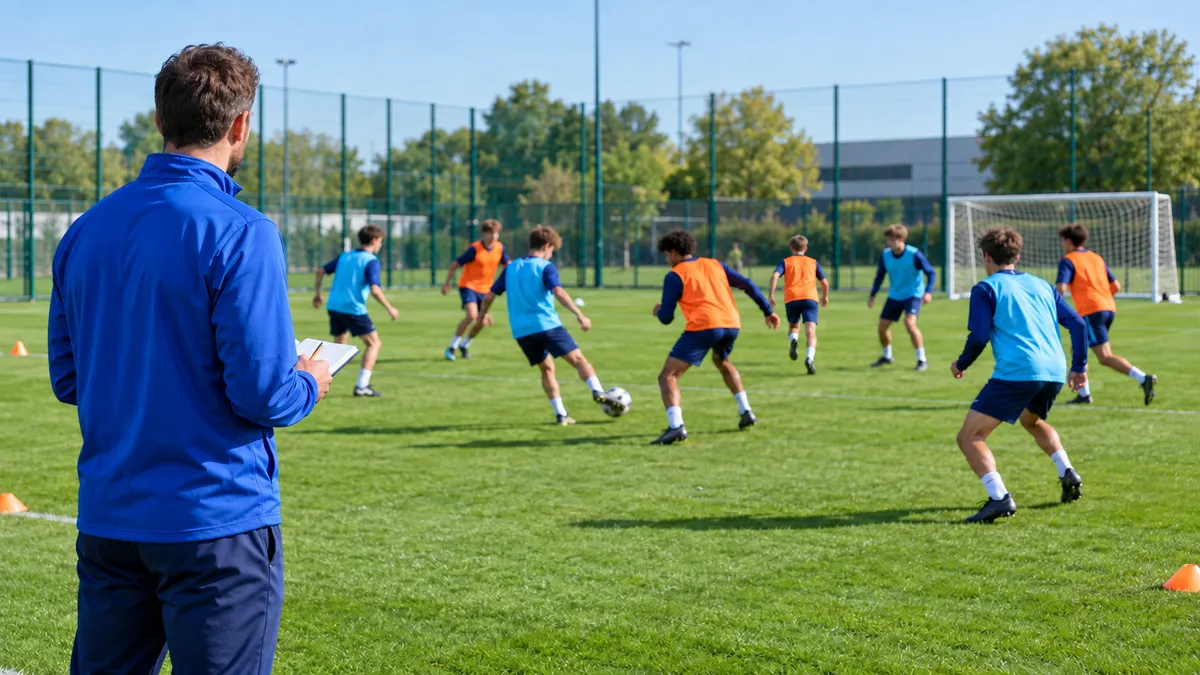
In the first four weeks you watch a few indicators, always the same ones, and record them on a one-page sheet per player.
- Indicators: technique in small-sided games, decision making, attitude and attendance, basic fitness and role in the group.
- Equipment: cones, tape measure, stopwatch and a notebook.
- Reviews: week 4 and Christmas, with a final snapshot at the end of the season.
- Communication: concrete behaviours and the next goal, no labels.
What you assess in the first weeks, and why
The first four weeks are for getting to know the group before you fix contents, positions and roles. An initial assessment gathers information to adjust your work, not to rank children from best to worst. Solo Fútbol Formativo takes the same line: the point is what you do with the results to improve.
The UEFA Grassroots Charter (2023 edition) asks federations for children's formats built around participation, inclusion and personal development before competition and performance. A sheet that only sorts players goes against that principle; one that shapes next week's session meets it.
Say three sessions a week and 16 or 18 children: there is no time for long test batteries. It works better to observe one or two aspects per session, following Aprende Entrenando, and keep the physical tests for a single session. A note for readers outside Spain: Spanish grassroots football groups players by age band, from prebenjamín (under-8) and benjamín (under-10) up to alevín (under-12), infantil (under-14), cadete (under-16) and juvenil (under-19).
Five indicators you can observe without lab equipment
We chose five because they fit on one page and each one shows up in an ordinary training session:
- Technique in small-sided games. Control, passing and dribbling under pressure, in 4 v 4 or 5 v 5, for example for 10 to 12 minutes. Note what the player solves successfully and what they lose when an opponent is close.
- Decision making. When they pass, when they dribble, when they offer themselves. According to MBP School, assessment goes beyond technical execution: knowing when to use the skill counts.
- Attitude and attendance. Punctuality, reaction to a mistake and to a correction, work off the ball. The Futbolsiete.eu template argues that a good attitude and strong commitment can make a less talented player more important to the team.
- Basic fitness. Two or three field tests repeated the same way at every review (see the next section).
- Role in the group. Who suggests, who follows, who looks for the teammate who is alone, who they sit with in the changing room.
For technique we prefer observing to timing. The Loughborough Soccer Passing Test separates levels in players aged 14 to 17 (40.3 s for elite against 66.6 s for non-elite), but its reliability in non-elite players is low to moderate (r = 0.47, against 0.96 in elite). In a grassroots squad, a timed pass tells you less than ten minutes of small-sided play and a notebook.
Basic fitness: three field tests with cones and a tape measure
Salinero and colleagues (2013) assessed footballers aged 10 to 17 and report the conclusion of Mercé and colleagues (2004): non-specific physical tests, although necessary, are not enough, and football-specific tests are needed. Hence a mix of two generic tests and one with the ball.
- Standing long jump. EUROFIT protocol: feet together behind the line, jump forward and measure from the line to the heel. The ALPHA-Fitness battery considers it valid and reliable in children and adolescents.
- 10 x 5 m shuttle run. Two lines 5 metres apart, five full cycles and total time. It also comes from EUROFIT.
- Zigzag dribbling. Ten metres with cones every 2 metres, out and back, two attempts and the best time, the specific protocol used by Salinero and colleagues.
If the group is aged 10 to 13, the modified Barrow test (a cone course with turns, a 5-metre slalom and backward running, without a ball) showed an ICC of 0.94 in a sample of 51 Basque footballers of those ages. It is an alternative to the 10 x 5 m run if you have time to set up the course.
On frequency, Evaluación Deportiva suggests 2 or 3 assessments a year in younger categories (a 'perhaps' in the source), with simple field tests and minimal equipment, and warns against extreme protocols in immature bodies. The high-priority ALPHA-Fitness battery takes about two hours with 20 children; three tests bring that load down to part of one session.
The one-page sheet per player
The sheet fits on one page and is filled in with observed behaviours. The manual from the La Rioja Football Federation and the University of La Rioja sums it up in one sentence: nobody "is", they only "behave". If the box says "lazy", there is nothing to work on; if it says "stops moving in defensive transitions", there is a goal for next week.
Header: name, date of birth (with the birth quarter), positions tried and one line with what the player said in the initial interview. Futbol Sesion suggests a short interview with each player before starting: what they expect from the season, what worries them and what motivates them.
| Indicator | What we record | Week 4 | Christmas |
|---|---|---|---|
| Technique in small-sided games | Control, passing and dribbling with an opponent close | Observed behaviour | |
| Decision making | When they pass, dribble or offer themselves | A concrete example | |
| Attitude and attendance | Sessions attended, reaction to mistakes | X of 12 sessions | |
| Basic fitness | Standing long jump (cm), 10 x 5 m (s), zigzag (s) | Three results | |
| Role in the group | Who they play with, who looks for them, how they relate to others | One sentence | |
| Goal for the next 4 weeks | Just one, measurable in a single training session | One line |
The Christmas column is left blank on purpose: the second review is compared with the first, not with the teammate next to them. If your club already works with match data, cross-check it against the sheet; our overview of how football clubs measure data helps you decide what deserves recording and what does not.
The coach's Sunday summary
Open course calls, up-to-date guides and new posts. Free, with one-click unsubscribe.
Leave your email and get the next issue:
Relative age: how to read the sheet's results
September's physical results depend partly on the month of birth. Among 990 Galician players from benjamín (under-10) to juvenil (under-19) (a study by Corredoira reported by Alto Rendimiento, seasons 2007-08 to 2011-12), 301 were born in the first quarter (30.4%) and 190 in the fourth (19.2%). Peña-González and colleagues (2025), in a ten-year study of 1,120 players from U12 to U16 at five Spanish academies, found 37.4% in the first quarter against 16.2% in the fourth, and at the highest competitive level 46.6% against 8.2%.
Práxedes and colleagues (2019) and Gutiérrez Díaz del Campo and colleagues (2010) point the same way: the more a club selects, the earlier it discriminates by date of birth.
That is why the sheet carries the birth quarter in the header. Peña-González and colleagues (2025) recommend that coach education insist on assessing by individual maturation and not only by chronological age. A short jump in September from a December-born player can say more about their maturation calendar than about their potential. The decision to move a player to another age group has its own analysis in moving a player up or down an age group in grassroots football.
When to review the sheet: week 4 and Christmas
We suggest three moments: a first snapshot between weeks 3 and 4, a review at Christmas and another at the end of the season. This fits the 2 or 3 assessments a year that Evaluación Deportiva suggests for younger categories. Between reviews the physical tests are not repeated; you keep observing the other indicators in sessions.
Week 4 makes sense because of the calendar. In the standard five-microcycle pre-season described by Futbol Sesion, week 3 corrects what is going wrong and week 4 develops the game model: there is already shared content against which to see what each child does. How it fits with the rest of the season is explained in planning the season by microcycles in grassroots football.
At the Christmas review you repeat the same three physical tests, with the same surface, footwear and time of day, and compare them with the September results. The week 4 goal is marked as achieved, in progress or changed, and the next one is written. If a child drops from 11 to 10.5 seconds in the 10 x 5 m run, they have improved, whatever the rest of the group records.
How to communicate it to the player and the family without labelling
The sheet is a coach's tool and is not handed out. What goes from it to the player and family is behaviours and a goal. The reason comes from the book by Lapresa and colleagues: when a child is labelled in the group, they tend to play the role they have been labelled with.
With the player, two or three minutes one to one after week 4: what they do well, what we will work on and how we will see it. Aprende Entrenando also suggests players assess themselves; comparing their view with ours opens the conversation better than a verdict. An example sentence: "in 4 v 4 games you offer yourself a lot; the goal for these weeks is to look before receiving".
With the family, SM Academia recommends not speaking to the coach in the heat of the moment after a match or training session, asking for an appointment instead, and asking about attitude to corrections and mistakes rather than about minutes. It works for us as a rule: the conversation is scheduled, lasts ten minutes and starts from two or three observed behaviours. Playing-time criteria are handled separately, as we explain in squad selection and playing time: winning or developing.
Maestre and colleagues (2018) brought together nine coaches, twelve players aged 14 to 18, eight parents and three psychologists, and point out that an excellent grassroots coach counts more as an educator than as a technician, with confidence, empathetic listening and positive communication. The sheet supports that listening because it makes you look at each child once, with a method, before forming an opinion of them.
About the author

Content produced by RutaMister from hands-on experience, editorial review and a development-focused approach for grassroots football coaches.
Frequently asked questions
What do you assess in a grassroots football player?
Five observable aspects: technique in small-sided games, decision making, attitude and attendance, basic fitness through field tests and role in the group. You record concrete behaviours on a one-page sheet, with no adjectives or marks. The aim is to set a single aspect to work on over the next four weeks.
When should you do physical tests with young footballers?
For younger categories, Evaluación Deportiva suggests 2 or 3 assessments a year. We suggest one between weeks 3 and 4, another at Christmas and one at the end of the season, always with the same tests and conditions. In between you observe in sessions. Avoid extreme protocols, because a child's body is not yet mature.
Which physical tests are used in grassroots football?
Field tests with minimal equipment: the standing long jump, the 10 x 5 m shuttle run from the EUROFIT battery and a cone zigzag dribble. For ages 10 to 13 there is also the modified Barrow test, with an ICC of 0.94 in Basque footballers. You need only a tape measure and a stopwatch.
How do you build a player assessment sheet?
One page with a header (name, birth quarter, positions) and one row per indicator: technique, decision making, attitude, basic fitness and role. Each box holds an observed behaviour, with two columns, week 4 and Christmas. It closes with a single goal for the following four weeks.
How do you talk to families about the assessment without labelling?
In a scheduled meeting, never in the heat of the moment after a match, and for ten minutes. Start from two or three observed behaviours and one concrete goal. Playing time is dealt with separately. Ask the family how the child reacts to corrections and mistakes.
How do you write an individual player report in youth football?
The one-page sheet is that individual report: a header with name, birth quarter and positions, one row per indicator with the behaviour observed at week 4 and at Christmas, and a single goal for the next four weeks. It is written in behaviours, with no marks or adjectives, and the coach keeps it; families receive the behaviours and the goal.
Sources
- Ruiz JR et al., ALPHA-Fitness test battery, Nutrición Hospitalaria 2011;26(6):1210-1214
- Aptavs, What the EUROFIT battery is
- Bidaurrazaga-Letona et al., modified Barrow test, Rev Bras Med Esporte 2015
- Salinero JJ et al., Rev Int Med Cienc Act Fís Deporte 2013;13(50):401-418
- Le Moal et al., Loughborough Soccer Passing Test, J Strength Cond Res 2014
- Alto Rendimiento, The relative age effect in Spanish youth football categories
- Peña-González et al., Frontiers in Sports and Active Living 2025
- Gutiérrez Díaz del Campo D et al., Journal of Sports Science and Medicine 2010;9:190-198
- Práxedes A et al., European Journal of Human Movement 2019
- Lapresa D et al., Orientaciones formativas para el entrenador del fútbol juvenil (training guidelines for youth coaches), La Rioja Football Federation and University of La Rioja
- Maestre M et al., Cuadernos de Psicología del Deporte 2018
- UEFA Grassroots Charter, 2023 edition, annex B
- SM Academia, How to talk to your child's coach in grassroots football
- Futbolsiete.eu, Template for assessing grassroots players
- Aprende Entrenando, How to create a technical and tactical assessment report
- Solo Fútbol Formativo, Assessment is a very powerful tool in football
- MBP School, Assessment in the training process
- Evaluación Deportiva, Setting up a physical assessment programme in football
- Futbol Sesion, How to plan your grassroots pre-season