How football clubs measure data in 2026 (and what reaches your bench)
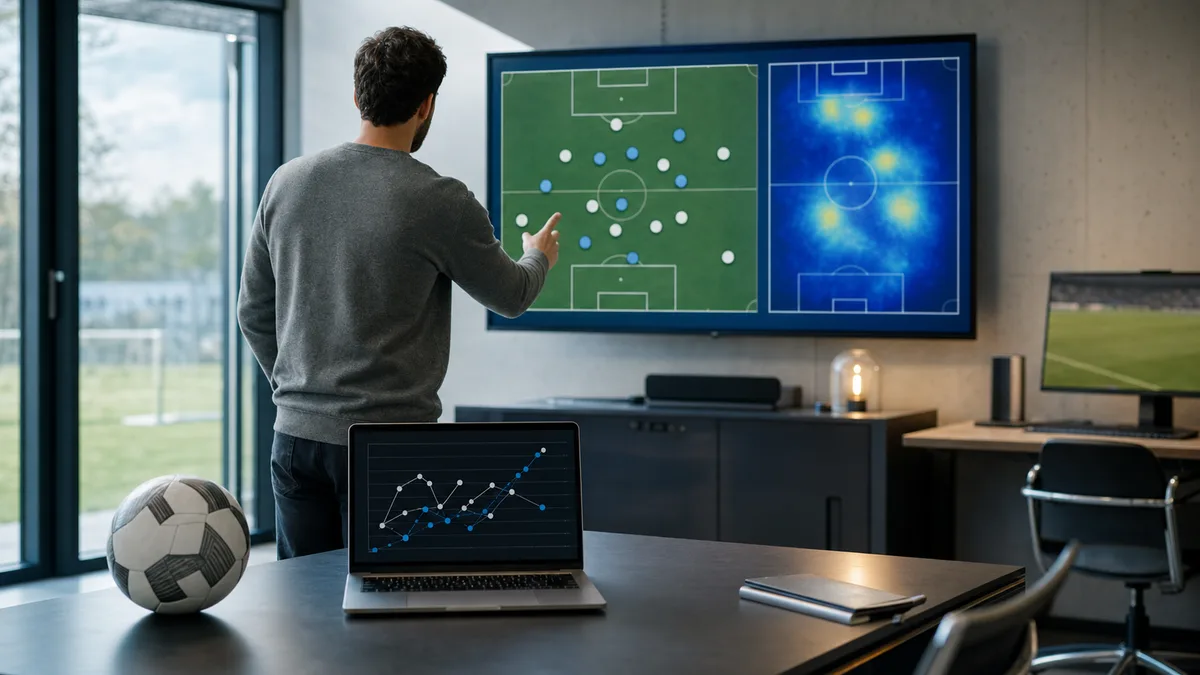
In 2026, football clubs measure the game through four data streams, and the people who turn them into decisions now sit next to the coaching staff, not in a back office.
- What they measure: every on-ball action, the position of all 22 players 25 times per second, computer vision and GPS.
- Who does it: data scientists, video analysts and research engineers embedded with the staff.
- Real cases: TacticAI with Palmeiras, the World Cup's technology and Mediacoach turned into Sportian.
- What reaches grassroots: the mindset of measuring and affordable tools, not elite tracking.
- Your career: you do not need to be an engineer; reading data is already an edge.
Clubs now sign engineers too
In July 2026, Arsenal had a job opening that would not have existed a decade ago: a Research Engineer in its Data Analytics team, embedded with the men's first-team analysis. It is not scouting or fitness: the posting asks for full-stack software engineering combined with applied machine learning, and describes the role as a subject-matter expert in applying AI techniques to football analysis. Requirements include Python, SQL and deep-learning frameworks such as PyTorch, JAX or TensorFlow.
On its own, that would be an anecdote. It is one signal among many. A Premier League club does not hire a research engineer to decorate the org chart, but because measuring the game has become as central a function as signing or coaching. The useful question for a coach is not what Arsenal does, but what that posting reveals about how clubs make decisions today: with data, and with people able to build the tools that produce it.
What clubs measure today: the four data streams
When a club says it "works with data", it almost always means a combination of four distinct streams. Each answers a different question, and none replaces the others.
- Event data (Opta, StatsBomb): every on-ball action (pass, shot, tackle, duel) tagged with its position, moment and outcome. It answers what happened in the match.
- Optical tracking: the position of all 22 players and the ball recorded about 25 times per second (25 Hz is the standard for systems like TRACAB or Opta Vision). It answers where each player was at every moment.
- Computer vision: algorithms that extract those positions straight from video, with no sensors on the player. It is what a Veo camera does in amateur football and what semi-automated offside does at the elite level. It answers how to turn video into data.
- Physical data (GPS and wearables): vests that measure each player's distance, sprints and load. It answers how much each player ran and at what intensity.
The power is not in one stream but in crossing them: knowing not just that an opponent had twelve shots (event data), but from which positions they arrived (tracking) and with how much accumulated load in the legs (GPS). A top club combines all four; a grassroots coach rarely has more than one, and that is fine. What matters is knowing which question each one answers.
Who does it: the new data department
The underlying change is organisational more than technological. A decade ago, the "analyst" was someone who cut up opponent videos. Today, a club that takes data seriously has a small department with distinct profiles: the data scientist who builds models, the video analyst who translates those models into what the coach sees, and figures like the research engineer who codes the bespoke tools.
What counts is where they sit. In clubs that do it well, they are not an office silo emailing reports, but people embedded with the coaching staff: Arsenal's own posting places the role inside first-team analysis. Data is only worth something if it reaches the coach in a format they can use in Tuesday's session.
An ecosystem has grown around these departments. LaLiga turned its Mediacoach platform into Sportian Performance, together with the technology firm Globant, to provide data services to its 42 professional clubs. And the Barça Innovation Hub works as a research and education community in sports analytics. They are the infrastructure a single club cannot build alone.
The coach's Sunday summary
Open course calls, up-to-date guides and new posts. Free, with one-click unsubscribe.
Leave your email and get the next issue:
From lab to pitch: what is real and what is marketing in 2026
Every week an "AI revolution in football" is announced. The question is which ones already work on a pitch and which are just an announcement. Four cases from 2026 mark the difference.
TacticAI, the system Google DeepMind built with Liverpool to optimise corners, took its first step out of the lab in June 2026: Palmeiras and the Brazilian Football Confederation are the first to build on it for open play, promising to anticipate the move up to 8 seconds ahead. The nuance matters: the peer-reviewed work still covers set pieces only; open play is, for now, an announced collaboration. We cover it in detail in our TacticAI analysis.
At the 2026 World Cup, by contrast, the technology is already deployed and measurable: FIFA installed 16 optical tracking cameras in each of the 16 stadiums, generating more than 150 million data points per match, and 3D-scanned every player for semi-automated offside. It also gave all 48 teams an analysis tool, Football AI Pro.
Sportian Performance (the evolution of Mediacoach) is not marketing either: it serves LaLiga's 42 clubs with more than 3.5 million data points and 6,400 metrics per match, and in June 2026 the United States national team, under Mauricio Pochettino, chose it for their preparation.
And it is not all about performance: the RFEF brought AI to refereeing. In July 2025, the Referees' Technical Committee chaired by Fran Soto hired the expert Chema Alonso to lead a technological-innovation area tasked, among other things, with developing algorithms to optimise referee assignments. Spanish football is also measuring who officiates.
The bridge to grassroots football: what trickles down (and what does not)
Of all the above, what reaches a youth coach on a Saturday morning? Two things, and neither is a supercomputer.
The first is the mindset of measuring: defining what you want to observe before the match, recording it with criteria, and reviewing it afterwards, instead of trusting everything to memory and gut feeling. That discipline costs nothing and is what separates analysis from noise.
The second is affordable tools. The same computer vision that powers semi-automated offside at the elite level exists, in a low-end version, in a club Veo camera or free tagging apps. We have mapped that full ladder, from free to club investment, in our guide to AI tools for coaches.
What does not trickle down is the rest: optical tracking at 25 Hz, event data at Opta quality, or a research engineer's bespoke model need an infrastructure and a budget grassroots football does not have and does not need. Sportian, for one, is exclusive to the 42 professional clubs, with no amateur version or public price.
That this is no longer a lab matter is shown by a regional federation, the FFCV, launching an official online course on artificial intelligence for coaches in 2026, together with the Academia RFEF. A note for international readers: in Spain, coaching qualifications run through regional federations under the RFEF, and when official training devotes a course to this, understanding it stops being optional.
What it means for your career: the hybrid coach
The conclusion is not that you have to start coding. No grassroots club expects its coach to train neural networks. What does make a difference is the profile now in demand everywhere: the hybrid coach, who does not build the data but knows how to read it and work with whoever holds it.
Where to start, without spending: understand the four data streams well enough to know which question each answers; learn to read a positioning map and a heat map without needing anyone to explain them; and if someone at your club films or tags matches, sit down with that person instead of waiting for their report.
And on the qualifications side, the usual principle: the edge does not come from an AI course, but from a solid base as a coach on which to build data reading. In Spain there are two parallel routes to qualify: the state-regulated Técnico Deportivo diploma and the RFEF/UEFA federative licence; it is worth being clear about the two routes to qualify as a coach before adding any specialisation. Technology changes every season; knowing how to teach and lead a dressing room does not.
If the analyst role is what appeals to you, the guide on how to become a football analyst covers the federation licence, the federation courses and the postgraduate programmes.
About the author

Content produced by RutaMister from practical experience, editorial review and a training-focused approach for grassroots football coaches.
Frequently asked questions
How do professional football clubs measure data?
Through four streams that cross over: event data (every on-ball action, tagged by providers like Opta or StatsBomb), optical tracking (the position of all 22 players about 25 times per second), computer vision (extracting positions from video) and physical GPS data. Each one answers a different question.
What is a "research engineer" at a football club?
A profile combining programming and artificial intelligence to build the analysis tools the coaching staff uses. Arsenal had such an opening in 2026, embedded in first-team analysis, asking for Python and deep-learning frameworks like PyTorch. It does not replace the analyst: it builds the bespoke software for them.
Do I need to know how to code to coach with data in grassroots football?
No. In grassroots football you do not need to code or buy expensive technology. What gives you an edge is the mindset of measuring, deciding what to observe and recording it with criteria, and being able to read a positioning map or heat map. If someone at your club films matches, work with them.
What data technology is used at the 2026 World Cup?
FIFA deployed its largest technology package: 16 optical tracking cameras in each of the 16 stadiums, generating more than 150 million data points per match, plus a 3D scan of every player for semi-automated offside. It also gave all 48 teams an analysis tool, Football AI Pro.
Can I use the same data as LaLiga in grassroots football?
Not at the same quality. Platforms like Sportian (formerly Mediacoach) are exclusive to LaLiga's 42 professional clubs, with no amateur version or public price. What does reach grassroots football is the mindset of measuring and affordable tools: free tagging apps, club cameras and low-end GPS.