Finishing drills in youth football: 7, 8 and 11-a-side by age group
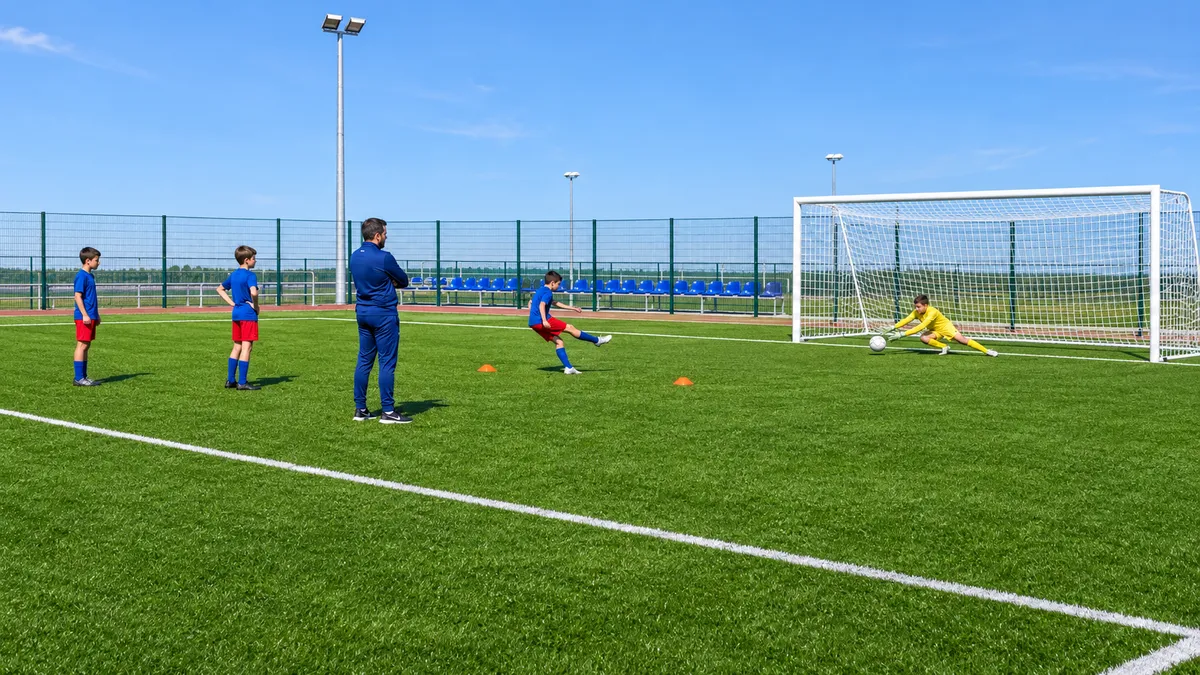
To coach finishing in youth football, combine shooting drills, passing moves with a finish and games against defenders. Choose the difficulty to match what your players can already do.
- Set-up: small stations and short turns to reduce waiting.
- Start with: control and shoot, or a passing move with a finish.
- Progress to: 2v1, 3v2 and small-sided games.
- Feedback: one point at a time, about the strike or the choice to shoot or pass.
The four types of finishing task
Choose the activity according to what you want to coach:
- Analytic shooting: no opposition, to fix striking technique and body position. Useful in the youngest ages and as a session opener.
- Finishing after a combination: wall pass, support and shot. It adds the previous pass and the moment to shoot.
- Finishing in superiority (2v1, 3v2): it adds the decision to shoot or pass.
- Finishing in small-sided games: with a goalkeeper, opposition and a scoreboard. It is the closest to a real match.
For help matching the difficulty to your group, see youth football drills by age.
How to organise groups and rotations
For shooting drills, split the players across several stations. The FIFA Cefor session uses groups of three and changes stations every three minutes. For games against defenders, use the number of players each activity needs.
- Balls ready. Organise collection so the next action can start promptly.
- Short turns. If a long queue forms, add a circuit or make the group smaller.
- Goalkeeper changes. Agree the rotation before starting. See coaching goalkeepers without a specialist.
- Clear rotation. Explain where players go after passing, shooting or defending.
Use goals suited to the activity and the players. See the comparison of 7, 8 and 11-a-side football for format differences.
Drill overview
Pick one or two drills to match the session objective. The descriptions below explain how to set them up.
| Drill | Suggested age group | Aim |
|---|---|---|
| 1. Pass-wall-shot | Benjamin to infantil | Link passes and a finish |
| 2. Control and shot in two touches | Prebenjamin and benjamin | Set up the shot with the first touch |
| 3. Triangles on the wing and central lane | Infantil and cadete | Time crosses and runs into the box |
| 4. 2v1 with goalkeeper | Benjamin and alevin | Choose whether to shoot or pass |
| 5. 3v2 with goalkeeper | Alevin | Find the free teammate |
| 6. Superiority 4v2 and 3v2 with mini goals | Alevin and infantil | Move from possession to attack |
| 7. 3v3 on pitches of different sizes | Benjamin and alevin | Find space to shoot |
| 8. 5v3 with goalkeepers | Infantil | Create shooting angles |
| 9. 7v7 in three zones | Alevin | Progress with support |
| 10. Conditioned 7v7 match | Infantil and cadete | Recognise shooting opportunities |
Analytic shooting and finishing after a combination
Start with control and shooting, then add passing and movement. Use both feet and allow a first touch before asking for a first-time finish.
1. Pass-wall-shot. Adaptation of the «pass and finish» from the under-12 Clearwater session (FIFA).
- Players: 6 per circuit; two parallel circuits with 12.
- Space: three stations in a line 10 m apart and a mini goal 10 m from the last one, facing the cones. For benjamin it can be shortened to 8 m.
- Duration: 8-10 minutes.
- Set-up: A starts with the ball at the first station; B occupies the second and C the third. The remaining players wait at the first station.
- Rule: A passes to B and receives a first-time return. A then passes to C; B moves forward, receives a lay-off from C and shoots. A takes B’s place, B takes C’s place, and C collects the ball and returns to the start.
- What to correct: firm passes to feet, soft lay-offs and B arriving in time to finish.
2. Control and shot in two touches. Adaptation of the finishing part of the «Create and finish chances» session (FIFA).
- Players: 6-8, in two side lines.
- Space: 20x15 m zone with a goal on each side and a cone in the middle (FIFA); in 7-a-side, mini goals and a keeper on each side.
- Duration: 6-8 minutes.
- Set-up: the first in each line goes round the cone and faces their goal; the last in the line throws the ball by hand or rolls it. The shooter goes to the back to become the passer.
- Rule: first touch to control, second touch to shoot. Variants: first time; with a ground pass from a teammate and a shot from anywhere between the cone and the far post.
- What to correct: work the footwork to set up before shooting and aim shots to both sides of the goalkeeper.
3. Triangles on the wing and central lane. Part 4 of the FIFA Cefor session (Cefor).
- Players: FIFA uses 3 teams of 6 and 2 goalkeepers; with fewer players, 3 stations of 3-4.
- Space: three stations, two on the wings and one in the central lane, in front of a goal with a keeper.
- Duration: station rotation every 3 minutes; about 9 minutes to go through all three.
- Set-up: one triangle per station, subgroups of 3 with a ball each and two goalkeepers taking turns.
- Rule: on the wing, A passes to B (back to goal), B lays off to C and C plays a through ball to A, who crosses for B or C to shoot. In the central lane, A passes to B, B releases C in behind and C finishes.
- What to correct: head up before crossing, a firm and deep pass to the winger, timing the run into the box to receive on the move and occupying different zones of the box.
Finishing in superiority: 2v1 and 3v2
A 2v1 creates a simple choice: shoot if there is space or pass to the free teammate. Add a second defender once the group can handle that situation. These drills adapt FIFA activities with an attacking overload.
4. 2v1 with goalkeeper. First progression, based on the 2v1 in the FIFA sheets.
- Players: 3-4 per group and a goalkeeper.
- Space: 15x12 m to one goal.
- Duration: 6-8 minutes.
- Set-up: two attackers against one defender; the next in line enters when the play ends.
- Rule: whoever loses the ball defends; the defender who wins it attacks next time.
- What to correct: when the ball carrier shoots, when they pass, and that the second attacker moves to offer a passing lane.
5. 3v2 with goalkeeper. Second progression, based on the 3v2 in the superiority part.
- Players: 5 and a goalkeeper, with groups taking turns.
- Space: 25x20 m to one goal.
- Duration: 8-10 minutes.
- Set-up: three attackers against two defenders; the next group enters when the play ends.
- Rule: a goal counts double if all three attackers touch the ball during the move.
- What to correct: pass before the defender closes the passing lane and keep the three attackers spread out.
6. Superiority 4v2 and 3v2 with mini goals. Adapted from FIFA’s “Creating and exploiting superiority situations”.
- Players: 8, in two teams of 4.
- Space: two 10x10 m zones 5 m apart and six mini goals: one at each end and one on each side, angled 45 degrees.
- Duration: 10 minutes.
- Set-up: in the possession zone 4 orange start against 2 blue; another 2 blue wait in the attacking zone.
- Rule: the team with the ball must string together ten consecutive passes, with two attempts. If it succeeds, three players move into the attacking zone and play 3v2 with three mini goals to score on; the fourth stays to win the ball back and return it.
- What to correct: press right after losing possession and choose the mini goal the opponent leaves free.
The coach's Sunday summary
Open course calls, up-to-date guides and new posts. Free, with one-click unsubscribe.
Leave your email and get the next issue:
Finishing in small-sided games and 7 against 7
In small-sided games, a shot follows beating an opponent or finding space. Choose one scoring rule and explain which goals earn extra points before starting.
7. 3v3 on pitches of different sizes. Skill development from the FIFA Grassroots 085 sheet (Different pitches).
- Players: 6 per pitch; with large groups, 2v2 in some zones.
- Space: four types of pitch; in each half, 1v1 with a goalkeeper.
- Duration: 4 minutes per pitch.
- Rule: teams move between pitches and discover how space shapes the game. To make it easier, a 2v1 in one half without keepers; to make it harder, limit touches.
- What to correct: whether players spread out to receive and find space to shoot.
8. 5v3 with goalkeepers. Second part of «Create and finish chances» (FIFA), designed for full-size goals.
- Players: two teams of 7: 5 orange against 3 blue inside, the rest wait behind their goal.
- Space: 30x20 m with a goal on each side; a line marks the penalty area.
- Duration: 8-10 minutes.
- Rule: with offside. If there is a goal or the ball goes out, the orange team attacks the opposite goal and players rotate. Points variant: a goal from outside the box 3, from inside 2 and 1 extra after an assist.
- What to correct: spot the spaces the opponents leave, move the ball to open shooting angles and create clear chances from different zones.
9. 7v7 in three zones. Game application from the Grassroots 085 sheet.
- Players: two teams of 7: 2 players per zone plus a goalkeeper.
- Space: the pitch split into 3 zones; a 7-a-side pitch works and, enlarged, an 8-a-side one.
- Duration: 10-12 minutes.
- Rule: the ball moves from zone to zone until a goal, nobody leaves their zone and players rotate zones after each goal. To make it easier, more players in the zones; to make it harder, the ball must pass through every zone.
- What to correct: whether the ball carrier has support and an alternative when the forward pass is blocked.
10. Conditioned 7v7 match. Last part of «Create and finish chances».
- Players: two teams of 7 and two goalkeepers.
- Space: 40x20 m, with the box marked 15 m from the goal line.
- Duration: 10 minutes.
- Rule: a goal from inside the box is worth 2 points and the «special goal», decided by the coach, 5 (for example first time or after a wall pass). With offside; a ball out restarts with a throw-in.
- What to correct: face the opposing goal and shoot at the first chance; if there is no shot, dribble or pass so someone else shoots.
From prebenjamin to cadete: what each age group needs
Use these age groups as a guide. Add opposition when players understand the task and can make decisions without rushing. See drills by age to plan the progression.
| Age group and format | Activity | What to look for |
|---|---|---|
| Prebenjamin (6-7), 7-a-side | Shooting and control on mini goals | Striking with both feet and no fear of missing |
| Benjamin (8-9), 7 or 8-a-side | Pass-wall-shot and 2v1 | Standing foot and head up |
| Alevin (10-11), 8 or 7-a-side | 2v1, 3v2 and small-sided games | Shoot or pass; occupy lanes |
| Infantil (12-13), 11-a-side | Stations with crosses, 5v3, 7v7 in three zones | Time the run into the box; first-time finishing |
| Cadete (14-15), 11-a-side | Conditioned match and finishing after a combination | Choose the shooting zone and the chance |
Adjust repetitions to how the group is coping. For session planning at these ages, see the guide to coaching cadetes.
Fitting it into the week and what to correct
You can spend 10-15 minutes on finishing after a rondo or build-up work. This is one possible sequence: the order depends on the objective and effort already made. For the day after a match, see the recovery session.
- Long queues: add another station or reduce the group.
- Always the same foot: dedicate a round to the non-dominant foot.
- No goalkeeper: an empty goal works for accuracy; add a keeper when you want players to choose where to shoot according to the keeper’s position.
- Too much feedback: give one cue before starting and discuss the action after the player finishes.
After the drill, ask: “What did you see that made you shoot or pass?” The answer will help you choose your next coaching point.
About the author

Contenido elaborado por RutaMister a partir de experiencia práctica, revisión editorial y enfoque formativo para entrenadores de fútbol base.
Frequently asked questions
Which finishing drills work in 7-a-side football
Use control and shoot, passing moves with a finish, or 2v1 with a goalkeeper. Choose according to your objective and the group’s experience. Start with a task they can manage, then add defenders. Use small stations for shooting drills so players get repeated attempts without spending too long waiting.
How do you avoid long queues in shooting drills
Use small stations and explain the rotation before starting: who passes, who shoots and who collects the ball. If a queue grows, add a circuit or reduce the group. Keep balls ready beside each station so the next move can start while the previous ball is being collected.
At what age do you add a goalkeeper and opposition to finishing
Match the opposition to the players’ experience. Start with control and shooting, introduce a defender in a 2v1, then move to 3v2. The age groups in the table are suggestions rather than fixed entry points. Check that players understand the task and can make decisions before making it harder.
Which finishing drill should you use for 2v1 and 3v2 superiority
Start with two attackers, one defender and a goalkeeper. Ask the player on the ball to look for a shot or a free teammate. Add a second defender and a third attacker once the group can handle that choice. You can award double goals when all three attackers touch the ball.
When should finishing be trained in the week, before or after the rondo
You can put finishing after a rondo to link possession and shooting, but this order is not compulsory. Choose according to the session objective and the effort players have already made. A 10-15 minute block is one option; adjust its duration and difficulty to how the group responds.
Sources
These drills adapt the sessions below. RutaMister’s age-group choices, timings and suggested dimensions are guidance, not an official FIFA progression.
- FIFA Training Centre, Cefor session: technical fundamentals and attack, multiple finishes
- FIFA Training Centre: Creating and exploiting superiority situations
- FIFA Training Centre, Grassroots 085: Different pitches (2v1 and 7v7 in three zones)
- FIFA Training Centre, under-12 Chargers Soccer Club session: pass and finish
- FIFA Training Centre: Creating and finishing chances
- EFDeportes no. 121: technical and tactical actions of shooting in youth football