Online football coaching courses in Spain: when they count and when they do not
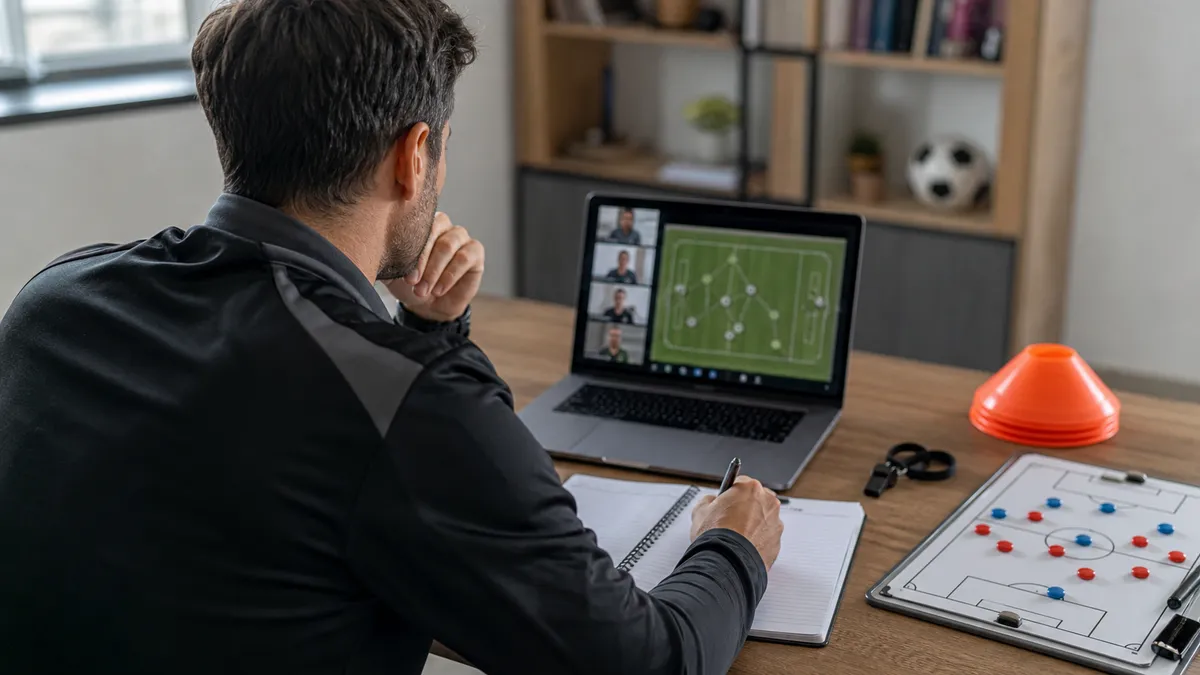
An online football coaching course in Spain only qualifies you to coach officially if it carries formal recognition. A private certificate can help you learn but on its own usually does not allow you to sit on a federated team's bench.
- UEFA federation licence (C, B, A or Pro) issued by the RFEF.
- Sports Technician qualification recognised by the education authority.
- A course accepted by the specific competition where you want to register.
- Private certificate (€150–190): useful for learning, not enough on its own.
- The decisive question before paying: does this let me register on a bench? If not, it is supplementary training.
The short answer: check the qualification it gives you
What matters first is not whether the course is online, cheap or intensive, but what document you receive at the end and who recognises it. If the course leads to a UEFA licence, a Sports Technician qualification or training required by a specific federation, it may count within that scope.
If the course only provides a private certificate of attendance, completion or methodology, it may be useful for learning, improving your CV or preparing better sessions, but you should not assume it lets you register as a coach. Before paying, ask in writing which categories you will be able to coach and where that validity can be checked.
Spain has two main pathways: the UEFA federation pathway and the academic Sports Technician pathway. Alongside them, there are private continuing education courses. Confusion starts when marketing mixes all three and candidates believe any online diploma equals a licence. If you arrive with a private course and want to know what it convalidates inside the official TD, see the Sports Technician convalidations.
Three types of online courses that are often confused
- Federation courses: These are courses run by federations or schools linked to the UEFA pathway. They may include online parts, but they must clearly state the licence, requirements, practical work, assessment and responsible body.
- Sports Technician courses at authorised centres: These are official sports education programmes. Some blocks may be distance-based or blended, but the centre must be authorised and the qualification must carry academic and professional recognition.
- Private methodology courses: They may be good for learning analysis, drills, leadership or physical preparation. The issue is not that they are private, but presenting them as equivalent to a federation licence when they are not.
A private course is not necessarily bad. It can be a good investment if you want to improve as a coach, prepare for a club interview or understand grassroots football better. But paying for learning is different from paying because you think you will receive official eligibility.
Checklist before paying for an online course
Before entering your card details, check these points. If the school cannot answer clearly, pause the decision.
- Exact name of the diploma: It is not enough for it to say "football coach". It must state whether it is UEFA C, UEFA B, Sports Technician, Sports Technician Superior or private training.
- Body that recognises it: Ask whether it is recognised by the RFEF, your regional federation, an autonomous community, an authorised centre or only the company selling the course.
- Categories where it works: Ask for a concrete answer: grassroots, regional, national, futsal, assistant, monitor or complementary training. Compare it with what each licence allows.
- Practical work and assessment: Courses that enable official coaching usually require real assessment, practice hours, attendance and access requirements. A course completed in a few hours with an automatic quiz rarely equals a licence.
- Total price: Check enrolment, fees, insurance, practical placement, diploma issue and possible later payments. Compare it with typical football coaching course prices in Spain.
The coach's Sunday summary
Open course calls, up-to-date guides and new posts. Free, with one-click unsubscribe.
Leave your email and get the next issue:
Warning signs in cheap courses
Cheap €150-190 courses often appear for searches like "official online football coaching course" or "get football coach licence online". Some are honest training products, but others use very ambiguous language.
- It promises an "official title" without naming the body: If there is no federation, authorised centre or regulation, be careful.
- It avoids saying which licence you get: A valid course should not hide whether it gives UEFA C, UEFA B, Sports Technician or a private certificate.
- It says "valid for coaching" without categories: Coaching under-8s, regional cadets or a national-level team does not require the same qualification.
- It does not mention practice hours or real assessment: A 100% online format is attractive, but enabling training usually includes genuine supervision.
- It uses federation names or logos unclearly: Always verify on the official federation or centre website, not only on the commercial landing page.
The practical rule is simple: if the course does not let you verify its validity before paying, treat it as complementary education, not as a route to coach registration.
Blended UEFA C: does it count the same as in-person?
Yes. The UEFA C licence is issued by your regional federation under the RFEF programme, and it is the same regardless of class format, as long as the course is an official federation call processed through academia.rfef.es. What changes between in-person and blended delivery is the format: theory is taught by video call or virtual campus, while in the calls we reviewed, field practice stays in person.
Several regional federations already run the UEFA C with an online part, each with its own split of hours, exam format and price. We gather the verified calls, federation by federation, in Blended UEFA C: online hours, exam and price by federation.
Outside those federation calls, coach registration does not depend only on the course either: it depends on the competition, the category and your federation's current rules for that season. Always confirm with your club which specific licence it requires before enrolling.
What to do if you already bought a doubtful course
First, do not throw everything away. If the content is good, use it to improve your sessions, tactical language and confidence in front of a group. Learning has value even when the certificate is not enabling.
Then ask the school for a written answer about the diploma's validity: exact name, body that recognises it and categories where it works. With that answer, contact your regional federation or the club where you want to coach. The question must be specific: "Can I register for this category with this document?"
If the answer is no, use the course as a complement and plan the correct route: UEFA C licence if you start through the federation pathway, or Sports Technician if you choose the academic pathway. The expensive mistake is not doing a private course; it is repeating the mistake without checking the next enrolment.
About the author

Content created by RutaMister based on practical experience, editorial review and a training-focused approach for grassroots football coaches.
Frequently asked questions
Can a cheap online course let me register as a coach?
Only if it gives a licence or qualification recognised by the federation that processes your registration. A cheap private certificate can help you learn, but it is usually not enough to coach a federated team. Before paying, ask which exact category you will be able to coach.
Can a 100% online coaching course be official?
It can include online parts, but validity depends on the body running the course, the final diploma, assessment and practical work. Online delivery does not automatically invalidate it. What you must verify is whether it leads to UEFA licence, Sports Technician status or training accepted by your federation.
What is the difference between a private certificate and a UEFA licence?
A UEFA licence belongs to the federation pathway and may allow you to coach depending on category and regulations. A private certificate proves you completed a specific course, but it does not always carry federation effects. It may help your CV, though it does not replace a required licence.
How do I check whether an online course is recognised?
Ask for the exact title name, responsible body and categories where it allows coaching. Then verify it with your regional federation, the RFEF or the authorised centre that supposedly backs it. If nobody can confirm it in writing, treat the course as complementary training.
What should I do if I already paid for a course that does not count?
Use the content as training, but do not present it as a licence if the federation does not accept it. Ask the school for written clarification and check your case with the club or federation. Then plan the right pathway: UEFA C, Sports Technician or another required qualification.
Does the blended UEFA C count the same as the in-person course?
Yes. The UEFA C licence issued by your regional federation is the same whether the course is in-person or blended, as long as it is an official call published on academia.rfef.es. What changes is the class format (online theory, in-person practice and exam), not the qualification or the categories it allows.
Where can I take a grassroots football coaching course online?
In the federation calls we reviewed, there is no 100% online UEFA C in Spain: they always include an in-person field-practice component. The closest option is the blended courses run by federations such as Aragón, Catalonia or Andalusia. 100% online courses from private academies do not grant a federation licence.