Football coaching access tests in Spain: what they ask and how to prepare
The access tests for Sports Technician in Football (Level 1) in Spain are called by each autonomous community and have two parts, both compulsory.
- Fitness test: 5 exercises: 50 m sprint, 2,000 m run, vertical jump, flexibility and medicine ball throw.
- Technical circuit with a ball: 9 exercises in 3 minutes or less with an average score of 5 or higher. The result is pass or fail.
- Academic requirement: secondary education (ESO) or an academic equivalent.
- Age: the specific test sets no minimum age.
- Validity: 18 months, valid across Spain.
What the access tests are and who needs them
The access tests are a mandatory requirement to enrol in the Sports Technician in Football diploma (academic pathway). They are regulated by Annex II of Royal Decree 320/2000 and by Royal Decree 1363/2007. They do not apply to the UEFA federation pathway, which has its own admission process managed by each regional federation.
To take the first level you need two things: the ESO secondary education certificate or an academic equivalent, and a pass in the football specific test. That specific test sets no minimum age in national rules, and some calls admit 4th-year ESO students with a statement of responsibility (Murcia, 2026). The age of 17 (reached, or reached within the calendar year, depending on the call) applies only to the general access test for Grado Medio, the route for entering without ESO. Some calls also ask for a medical fitness certificate (Murcia, 2026).
The test is called and supervised by the education authority of each autonomous community, which sets the venue and appoints the panel. National rules require at least one call per year; Catalonia, for example, had four registration periods in 2025-26. Check your region's education website for dates and venue. Registration is paid: 49.25 EUR in Catalonia (2025-26) and 42.04 EUR in Murcia (2026). For the full cost of the course, see fees and costs.
Part 1: fitness tests, 5 exercises with minimum marks
The first part assesses general physical fitness. You do not need to be an elite athlete: the marks are designed to confirm you can follow the course. But if you have been inactive for a while, preparation is advisable.
The five exercises and their minimum marks (Annex II of Royal Decree 320/2000) are:
- Speed (50 metres): Under 8 seconds (men) or 8.5 seconds (women).
- Endurance (2,000 metres): Under 10 minutes (men) or 12 minutes (women).
- Vertical jump: At least 45 cm (men) or 35 cm (women).
- Flexibility (trunk flexion): Barefoot, standing on a flexometer, bend the trunk without momentum and pass the arms between the legs as far back as possible. At least 30 cm (men) or 35 cm (women).
- Medicine ball throw: Over 6 metres (both), with a 5 kg ball (men) or a 3 kg ball (women).
You must pass all the exercises in this part. There is only one attempt per exercise, and to be declared fit you must also pass the second part. The panel sets the order of the exercises.
Part 2: technical circuit with the ball
The second part is a technical circuit on a regulation-size football pitch that tests your ball control under time pressure. Each examiner scores the overall circuit from 1 to 10. To pass you need an average of 5 or higher and a time of 3 minutes or less. The final result of the test is simply pass or fail.
According to Annex II of Royal Decree 320/2000, the circuit includes these 9 exercises, in this order:
- Long pass.
- Straight-line dribbling: Speed and control without losing the ball.
- Zigzag dribbling: Weave through 4 obstacles spaced 2 metres apart.
- Shot on goal: Strike from outside the box.
- Aerial dribbling (dynamic skill): Pick up the ball from the back of the goal and carry it in the air to the edge of the box.
- Precision shot: Strike into a small goal (2×1 metres) placed on the touchline.
- Control and wall pass (1-2): Control a ball played by a partner, play a wall pass and dribble with a change of direction.
- 50 cm hurdles: Push the ball under one hurdle and jump over it; without stopping, push the ball over another hurdle 5 metres further on and pass under it.
- Three shots on goal from outside the box.
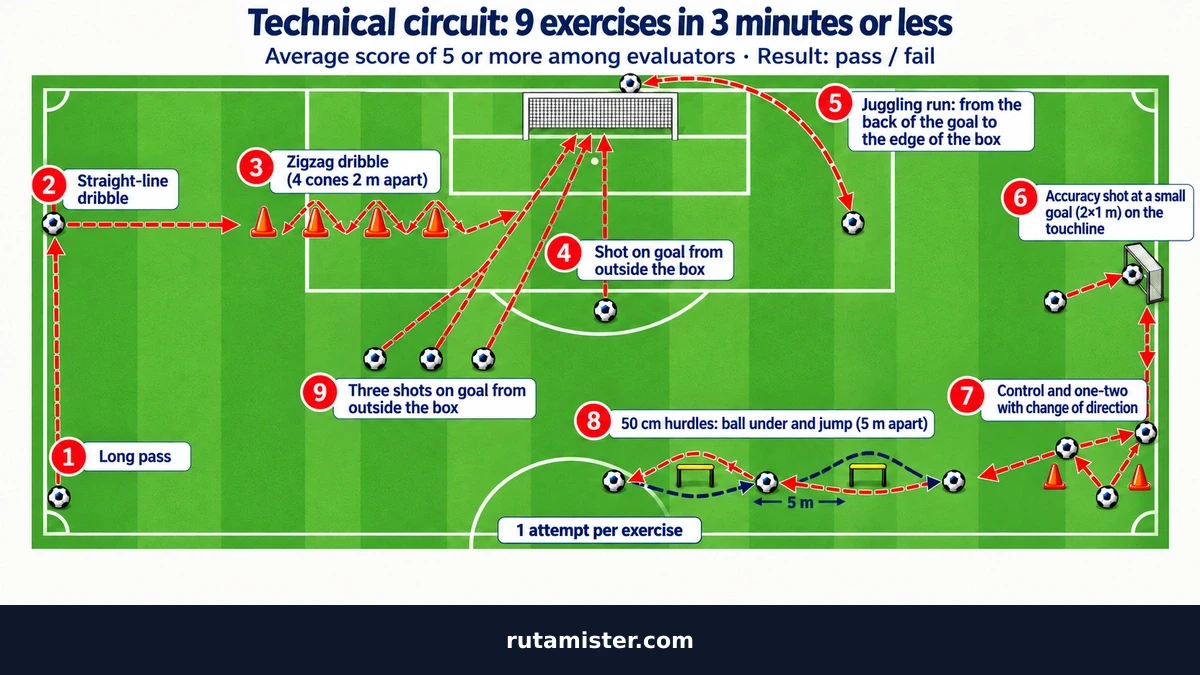
Because each examiner scores the circuit as a whole, prioritise technical cleanliness: a controlled circuit within the time limit is worth more than a rushed one with several losses of possession.
How to prepare for the fitness tests in 4-6 weeks
If you already exercise regularly, the marks are achievable with a few targeted sessions. If you have been inactive for months, allow at least 4-6 weeks of specific preparation.
- 50m sprint: Do 30-60 metre sprints, 6-8 reps with full recovery (2-3 minutes). Twice a week. Focus on the start: practise your reaction and the explosive first 10 metres.
- 2,000m run: Run 3 times a week, alternating steady runs (20-30 min at comfortable pace) with 400m intervals at target pace (2 min per lap). You will see improvement within 4 weeks.
- Vertical jump: Work on squats, lunges and box jumps. 3 sets of 8-10 reps, twice a week. Vertical jump responds quickly to basic plyometrics.
- Flexibility: Static hamstring and posterior chain stretches, 15-20 minutes daily. This is the easiest test to improve and the one most people neglect.
- Medicine ball throw: Practise the technique: feet apart, knee bend, explosive throw coordinating trunk and arms. With a 5 kg ball (men) or a 3 kg ball (women), 3 sets of 5 throws.
The coach's Sunday summary
Open course calls, up-to-date guides and new posts. Free, with one-click unsubscribe.
Leave your email and get the next issue:
Common mistakes in the technical circuit
The technical circuit is where most candidates struggle, not from lack of ability, but from nerves and poor time management. These are the mistakes that cost the most points:
- Starting too fast: Many candidates sprint from the first station and lose the ball in the zigzag. Start controlled and accelerate from the third exercise onwards.
- Neglecting the long pass: It is the first exercise in the circuit, so it pays to start well. Practise 20-25 metre passes with your instep.
- Losing the ball during aerial dribbling: Examiners score the circuit as a whole, so losing control lowers your mark. Practise keep-ups with both feet while moving, not standing still.
- Missing the precision shot: The small goal (2×1m) looks easy, but time pressure makes it tricky. Aim for the centre, not the corners.
- Failing to communicate during the wall pass: The control and pass with a partner requires verbal coordination. Call before you pass and orient your body towards where you will dribble next.
Validity of the test and exemptions
A pass is valid across Spain and has a validity of 18 months counted from the date the test ends (article 9 of Royal Decree 320/2000).
Under article 33 of Royal Decree 1363/2007, people with the status of top-level or high-performance athlete are exempt from the specific requirements. Each call specifies how to prove it. As an example, the 2026 Murcia call also exempted anyone who, in the last two years, had been part of a squad for at least one season in a national-category competition, with an RFEF certificate. That case is not general: it depends on the call.
What happens if you fail
Failing does not close the door. The test is called at least once a year in each region (several times in Catalonia), and national rules set no limit on attempts; confirm it in your region's call. Each attempt requires paying the registration fee again.
To be declared fit you must pass both parts, and there is only one attempt per exercise within each test. If you fail, you will know which mark or exercise let you down and can focus your preparation on it for the next call.
If you fail the technical circuit, check the call for the window to appeal the marks and, where possible, ask which aspects were penalised most. You can also consider the UEFA federation pathway as an alternative: the admission process and training focus are different.
Either way, there is no rush. Many active coaches needed two attempts to pass. Start the journey and do not let one result stop your decision.
About the author

Content created by RutaMister based on practical experience, editorial review and a training-focused approach for grassroots football coaches.
Frequently asked questions
How many times a year can I sit the access tests?
It depends on the autonomous community, which calls the tests. National rules require at least one call per year; Catalonia, for example, opened four registration periods in 2025-26. National rules set no limit on attempts, but each registration carries a fee. Confirm the calendar on your region's education website.
Are the fitness tests the same in every region?
Yes in essentials. The exercises, marks and assessment criteria are set by Annex II of Royal Decree 320/2000, and Royal Decree 1363/2007 regulates access. Each region sets the venue, calendar, fee and paperwork, so the practical organisation of the circuit can vary from one call to another.
What do I need to bring to the test?
According to Andalusia's 2025-26 guide, you must bring your original ID card in physical format and sportswear, with trainers for the fitness tests and football boots for the technical ones. Some calls also ask for a medical fitness certificate, such as Murcia's in 2026. Always check your region's call.
Can I access the course without secondary education if I have playing experience?
Playing experience does not replace the academic requirement. You need the ESO, an academic equivalent, or a pass in the general Grado Medio access test. That test requires age 17, reached or reached within the calendar year depending on the call.
Are the minimum marks the same for men and women?
No. Women have wider times for speed (8.5 s vs 8 s) and endurance (12 min vs 10 min), and a lower bar for vertical jump (35 cm vs 45 cm). Flexibility asks more of them (35 cm vs 30 cm). The medicine ball must travel over 6 m for both, weighing 5 kg (men) or 3 kg (women).
How long is the test valid and who is exempt?
A pass has an 18-month validity and is valid across Spain. Under article 33 of Royal Decree 1363/2007, top-level and high-performance athletes are exempt from the specific test. Some calls add other cases, such as national-category players in Murcia in 2026.
Sources
- Royal Decree 320/2000, Annex II: specific tests for Football (BOE)
- Royal Decree 1363/2007: general organisation of sports education (BOE)
- Resolution of 9 April 2026: Football and Futsal tests in Murcia (BORM)
- Proves específiques d'accés als ensenyaments esportius (Generalitat de Catalunya)
- Student guide: Football Level I specific test 2025-2026 (Junta de Andalucía)
- Maturity and specific tests 2026-2027 (Junta de Extremadura)