Luis de la Fuente: from U21 to senior Spain, the method behind two Euros
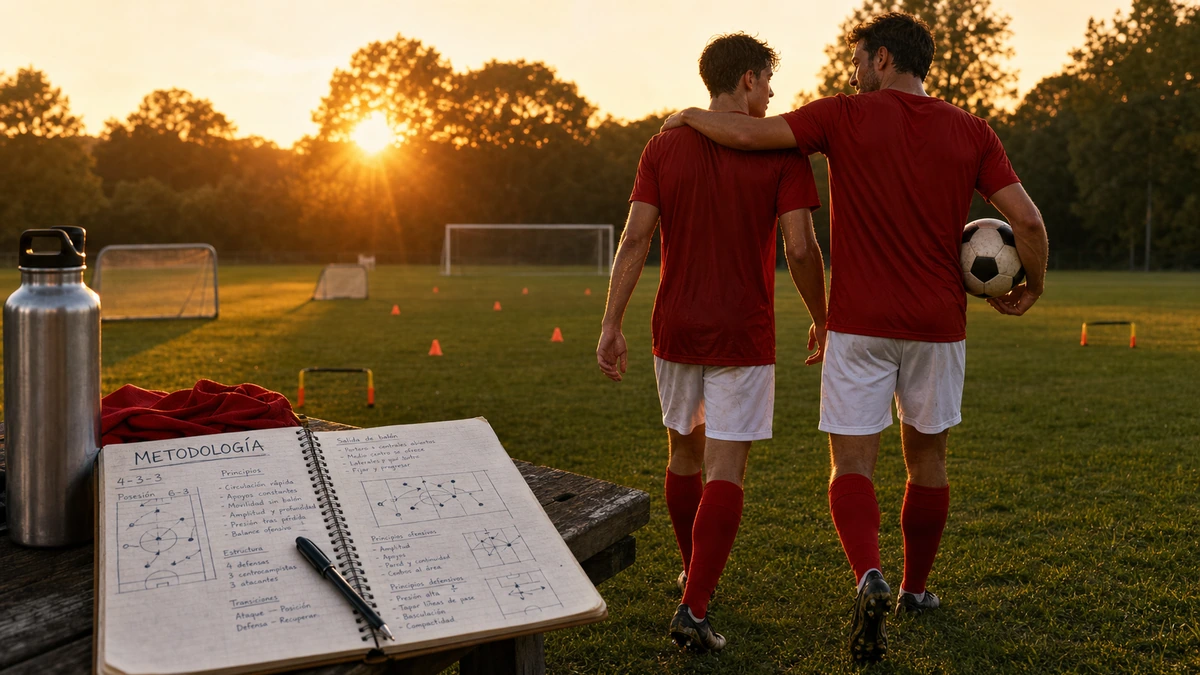
Luis de la Fuente worked inside the Spanish Football Federation from 2013. When he took over the senior side in December 2022, he already knew most of the eventual title-winning players. Methodological continuity explains why Spain competed from day one.
- U-19: 2015 European champion.
- U-21: 2019 European champion (2-1 vs Germany in the final).
- Olympic team: silver medal in Tokyo 2020.
- Inherited core: Fabián Ruiz, Dani Olmo, Mikel Oyarzabal, Mikel Merino and Unai Simón, all developed in the youth set-up.
- Senior outcome: Euro 2024 with the same group he had coached years earlier.
A decade inside the federation: the path step by step
When the public attaches the Euro 2024 success to Luis de la Fuente's individual name, important context is missing. He didn't arrive from outside with a revolutionary idea, he is a coach who had been inside the Spanish federation for nearly a decade working with several consecutive generations of Spanish players before taking the senior job.
His federation timeline is sequential and covers three stages:
- U19 (2013-2018): starts as an assistant and finishes by winning the 2015 U19 European Championship, played in Greece.
- U21 (2018-2022): four years in charge of the category, ending with the 2019 U21 European Championship in Italy and San Marino, where Spain won their fifth U21 title, defeating Germany 2-1 in the final.
- Olympic team (2021): leads Spain at the Tokyo 2020 Olympics (held in 2021 due to the pandemic), winning the silver medal after losing the final to Brazil.
- Senior team (since December 2022): with the 2023 Nations League and Euro 2024 trophies on his record.
This sequence explains why he reached the senior team without having to invent a side: by 2022 he had already worked directly with most of the players he would inherit from the Luis Enrique era. For the full background, see the Luis de la Fuente career.
The 2015 U19 European Championship: the first title
De la Fuente's first major federation title arrived in the summer of 2015 in Greece with the U19 European Championship. Spain were crowned European champions in a generation that was already showing promise and ended up sending several players into Spanish professional football (Mikel Oyarzabal among the most visible).
The U19 project let De la Fuente refine two ideas that would later appear in his senior sides: the methodological continuity between camps (a U19 group only meets six or seven times a year, so there's no room to improvise) and the importance of the competitive environment (players arrive from very different clubs and a common tactical language has to be built fast). These traits later distinguished his federation work from coaches arriving from clubs.
The 2019 U21 Euro: the game that predicted the senior model
The second major title came on 30 June 2019 in Udine, Italy. Spain beat Germany 2-1 in the U21 European Championship final to become continental champions for the fifth time (a record at the time, shared with Italy).
The story of the game is telling. Fabián Ruiz opened the scoring in the 8th minute after a deep carry through the middle: he picked up a ball from build-up, beat the German pivot and finished low across the goalkeeper from the edge of the box. Dani Olmo scored the second a few minutes later after an assist from Mikel Oyarzabal. It is exactly the attacking structure we saw five years later at Euro 2024: associative winger finding the free interior through the middle, late runs into the box, far-corner finish.
After the title, Fabián Ruiz was named Player of the Tournament. Olmo and Oyarzabal were locked in as future references. And Luis de la Fuente saw confirmation of the plan he would later take to the senior side: play through the middle, give the creative interior the spotlight, build numerical superiority with full-backs pushing up asymmetrically.
Tokyo 2020: Olympic silver with a transition team
The third federation step was leading Spain at the Tokyo 2020 Olympics (played in 2021). Spain claimed silver after losing the final to Brazil 2-1 in extra time (7 August 2021).
The Olympic team allows three over-23 reinforcements and forced De la Fuente to integrate senior-level profiles with his federation generation. The squad included names like Pedri, Mikel Oyarzabal, Marco Asensio, Dani Olmo, Mikel Merino, Eric García, Unai Simón, Pau Torres and Rafa Mir, all of them later relevant to the senior side.
Reaching an Olympic final, two years after the U21 title, confirmed that the federation bloc could compete against teams made up of established international players. It was the final proof that De la Fuente's model worked with mature profiles, not only with the youngest category.
The coach's Sunday summary
Open course calls, up-to-date guides and new posts. Free, with one-click unsubscribe.
Leave your email and get the next issue:
Who crossed from the U21 to the Euro-winning senior side
One of the questions that best explains the Euro 2024 success is this: how many players from that federation bloc carried on with De la Fuente into the senior side? The overlap is high and it's worth looking at by name:
| Player | Federation stint with De la Fuente | Role at Euro 2024 |
|---|---|---|
| Unai Simón | U21 (2017-2019), Tokyo 2020 | Undisputed starting goalkeeper |
| Fabián Ruiz | 2019 U21 champion (Player of the Tournament) | Starting interior, MOTM vs Croatia |
| Dani Olmo | 2019 U21 champion (scorer in the final), Tokyo 2020 | Interior after Pedri's injury, Spain's top scorer |
| Mikel Oyarzabal | U19 2015, 2019 U21 champion, Tokyo 2020 | Rotation forward, scored the 2-1 in the final |
| Mikel Merino | U21, Tokyo 2020 | Midfielder, decisive goal at 119' vs Germany |
| Pedri | Tokyo 2020 | Starting left interior |
The most striking fact is that the decisive goals in the big games at Euro 2024 were scored by former federation players of De la Fuente: Merino (vs Germany, 119'), Olmo (assist to Williams in the final) and Oyarzabal (2-1 in the final). The bloc isn't an accident: it's a generation cohesive over years under the same head coach before reaching the senior side. How that continuity plays against the previous cycle, and where it breaks from it, is unpacked in the comparison between De la Fuente and Luis Enrique.
What transfers from youth to elite (and what doesn't)
De la Fuente's success opens an interesting question: what can be transferred from youth football to the top level and what can't? His career leaves useful answers for grassroots coaches:
- Playing principles transfer. The 4-3-3 with single pivot, the 3-2 build-up with an asymmetric full-back, the oriented press to one side are all ideas that already worked in the U21 side. The elite doesn't invent them, it consolidates them.
- Common technical language transfers. When players already know the vocabulary ("play to the pivot", "link the interior", "drop to receive"), sessions pay off faster with fewer camp days. Youth football is where that language gets built.
- Tactical confidence transfers. A player who already understood a system under a specific coach needs less adaptation time. That's why Fabián Ruiz was key from day one under De la Fuente at senior level.
- Margin for error doesn't transfer. In youth football, a bad first touch in build-up can be a coaching opportunity. In the elite, a bad first touch in build-up against Germany can be a goal conceded and elimination. Decision speed and competitive pressure are differences you can only learn by competing.
- Physical condition doesn't transfer. The match intensity at a Euro is radically higher than at a U21 tournament. Principles stay, distances and intensities change.
The editorial point is that youth football is not "less demanding" than elite football: it's demanding in a different way. It builds the habits the elite simply takes for granted.
Lessons for grassroots football coaches
If a grassroots coach treats De la Fuente's career as a case study, there are five lessons that apply directly to daily work:
- 1. Build a clear, repeatable vocabulary. His players have spoken the same tactical language since the U21 days. At grassroots level, that means naming concepts with simple words and keeping them for seasons: "passing lane", "body shape", "attack the space". Repetition of the vocabulary matters more than sophistication.
- 2. Prioritise behaviours over phrases. Saying "we play out from the back" isn't enough: you have to design tasks that force exactly that pattern and let you correct it. De la Fuente built those habits over years in youth football before demanding them at the elite level.
- 3. Be patient with individual development. Pedri, Yamal and Cubarsí reached the senior side at 18, 16 and 19 respectively. But before that they had hundreds of minutes in their clubs and, in some cases, in youth categories. Precocity isn't improvisation, it's accelerated preparation.
- 4. Recognise bench value. Mikel Merino scored the most important goal of Euro 2024 coming off the bench. At grassroots level, giving minutes to the substitutes and rotating builds depth that one day will be needed.
- 5. Professionalise observation. De la Fuente and his staff have files on U15 players who later end up in the senior side. At grassroots level, taking systematic notes on the kids (what they understand, what they struggle with, where they are in their learning curve) makes a real difference in the medium term.
None of these lessons is spectacular or immediate. All of them are cumulative, and all of them depend on the continuity of the coach in the role. That is exactly what De la Fuente did for ten years in the federation before winning the Euro.
From study to practice: how to become a coach in Spain
Turning all of this into work on the pitch needs formal training. In Spain there are two main routes to a coaching qualification: the Técnico Deportivo en Fútbol diploma (governed by the education system) and the UEFA C, B, A and Pro licences (federation route, the ones used by professional coaches). They're connected but follow different administrative paths. Here is the full comparison between Técnico Deportivo and UEFA licences.
For someone starting from zero with kids in a school or grassroots club, the usual order is: Monitor de fútbol (regional intro course, required by most federations), then UEFA C (allows you to coach up to U16 level), and depending on the path you want, on to UEFA B, UEFA A or UEFA Pro. Each licence unlocks specific categories, as detailed in the guide on what you can coach with each licence.
For a step-by-step roadmap with deadlines, fees, requirements and common mistakes to avoid when enrolling, see the master guide on how to become a youth football coach in Spain. The same path De la Fuente walked first as a Técnico Deportivo and then with the UEFA Pro starts, for any new coach, exactly there.
About the author

Content produced by RutaMister from practical experience, editorial review and a training-focused approach for grassroots football coaches.
Frequently asked questions
What trophies did Luis de la Fuente win before the senior side?
He won three federation trophies before the senior team: 2015 U19 European Championship (Greece), 2019 U21 European Championship (Italy, 2-1 vs Germany) and the Olympic silver medal at Tokyo 2020 (played in 2021). That track let him take over the senior side already knowing most of the players he would inherit.
Who played in the 2019 U21 winning side?
The starting XI included players who would later become key in the senior squad: Fabián Ruiz (Player of the Tournament), Dani Olmo (scorer in the final), Mikel Oyarzabal, Unai Simón, Marc Roca, Pau Torres and Carlos Soler, among others. Spain beat Germany 2-1 in the final played in Udine.
How many U21 generation players were at Euro 2024?
At least six players De la Fuente had coached in youth setups were at Euro 2024: Unai Simón, Fabián Ruiz, Dani Olmo, Mikel Oyarzabal, Mikel Merino and Pedri (the last one under him at Tokyo 2020). They scored or assisted the decisive goals of the tournament.
What happened in the Tokyo 2020 Olympic final?
Spain lost 2-1 to Brazil in extra time on 7 August 2021. Mikel Oyarzabal scored the 1-1 that took the game to extra time. The defeat gave Spain the silver medal, their third historic Olympic silver in men's football after Antwerp 1920 and Sydney 2000.
Is the U21 methodology the same as the senior team's?
The principles yes, the details no. The 4-3-3 with a single pivot, building from the back and the oriented press are shared. What changes is execution speed and tolerance for error: in youth football there is room to correct; in the elite, a technical mistake costs a goal or a trophy.
How can I become a grassroots football coach in Spain?
The usual path: Monitor course (introductory, regional), UEFA C (up to U16), UEFA B and, if the trajectory calls for it, UEFA A and UEFA Pro. In parallel there is the Técnico Deportivo en Fútbol route through the education system. The guide on how to become a youth football coach details the steps.
What transfers from youth football to professional football?
What transfers: tactical principles (what to do on the ball, what to do off the ball), the common technical language between players and staff, and the basic defensive habits (body shape, distances, counter-pressing). What doesn't transfer: decision speed, physical intensity and margin for error. Youth football teaches what to do; the elite teaches you to do it faster and better.
Why does De la Fuente trust so many young players?
Because he already knows them. Pedri, Yamal and Cubarsí reached the senior team at 18, 16 and 19, after coming through youth categories De la Fuente was tracking closely. It is not a blind bet: it is a continuous process that starts years earlier in the academy.