Luis de la Fuente: career, method and lessons for coaches
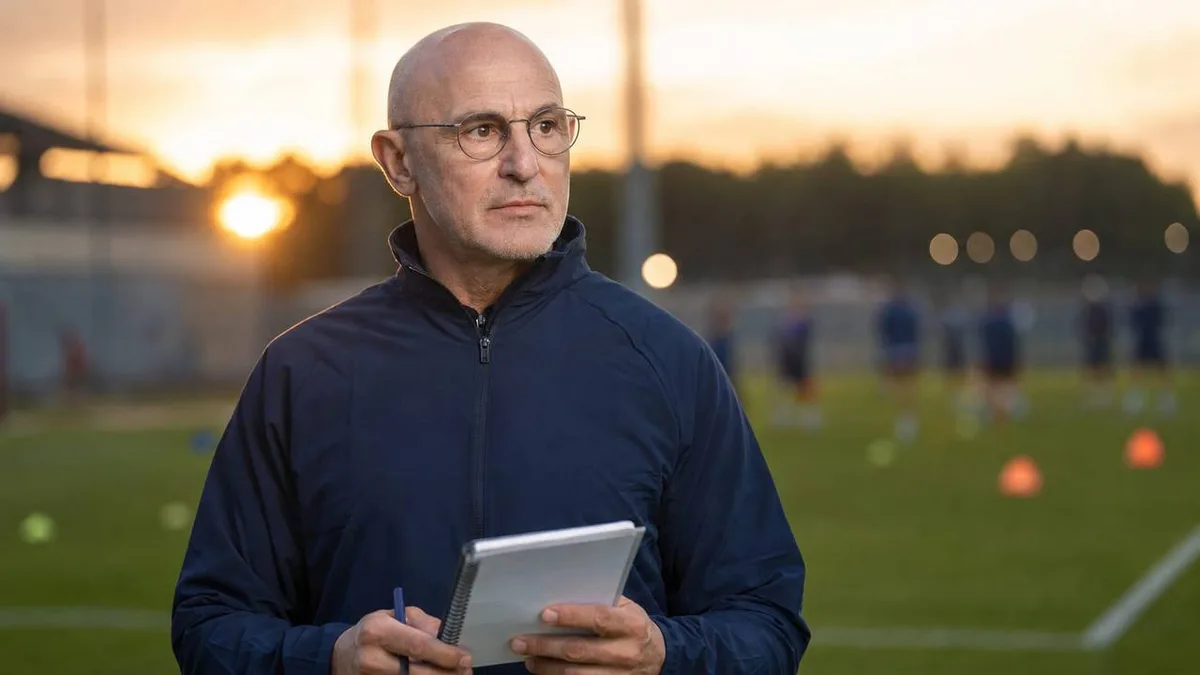
Luis de la Fuente reached the top by accumulating stages, not by skipping them. His path is useful for any coach trying to understand how an elite career is built from the grassroots up.
- Professional player (1980–1994): Athletic Club, Sevilla and Deportivo Alavés.
- First bench in 1997 at Portugalete; later Sevilla youth (where he coached Sergio Ramos), Bilbao Athletic and other reserve teams.
- Spanish FA youth teams: U-19 Euro (2015), U-18 Mediterranean Games gold (2018), U-21 Euro (2019).
- Senior Spain head coach since December 2022: Nations League 2023, Euro 2024 and the 2026 World Cup.
- Lesson for coaches: youth development and elite competition belong on the same coherent path, not on parallel tracks.
A career built step by step
Looking for the biography only: birthplace, age, playing career, every club coached? Read the full Luis de la Fuente biography. This article focuses on what his coaching method teaches other coaches.
Luis de la Fuente does not fit the profile of a coach who suddenly appears in the media spotlight. His path is made of long processes, different contexts and one clear idea: competing without losing sight of player development.
That combination matters. Modern football talks a lot about immediate results, but many solid careers are built far from the noise. De la Fuente's case shows that grassroots work, methodological continuity and group management can end up having an impact at the highest level.
Full career timeline: teams as player and coach
Luis de la Fuente was born in Haro (La Rioja, Spain) on 21 June 1961. This is the complete list of teams he has been part of, first as a player and then as a coach:
- Playing career (1980-1994): Athletic Club (youth and two senior spells, 1980-1987 and 1991-1993), Sevilla FC (1987-1991), Deportivo Alavés (1993-1994).
- Club coaching career (1997-2011): Portugalete (1997-2000), Aurrera de Vitoria (2000-2001), Sevilla FC youth team (2001-2005, with Sergio Ramos and Jesús Navas), Athletic Club Juvenil de Honor (2005-2006), Bilbao Athletic, Athletic Club's reserve side (2006-2007 and 2009-2011), and Deportivo Alavés (July-October 2011).
- Spanish federation roles (2013-2022): Spain under-19 (European champion 2015), under-18 (Mediterranean Games gold 2018) and under-21 (European champion 2019).
- Senior Spain head coach (from December 2022): Winner of the 2023 Nations League, Euro 2024 and the 2026 World Cup.
That sequence explains why his profile is interesting for coaches: it combines professional playing experience, work at modest clubs, youth talent development and elite competition. For the full biographical record (origin, age, playing position) see the full Luis de la Fuente biography, and for the year-by-year list of every team he managed, see all teams Luis de la Fuente has coached.
From professional player to coach
His early years as a young footballer started in the Athletic Club academy, where he made it to the top flight. He moved to Sevilla FC, returned to Athletic in 1991 and closed his playing career at Deportivo Alavés.
That stage as a footballer allowed him to experience demanding dressing rooms, different playing models and the pressure of professional football. For a future coach, that experience brings tactical knowledge and also helps to understand internal dynamics, leadership, roles and difficult moments within a group.
The transition from player to coach never depends solely on football knowledge. It requires learning to observe from the outside, communicating better and making decisions that affect the whole team. In De la Fuente's case, that competitive mindset was an important foundation for building his later profile.
First steps on the bench
His coaching career began in 1997 at Portugalete. He then moved to Aurrera de Vitoria, ran the Sevilla FC youth team for four seasons (coaching Sergio Ramos and Jesús Navas), one season at the Athletic youth team, two spells at Bilbao Athletic (2006-2007 and 2009-2011) and a brief stint at Deportivo Alavés in 2011. It was not a direct route to the elite, but a long learning phase in very different environments.
That period is especially interesting for grassroots coaches. In those contexts, the coach prepares matches but must also develop players, adapt to limited resources, manage expectations and sustain an idea even when results do not always follow.
That is where a fundamental part of the job is learned: organising daily work. A coach grows when he understands that methodology is not an abstract word, but the concrete way in which he prepares sessions, corrects, communicates and makes decisions week after week.
2011-2013: unemployment and a newspaper ad
Between the club stage and the federation stage there is a stretch that almost no career summary includes. In October 2011, after nine matchdays, Deportivo Alavés dismissed him. The calls stopped coming and he spent around a year and a half without a bench. The way back did not come from a boardroom or an agent: in 2013 he found a newspaper ad in which the Royal Spanish Football Federation was looking for a coach for its youth national teams. He called Iñaki Sáez, the former Spain manager who knew him well, submitted his CV and went through several interviews.
The offer was minimal: a three-month contract signed on 1 May 2013, with one specific mission: qualifying the under-19 side for the European Championship in Lithuania, and no guarantees beyond that stage. He accepted it and treated the assignment as if it were permanent. Everything that came later (the 2015 U-19 Euro, the under-21s, the senior team, the 2026 World Cup) hangs from that signature.
For a grassroots coach this stretch is as instructive as any title, because it describes a situation almost every coach goes through and almost nobody prepares for. It leaves three practical ideas: unemployment is part of a coaching career, and it is easier to get through with a routine of your own (keep watching football, maintain your network, keep your CV up to date); real opportunities rarely arrive well wrapped, and a short contract in a category nobody watches can be the right door; and a small assignment forces you to define what you can prove in a short time. De la Fuente did not sign for a project: he turned a three-month assignment into one.
The move to the Spanish Football Federation
In 2013, De la Fuente joined the structure of the Royal Spanish Football Federation. That step changed the scale of his work, but not its essence. He entered an environment where the focus was on detecting talent, supporting young generations and competing in the most demanding tournaments.
With the under-19 team he won the 2015 European Championship. He later earned gold at the 2018 Mediterranean Games with the under-18s and won the 2019 Under-21 European Championship. That sequence is not explained by good players alone: there is also a recognisable working method.
In youth national teams, the coach has little time to build a team. He must select well, communicate quickly and get players to understand a common idea in just a few days. That ability to simplify without impoverishing the game is one of the keys to his evolution.
The coach's Sunday summary
Open course calls, up-to-date guides and new posts. Free, with one-click unsubscribe.
Leave your email and get the next issue:
Spain's senior head coach
In December 2022 he was appointed head coach of Spain's senior national team. His arrival was not a total break, but a natural evolution within the federation's work. He knew many players from youth categories and understood the competitive model of the national team.
Since then, Spain has maintained a playing idea based on balance, control, young talent and competitive ability. The 2023 Nations League, Euro 2024 and 2026 World Cup titles reinforced his standing, but the value of his career goes beyond those results. The world title is broken down rival by rival in De la Fuente's plan against every rival.
His merit lies in having transferred lessons from development football to a context of maximum pressure. In a senior national team there is not much time to train. That is why clarity of message, group management and methodological coherence become decisive.
Tactical method: 4-3-3, pressing and 3-2 build-up
Luis de la Fuente usually builds Spain from a recognisable 4-3-3, with wingers holding width and associative interiors appearing between the lines. It is not slow possession for its own sake: the aim is to attract, progress and arrive with numbers in finishing zones without splitting the team.
In build-up, Spain can form a 3-2 structure: one full-back stays deeper, the free centre-back carries the ball and the holding midfielder stays close to provide continuity. That base helps beat the first press and lets the interiors receive facing forward or behind the rival holding midfielder.
Out of possession, the high press is guided by clear references: closing the inside pass, jumping to a centre-back or full-back when the opponent body shape is poor and activating counter-pressing after loss. Defensive transition is central to the plan: if Spain loses the ball near the rival box, it tries to bite quickly before dropping off.
What explains his success as a coach
Several factors help explain his journey:
- Patience. De la Fuente did not reach the elite through a sudden leap, but through an accumulation of experiences. He went through clubs, reserve teams and youth national sides before taking charge of the senior team.
- Understanding of the young player. Having worked for years with youth categories gave him a precise view of maturation processes, competitive adaptation and talent management.
- Continuity. His career shows a recognisable idea: organised teams, importance of the group, trust in development and the ability to compete without losing structure.
- Adaptability. Coaching a modest club is not the same as managing a national team. Nor is developing players the same as competing for titles. His career demonstrates the ability to adjust the message without losing identity.
What grassroots coaches can learn
Luis de la Fuente's career offers several useful lessons for coaches who are starting out or working in development football:
- There is no need to rush. Every stage contributes something if it is used well. Coaching in small contexts also builds judgement, character and adaptability.
- Methodology matters when it becomes habit. Having a nice idea is not enough. You need to know how to turn it into sessions, corrections, standards and repeatable decisions.
- Development and competition are not opposing paths. A good development process must also teach players to compete, handle pressure and make decisions in real contexts.
- A coach must sustain an identity. Adjusting details to the group is necessary, but losing the thread of work every week prevents building anything solid.
Conclusion
Luis de la Fuente's career sums up one idea: solid projects need time, judgement and continuity. It cannot be understood only through the titles he won, but through the previous journey that allowed him to arrive prepared at the elite level.
Although immediate impact is often what counts, his path reminds us that a coach is built step by step. First he learns to compete, then he learns to develop, later he learns to manage talent and, if he maintains a coherent line, he can transfer all that knowledge to the highest level.
About the author

Content produced by RutaMister from practical experience, editorial review and a training-focused approach for grassroots football coaches.
Frequently asked questions
Where was Luis de la Fuente born?
Luis de la Fuente was born in Haro, in Spain's Rioja Alta. He trained as a player at Athletic Club, where he debuted in the top flight, and later built his entire coaching career in Spain, from modest clubs and the national youth setup all the way to the senior national team bench.
Which teams has Luis de la Fuente coached?
Luis de la Fuente has coached Portugalete, Aurrera de Vitoria, the Sevilla FC youth team (where he coached Sergio Ramos), the Athletic youth team, Bilbao Athletic in two spells and Deportivo Alavés. He then managed Spain's under-19, under-18 and under-21 sides at the federation, before becoming senior head coach in December 2022.
Why is Luis de la Fuente's career interesting for coaches?
It is interesting because it shows a progression from development football to the elite while keeping methodological continuity. For a coach, Luis de la Fuente is a useful case for understanding patience, young talent management and coherence in highly competitive environments.
Which titles did Luis de la Fuente win with Spain's senior team?
With Spain's senior national team, Luis de la Fuente won the 2023 Nations League, Euro 2024 and the 2026 World Cup. Those titles consolidated a period defined by young talent, competitive balance and a recognisable playing idea, achieved under very high media pressure and after a difficult start that many had used to question his appointment.
What can grassroots coaches apply from his method?
Grassroots coaches can apply three ideas: give continuity to what they train, adapt the plan to the real profile of their players and compete without abandoning development. The practical value is creating stable habits, not copying elite systems without context.
Does playing experience help someone become a better coach?
Playing experience can help because it brings dressing-room awareness, understanding of pressure and knowledge of competitive rhythm. But it is not enough on its own: a coach needs method, communication, analysis and the ability to turn that experience into useful decisions for the group.
When was Luis de la Fuente born?
Luis de la Fuente was born on 21 June 1961. That date helps frame his career: first a long spell as a professional player, then club coaching in modest environments and finally a long rise through the Spanish federation.
How old is Luis de la Fuente?
Luis de la Fuente is 65 years old (he turned 65 on 21 June 2026). His age matters because his appointment was not a sudden trend: it followed decades of work as a player, club coach, youth national-team manager and, eventually, Spain senior head coach.
Who is Luis de la Fuente married to?
Luis de la Fuente keeps his family life very private and rarely makes it part of his public profile. From a coaching perspective, the useful focus is his professional pathway, federation work and the way he manages high-performance groups under national-team pressure.
What trophies has Luis de la Fuente won?
Luis de la Fuente has won the 2015 European Under-19 Championship, Mediterranean Games gold in 2018, the 2019 European Under-21 Championship, the 2023 Nations League, Euro 2024 and the 2026 World Cup with Spain senior team, his third major title with the senior side.
What is Luis de la Fuente next match with Spain?
Luis de la Fuente next match depends on Spain official calendar and each FIFA window. To read it properly, look at opponent, squad list and competitive context, not only the date. His Spain usually keeps a stable idea while adjusting profiles to player availability.
How much does Luis de la Fuente earn?
The exact salary of Luis de la Fuente can change through contract terms, bonuses and renewals, so any figure should be treated as approximate unless it comes from an official source. For coaches, the important lesson is that his professional value was built before the senior spotlight.
Since when has Luis de la Fuente coached Spain?
Luis de la Fuente has been Spain senior head coach since December 2022. His appointment was a natural continuation of his federation work, where he had already coached several young Spanish generations before competing and winning with the senior team.