Ceuta, land of football: the story behind the return to Spain's second tier
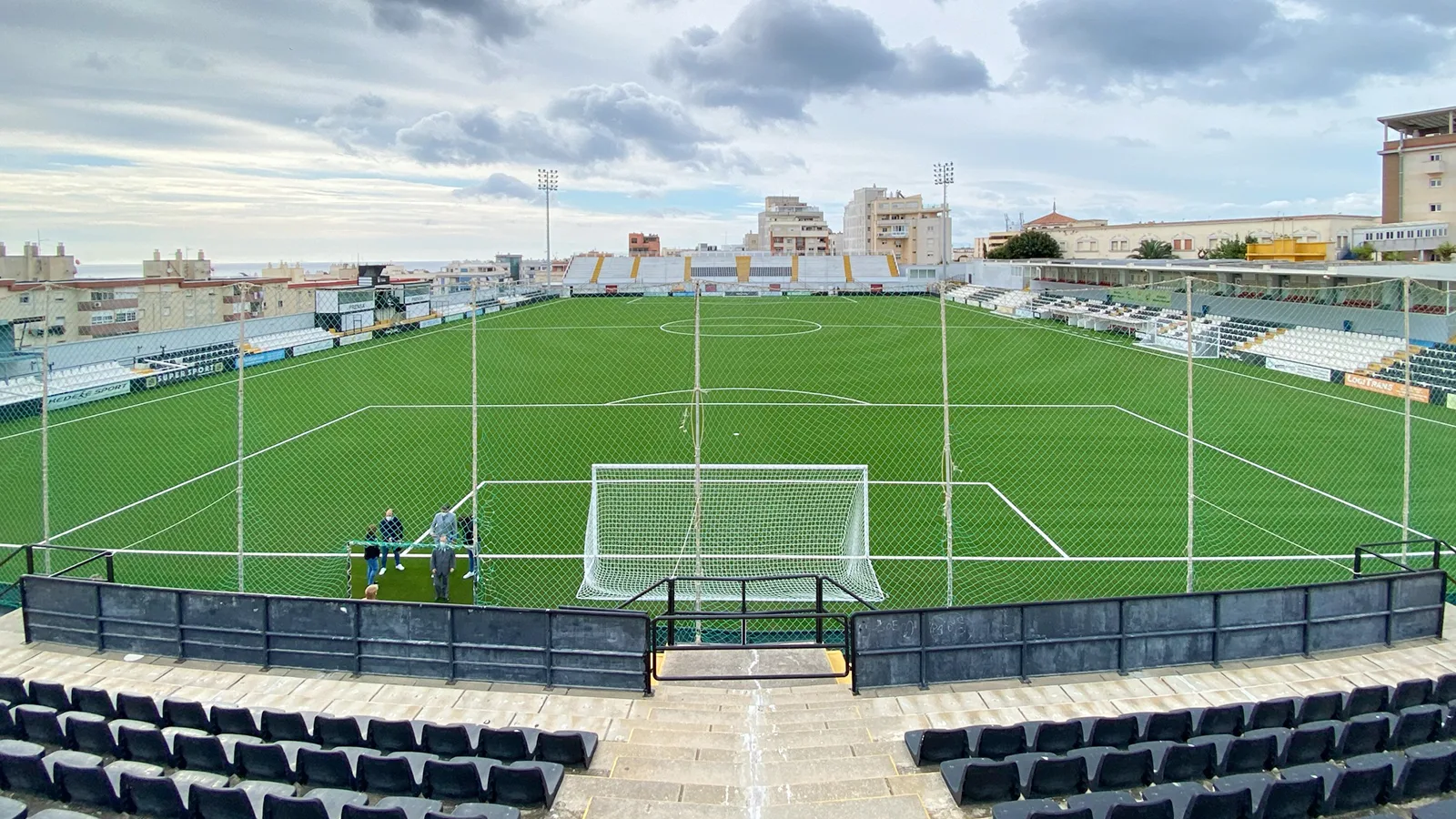
Football in Ceuta spans almost a century, from Ceuta Sport in 1932 to AD Ceuta FC's return to Spain's second tier in 2025. Today it combines professional competition, grassroots football and one of the most affordable coaching schools in Spain.
- Historic milestone: promotion to Segunda División on 11 May 2025.
- Current division: Segunda División (LaLiga Hypermotion), 2026-27 season.
- Coaching: the cheapest UEFA B course in Spain, €450 at the RFFCE.
- Federation base: Ciudad del Fútbol de Ceuta, next to the Alfonso Murube.
The origins: from Tetouan and Ceuta to a name of its own (1922-1941)
Before a club carrying Ceuta's own name existed, organised football was already being played on both sides of the Strait of Gibraltar. Club Atlético de Tetuán was founded on 12 March 1922 in Tetouan, across the Strait. Its story, born outside Ceuta, would become entangled with the city's own three decades later.
In Ceuta, football first organised itself as a federation: on 13 January 1931, the Federación Hispanomarroquí de Fútbol was founded, forerunner of today's RFFCE, Ceuta's regional football federation. A year later, in 1932, the first two of those clubs merged to form Ceuta Sport, the seed of the club known today.
The name did not last a decade. In 1941, naming rules of the era required sports organisations across Spain to Hispanicise their names, and that same year Ceuta Sport became Sociedad Deportiva Ceuta.
Second Division years, then a merger with Atlético de Tetuán
With the new name came the best years of Ceuta's pre-war football. SD Ceuta played in Segunda División, Spain's second tier, for seven seasons (1939-40, 1941-42, 1942-43, 1943-44, 1944-45, 1945-46 and 1950-51), peaking in 1942-43, when it won its group and reached the quarter-finals of the Copa del Rey, Spain's domestic cup, in the same campaign.
Across the Strait, Atlético de Tetuán was enjoying its own high point: it won group II of Segunda División in 1950-51 and reached Primera División, the top flight, in 1951-52, though it was relegated immediately after finishing bottom of 16 teams.
In 1956, SD Ceuta and Club Atlético de Tetuán merged to form Club Atlético de Ceuta, which inherited the federative rights and the Segunda División place of the Tetouan club. The best result of that new era came in 1960-61: runner-up in group B, losing the promotion play-off to Elche CF. Relegation to Tercera División followed in 1968, and the club kept changing its name (Ceuta Atlético Club between 1992 and 1994, back to Club Atlético de Ceuta until 2012, Asociación Deportiva Atlético de Ceuta for one more year) before settling in 2013 on Agrupación Deportiva Ceuta Fútbol Club (AD Ceuta FC), the name it still carries.
Three names from Ceuta in the big history of Spanish football
The city's academy also produced three players who defined eras far from Ceuta. Pirri (José Martínez Sánchez) started out at Club Atlético de Ceuta before moving through Granada and signing for Real Madrid in 1964, where he won 10 league titles, 4 Copa del Rey trophies and one European Cup.
Migueli (Miguel Bernardo Bianquetti), formed at C.D. O'Donnell de Ceuta, played 16 consecutive seasons at FC Barcelona (549 matches) and earned 32 caps for the Spanish national team, including the 1978 World Cup and the 1980 European Championship.
And Nayim (Mohamed Alí Amara), formed in Barcelona's youth academy, scored one of the most remembered goals in European football: a 49-metre extra-time strike that won Real Zaragoza the 1995 Cup Winners' Cup final against Arsenal, after he had already won the FA Cup with Tottenham Hotspur.
The Alfonso Murube: from the 1933 'Docker' to a Segunda División stadium
The ground where Ceuta football has always been played is almost as old as the modern club itself. It opened on 4 August 1933 as the Campo Municipal de Deporte (nicknamed 'Docker'), designed by architect José Blein at a cost of 167,686.13 pesetas.
On 17 April 1942 it was renamed Estadio Alfonso Murube, honouring a Ceuta Sport player who died in Aranjuez during the Spanish Civil War. A renovation reopened it on 8 October 1997, with the dimensions it still has today: 105 by 68 metres.
The most recent renovation came in 2025, to meet the requirements of Spain's professional league body: new changing rooms, a press room, an authorities' box, VIP boxes, a modular preferential stand and a VAR room, built by the Valencian joint venture CYES-VARESER. The Murube reopened on 23 August 2025 with AD Ceuta FC's Segunda División debut against Sporting de Gijón; its capacity is cited as between 5,500 and 6,500 spectators depending on the source.
The coach's Sunday summary
Open course calls, up-to-date guides and new posts. Free, with one-click unsubscribe.
Leave your email and get the next issue:
The return to the second tier: Ceuta back in professional football
On 11 May 2025, AD Ceuta FC beat Fuenlabrada 1-2, won its Primera Federación group and secured direct promotion to Segunda División (57 years after the club's last season at that level, 1967-68). It remains in Segunda División (LaLiga Hypermotion) for the 2026-27 season, facing new rivals such as newly promoted CD Tenerife and CD Eldense, and clubs relegated from Primera División such as RCD Mallorca, Girona FC and Real Oviedo.
Promotion was not limited to the men's first team. AD Ceuta FC's women's section also made its debut in the top division of the Liga Iberdrola futsal competition (not to be confused with 11-a-side women's football), playing its home matches at the Guillermo Molina pavilion in Ceuta.
The cheapest UEFA B course in Spain is taught in Ceuta
This whole history rests on an active regional federation. The Real Federación de Fútbol de Ceuta (RFFCE), founded on 13 January 1931, was granted the title of "Real" (Royal) by King Felipe VI in 2022; it is now led by president Antonio García Gaona from the Ciudad del Fútbol de Ceuta, on avenida de África, next to the Alfonso Murube itself, a facility the federation describes as "the pearl" of its regional installations.
For the 2026-27 season, the RFFCE has opened its coaching school with prices that put it at the front of Spain for accessible training. The UEFA C licence, Spain's entry-level coaching qualification, costs €200, starting on 1 September with thirteen in-person classes on Mondays from 19:00 to 20:30 between 21 September and 18 January, plus seven practical sessions on Thursdays. The UEFA B course costs €450 (€250 pre-registration), with classes on Tuesdays from 19:00 to 21:00 between 22 September and 15 June.
Compared with the other regional federations in RutaMister's own tracking feed as of today, Ceuta's UEFA B course, at €450, is the cheapest in the whole of Spain. In the other federations the same course costs €600-1,100 according to RutaMister's course-call radar: none goes below €600.
Grassroots, goalkeepers, referees, and what Ceuta gives back to Spanish football
Coaching education sits alongside an active grassroots scene. Per the English-language Wikipedia, the RFFCE administers around 88 football clubs across the city, organised into separate categories (grassroots, youth, regional preferential and third-division futsal). The 2026-27 season kicks off on 25, 26 and 27 September 2026 and runs until 30 June 2027 across 34 matchdays; club pre-registration is open from 15 July to 4 September, and the federation is distributing €50,000 in sports equipment and €80,000 in coach grants this season.
The municipal grassroots schools, based at the Emilio Cózar pitch, take players from age 4 (Chupetines, born 2019-2021) up to Fútbol 7 (born 2014-2018), for €195 including kit and insurance. Alongside them, the federated goalkeeper school trains players from prebenjamín to infantil age groups for €150, and the federation also runs an open referee school. Ceuta also fields an amateur regional select side that plays in the Spanish stage of the UEFA Regions' Cup, though in the 2025-26 edition it withdrew from the competition together with Melilla.
For a city of its size, the football history goes a long way: a club that once played in the top flight under a different name, a merger that crossed the Strait of Gibraltar, three players who defined eras at Real Madrid, Barcelona and Real Zaragoza, and a return to the second tier almost six decades after losing it. At RutaMister we follow this federation closely because, beyond its history, it now offers one of the most affordable routes into football coaching in Spain, compared with the rest of the country's coaching course prices.
About the author

Content created by RutaMister based on practical experience, editorial review and a training-focused approach for grassroots football coaches.
Frequently asked questions
What division does AD Ceuta FC currently play in?
AD Ceuta FC plays in Segunda División (LaLiga Hypermotion), Spain's second tier, in the 2026-27 season, after securing direct promotion on 11 May 2025 by beating Fuenlabrada 1-2. It marked the club's return to the category 57 years after its previous spell, which had ended with relegation in 1968.
What is the history of the Alfonso Murube stadium?
The Alfonso Murube opened in 1933 as the Campo Municipal de Deporte and took its current name in 1942, honouring a Ceuta Sport player who died during the Spanish Civil War. It was renovated in 1997 and again in 2025, expanding capacity to around 6,000 spectators for the club's return to Segunda División.
How much does coaching training cost in Ceuta?
For 2026-27, the RFFCE offers the UEFA C licence for €200 and the UEFA B licence for €450, with pre-registration open until 15 September. According to RutaMister's own tracking feed across regional federations, Ceuta's UEFA B course is, as of today, the cheapest in the whole of Spain.
What is grassroots football like in Ceuta?
The RFFCE organises grassroots, youth and regional preferential football through its own categories, with the 2026-27 season starting on 25 September. The municipal schools at the Emilio Cózar pitch admit players from age 4 for €195, and there are also federated goalkeeper and referee schools.