How to start a grassroots football team from scratch, with no club yet
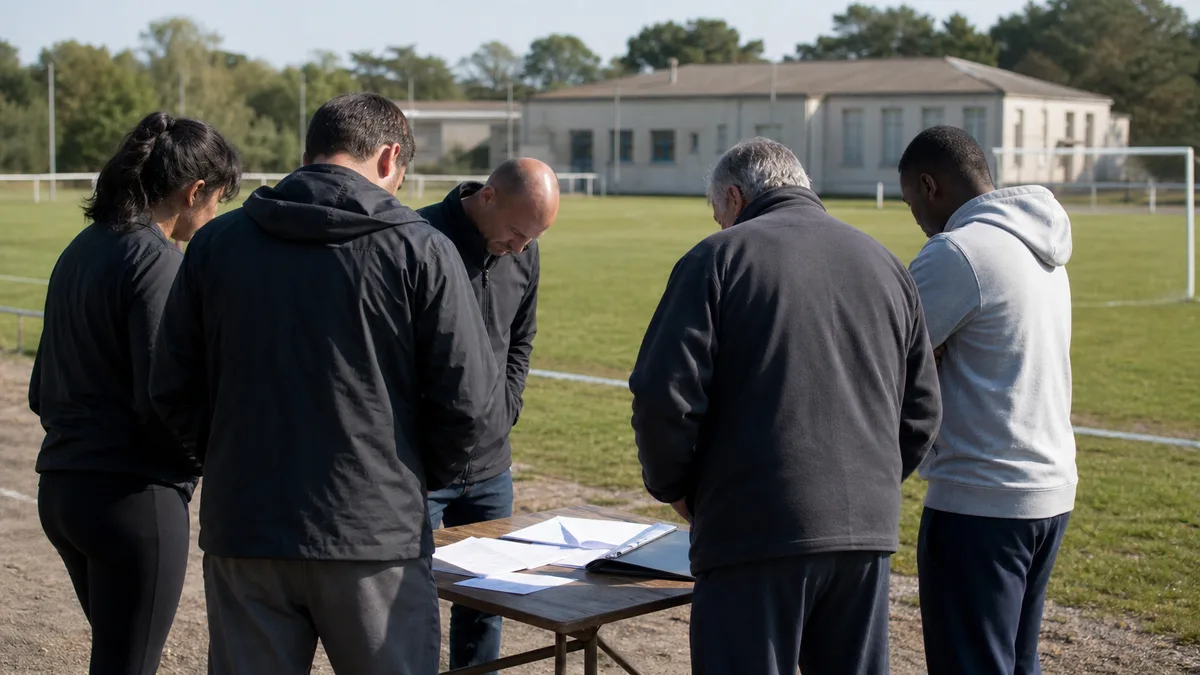
Starting a grassroots team where no club exists means two procedures — registering the entity, then affiliating it with your federation — plus minimum requirements to compete.
- Route: a brand-new club, a section inside an existing club, or a team via a municipal sports school, depending on what exists locally.
- Setting it up: a founding act and bylaws, registered with your region's registry before applying for federation affiliation.
- Minimum requirements: a compliant pitch, mandatory player insurance and a coach holding a coaching licence.
- Cost: the only verifiable figure in advance is the coaching course (€175-400 for UEFA C); the rest varies by federation.
Three routes to starting a team where no club exists
When there is no grassroots football club in your town or neighbourhood, or the one that existed has folded, there is no single procedure that fixes it. Three realistic routes exist, and choosing between them shapes everything that follows: how much paperwork you take on, how fast you get a team competing and how much control you keep over the project.
- Start a brand-new club: you set up your own sports entity, with bylaws and its own legal personality. It is the route with the most paperwork, but also the one that gives you full control over the name, the management and the project's future growth.
- Open a section inside an existing club: if your area has a multi-sport or other-sport club with an active legal entity, adding a football section is usually faster than starting from zero, because the legal personality already exists.
- Run a team through the municipal sports school: many Spanish town halls run their own sports schools where the team trains and competes under the municipal umbrella, without you having to set up any entity yourself.
This article covers those three routes: starting a team where, quite simply, nothing exists yet. If what you are after is something else — taking over a dugout at a grassroots club that already runs, as an assistant or as a first coach — the paperwork is different and much faster: it is covered in how to get your first team as a coach.
Setting up the club: founding act, bylaws and the regional registry
If you choose the brand-new club route, the first procedure is not with the federation — it is with your region. You need a founding act signed by the promoting members — most Spanish regions require a minimum of three to five people — and bylaws covering the entity's purpose, its governance and its non-profit status.
With those two documents, the club registers with your region's sports entities registry, a different body in each of Spain's autonomous communities. That registry — not the federation — grants the club legal personality: without it, you cannot sign contracts, rent facilities in the club's name or, as the next section covers, affiliate with the federation. In Andalusia, for example, the Registro Andaluz de Entidades Deportivas spells out exactly what documentation it asks for by entity type.
The exact paperwork — forms, minimum number of members, whether the bylaws need a separate approval act — varies from one autonomous community to another. Before drafting anything, check directly with your own region's registry and confirm the current procedure, rather than assuming another region's steps apply to you.
Then, affiliating with the territorial football federation
Affiliating with the territorial football federation is a separate, later step from the regional registry: the federation only admits clubs that already hold their own legal personality. If you choose the section-within-an-existing-club route, this step can be simpler, because the parent entity is already affiliated and you only need to register the football section.
Newly created clubs are usually placed in the lowest available category, and the federation requires guaranteed access to a pitch that meets the minimum regulatory conditions — not necessarily one you own: many grassroots clubs play on municipal facilities on loan from the town hall.
The specific affiliation requirements — documentation, whether there is an entry fee, deadlines — are set by each territorial federation in its own regulations. Ask your federation directly before taking any further step, because the detail changes from one territory to another.
The coach's Sunday summary
Open course calls, up-to-date guides and new posts. Free, with one-click unsubscribe.
Leave your email and get the next issue:
Minimum requirements to compete: pitch, insurance and a qualified coach
Beyond affiliation, three requirements repeat across every territorial federation for a team to compete. The first is the pitch: it must meet the format, dimensions and minimum condition set by the rules for each age group — the detail on pitch, ball size and number of players by age is in our guide to grassroots football categories by age.
The second is insurance: a federated licence carries mandatory sports accident cover. Real Decreto 849/1993 is the state-level reference framework (it sets minimum benefits for national competition), but grassroots football almost always competes at territorial level: the effective cover for your players is determined by regional rules and the policy taken out by the territorial federation. Bear in mind too that the 1993 decree's amounts have gone unrevised for over thirty years, and the 2022 Sports Act (Ley 39/2022) provides for updating the mandatory sports insurance. In practice the insurance is built into the cost of the player's licence and is managed by the territorial federation, not the club on its own.
The third is a qualified coach: to appear on the match sheet and sit in the dugout in official competition you need a coaching licence, and the most common entry point is the UEFA C licence — minimum age, requirements and price are in our UEFA C licence in Spain guide. If the club grows to several age groups, you will need one qualified coach per team in competition, though the rest of the coaching staff can start as assistants.
How much it costs to start a grassroots team from scratch
There is no single reliable figure for "how much it costs to start a team": it depends on the autonomous community, whether you use municipal or private facilities, whether you start a new club or open a section, and how many age groups you launch at once. Any fixed number that does not come from your own federation is, at best, a rough guide.
The one figure that can be given as verified is the cost of the coaching course: the UEFA C licence runs around €175-400 through the federation track, depending on the call. Everything else — annual affiliation fee, competition entry, player insurance, kit, facility upkeep if it is not municipal — varies so much between federations that any range we gave here would be, at best, approximate.
If budget is the main barrier, the section-within-an-existing-club or municipal-school routes cut the upfront outlay compared with starting a brand-new club, because they avoid part of the setup costs and, in the municipal case, facility rental.
Practical first steps: from the idea to the first training session
The order that wastes the least time is working in parallel, not in sequence. Talk to the town hall about facilities from day one — pitch availability shapes how many teams you can field — while you move the setup and affiliation paperwork forward and look for a qualified coach, or start their training. If they do not hold the licence yet, our course calls table lists pre-registration deadlines for every federation.
Affiliating a new club is usually processed ahead of the start of competition: check the exact calendar with your territorial federation so you are not late for the season. In parallel, you can start lining up the pitch and any basic sponsorship deal for kit, though neither is a requirement to register the club.
With the paperwork underway, the last step is filling the squad: a well-planned trial day is the most orderly way to gather your first players in a short time. We have a full guide on how to organise a grassroots football trial day, covering the call for players, age groups and the day's schedule.
About the author

Content produced by RutaMister from hands-on experience, editorial review and a development-first approach for grassroots football coaches.
Frequently asked questions
Can I start a football team without founding a new club?
Yes. You can open a football section inside an existing sports club, which uses its legal personality, or run the team through your town hall's municipal sports school without setting up an entity of your own. Founding a new club is the route with the most paperwork, but also the most control over the project.
What comes first, the regional registry or federation affiliation?
The registry. The territorial federation only affiliates clubs that already hold legal personality, and that personality is granted by your region's sports entities registry once you register the founding act and bylaws. Without that step first, the federation cannot process the club's affiliation.
Do I need to own a pitch to register a team?
Not necessarily. Many grassroots clubs train and compete on municipal facilities on loan from the town hall. What the federation requires is guaranteed access to a pitch meeting the minimum regulatory conditions for your age group, not ownership of the pitch itself.
Is player insurance mandatory to compete?
Yes. A federated licence includes mandatory sports accident insurance: Real Decreto 849/1993 sets the minimum benefits for state-level competition and each region regulates the territorial equivalent. In practice it is built into the cost of the player's licence and is managed by the federation, not the club directly.
How much does it cost to start a grassroots football team from scratch?
There is no single figure: it depends on the federation, the autonomous community and whether you use your own or municipal facilities. The only figure you can verify in advance is the coaching course (UEFA C licence, €175-400); check affiliation, insurance and kit costs directly with your federation.