How to get your first team as a football coach for the 2026/27 season
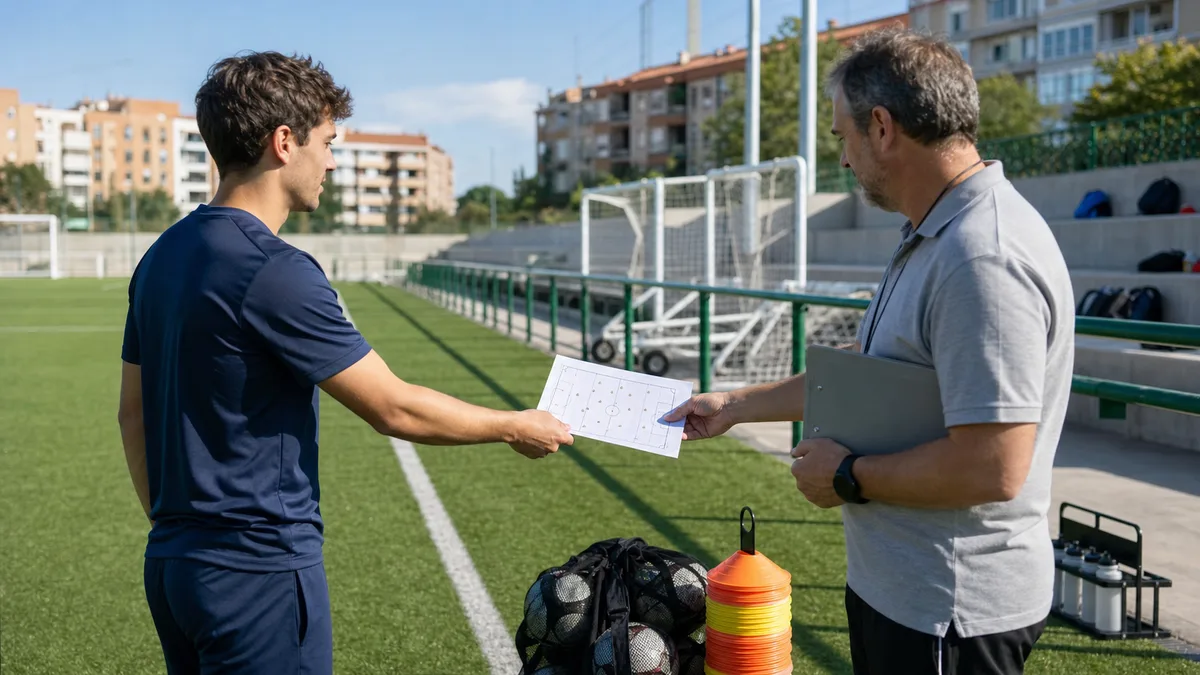
Your first dugout almost never comes from a public job ad: it comes from availability, federation contacts and showing up at the right club at the right time.
- Local grassroots club: offer yourself as an assistant; U-8 to U-12 teams are chronically short of coaches.
- Course placement: use your coaching-course practicum as a real way into a dressing room.
- Federation: coaching committees and job boards, like the FIFLP digital board for 2026/27.
- Timing: clubs close their coaching staffs mostly between May and August.
Why nobody advertises your first coaching job
The market for first coaching jobs is nearly invisible: Spanish grassroots clubs rarely post vacancies. They fill teams with club insiders, helpful parents and the coordinator's contacts. When an under-12 side is left without a coach in August, it gets solved with a phone call, not a job ad. All of this assumes a club already exists near you; if it does not, the route is starting a team from scratch.
What looks like a barrier is actually your opening: demand is real and chronic. A typical neighbourhood grassroots club easily runs more than a dozen teams from under-7s to under-19s, and loses coaches every season to studies, work or moving away. What is missing is a formal channel to find you, which is why the routes that work are showing up in person, course placements and the federation.
Set your financial expectations early: first-year coaching pays little or nothing. We break down the real ranges by age group in how much a grassroots football coach earns.
Your local club: the route that opens the most dugouts
The most direct way in is to show up at a nearby club in May or June and offer yourself as an assistant or second coach for the following season. Ask for the grassroots coordinator, not the first board member you find: the coordinator is the person who suffers the gaps in the coaching staff.
The message that works is short and concrete: who you are, what qualification you hold or are studying for, your real availability by days and time slots, and that you will happily start as an assistant wherever needed. The age groups with the fewest candidates are under-8s to under-12s, and they are exactly where you learn most about managing a group.
A well-used year as an assistant beats any cover letter: you see dressing-room management, parents and competition up close, and you are first in line when a dugout opens mid-season.
Your coaching-course placement counts as experience
If you are working towards your licence, the course practicum is a genuine way in, not a formality. Many Spanish federation courses include a club placement period (check your course's official listing) and the club where you do it is the natural candidate to offer you a team the following season.
Choose your placement club with the future in mind: a grassroots club near home that is short of coaches beats a big academy where you will be one among many. When the placement ends, ask the coordinator for ten minutes and say it plainly: you want a team next season.
To coach in official competition you will need a coaching licence, and each age group requires a minimum qualification: the detail per licence is in what each UEFA licence lets you coach. If you have not started a course yet, our course calls table lists pre-registration deadlines for every Spanish federation.
The federation: coaching committees and job boards
Every territorial federation in Spain has a coaching committee that connects coaches and clubs, and some are digitalising the service. The FIFLP (Las Palmas) launched a two-way digital job board for the 2026/27 season in July 2026: qualified coaches register online and clubs search the database.
If your federation does not advertise a job board on its website, ask directly: many committees keep internal lists they activate whenever a club calls looking for a coach. Signing up costs you an email and puts you in a channel where real offers do circulate.
Your course instructor is another contact worth keeping: they are usually an active coach and among the first people clubs call when they need someone.
The coach's Sunday summary
Open course calls, up-to-date guides and new posts. Free, with one-click unsubscribe.
Leave your email and get the next issue:
Your coaching CV when you have no experience yet
A coordinator gives your application one minute, so one page is enough. What they look for: your qualification (or course in progress, with expected completion date), any playing background (any level counts, futsal included), experience with children even outside football (camps, youth work) and concrete availability by days and time slots.
Attach something almost nobody does: a one-page sample session for the age group you are applying for. It shows you know what to do with fifteen kids on a Tuesday at 6pm, which is the real doubt in the coordinator's head. If you need ideas to build it, our selection of books for football coaches includes several session manuals by age group.
Do not pad your CV with online courses that carry no federation recognition: they do not qualify you to coach and coordinators know it. We explain which qualifications count in how to become a grassroots football coach.
And if what holds you back is not having played, remember José Mourinho: he reached the dugout via translation and assistant work, with no professional playing career, and no club held it against him once he started winning.
Timing: when to move for the 2026/27 season
Clubs plan the following season between May and July: that is the window where introducing yourself goes furthest, because coordinators are closing their coaching staffs. A second window opens in August and early September: the emergencies, when a coach drops out late and a team starts pre-season without one.
Course calls follow a similar calendar: most federations opened 2026/27 pre-registration between April and July, with courses starting between September and October. Move now and you can reach the season with your course underway and an assistant's spot in a dugout.
Outside those windows the door is not fully closed: mid-season departures happen at every club, and that is where having left your name with the coordinator, or being on the committee's list, makes the difference.
From the phone call to the trial, and from the trial to year one
When a club says yes, they will usually want to watch you run a session before confirming you. We have a dedicated guide for that day: how to prepare a trial session with a new team: what to observe, what session to bring and which mistakes to avoid.
And once the dugout is yours, the real work starts: your first year as a coach has traps of its own, and we have collected the five tips that save the most trouble, with a month-by-month checklist.
The whole sequence in one line: show up in May-June, run placements and the federation as parallel channels, take the assistant role if that is what is available, and turn every session into your application for next season.
Once you have a season or two on the bench, the next step has its own path: we cover it in how to work as a coach in a professional club's academy.
About the author

Content produced by RutaMister from hands-on experience, editorial review and a development-first approach for grassroots football coaches.
Frequently asked questions
Can I become a football coach without having played?
Yes. No Spanish federation requires a playing background to enrol in a coaching course. Your federation qualification, your placement and how you run a session matter far more. Playing experience helps you read the game, but grassroots clubs value reliability, availability and training first when choosing a new coach.
Do I need a coaching licence before starting as an assistant?
Usually not for helping at training sessions, but to appear on the match sheet and sit in the dugout you need a coaching licence, and each age group demands a minimum qualification set by its federation. The common path is assisting while you complete the UEFA C and registering once you pass.
How much do you earn with your first grassroots team?
Little or nothing: grassroots football in Spain pays between 0 and 500 € per month depending on age group, club and qualification, and the first year often means expenses, kit or a token payment. Pay improves with your qualification and experience; the ranges by age group are in our salary guide.
Where can I find job boards for football coaches in Spain?
At the coaching committees of the territorial federations. The FIFLP (Las Palmas) launched a two-way digital job board for coaches and clubs in July 2026 for the 2026/27 season, and other federations keep internal lists they activate when a club calls. Ask your territorial committee directly.