TacticAI: DeepMind's new brain that is reshaping football (and why Liverpool already uses it)
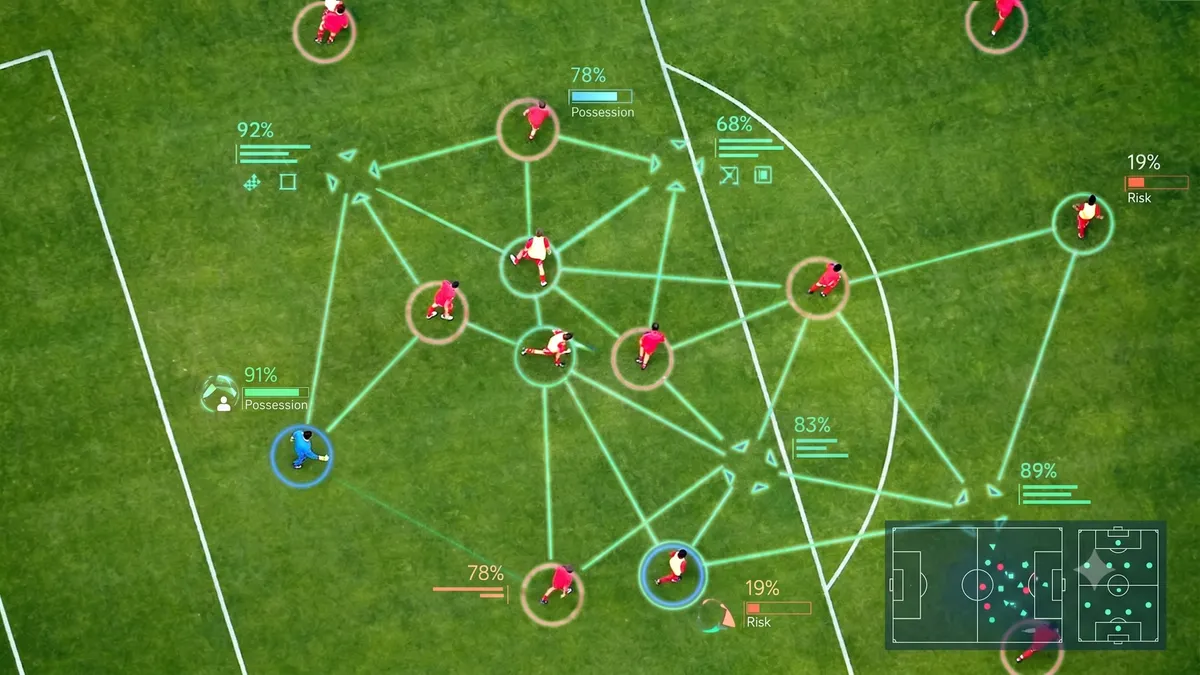
TacticAI is a cutting-edge tactical assistant built by Google DeepMind in a multi-year collaboration with Liverpool FC analysts.
- What it is: a tactical AI system, not a statistics viewer.
- Who builds it: Google DeepMind with Liverpool FC analysts.
- How it models the game: as a graph of relationships between players, not as a flat event table.
- What it targets: one of the most critical and decisive phases of the game — the corner kick.
- Why it matters: the corner is a phase where planning beats randomness, and where AI can add genuine value to a coaching staff.
Introduction: The game of millimetre margins
In contemporary elite football, victory is no longer measured in metres but in millimetres. In a high-competition ecosystem where physical and technical performance has reached a near-absolute ceiling, competitive advantage now lies in algorithmic optimisation. Under that premise, TacticAI was born: the fruit of a multi-year collaboration between Google DeepMind scientists and Liverpool FC analysts. This system is not a simple statistics viewer; it is a cutting-edge tactical assistant designed to master one of the most critical and decisive phases of the game: the corner kick.
Why the corner kick is the perfect laboratory
For an AI analyst, free-flowing football is a challenge of noisy spatiotemporal data. Set-piece plays, however, offer an oasis of order within the chaos. Researchers focused on corners for fundamental strategic reasons:
- Frequency and Stability: They occur on average 10 times per match, providing a constant volume of data under rigid starting conditions.
- Tactical Control: They are executed from a fixed position, allowing coaches to implement rehearsed patterns that are far easier to model than open play.
- Direct Impact: They represent an immediate goal-scoring opportunity, where a positional adjustment of half a metre can be the difference between a clean header and a defensive clearance.
While dynamic play is unpredictable by nature, the corner allows for an analysis of "deep geometry" in which strategy can be dissected and optimised before the ball even begins to fly.
The mirror effect: Learning football with "Deep Geometry"
The great obstacle of AI in sport is the scarcity of high-quality data; an elite league barely produces a few hundred matches per year. TacticAI overcomes this limitation through Geometric Deep Learning and the use of Graph Neural Networks (GNN).
Instead of treating players as mere coordinates on a two-dimensional map, TacticAI models them as nodes in a graph. This allows the system to prioritise the "relationships" between footballers (who marks whom, what spaces open up between defenders) over absolute distances. To maximise data efficiency, the model uses the concept of symmetry through the dihedral group D_2 —the mathematical group that describes the symmetries of a rectangle—, applying horizontal and vertical reflections (the "mirror effect"). As the study notes:
Geometric deep learning ensures that TacticAI's player representations will be identically computed under such reflections, such that this symmetry does not have to be learnt from data.
By integrating these symmetries directly into the model's architecture, the AI does not need to "see" a thousand corners from the left and a thousand from the right to understand that the tactical logic is the same; it deduces it geometrically.
More real than reality: The expert verdict
The acid test for any AI analyst is qualitative validation by elite professionals. In a study with Liverpool FC experts, TacticAI demonstrated an astonishing ability to mimic —and improve on— human judgement.
The results revealed that the tactics generated by the AI are virtually indistinguishable from the real ones. Human analysts achieved an F1 score of just 0.60 when trying to differentiate real plays from those suggested by the machine —on a scale where 0.50 is equivalent to guessing at random and 1.00 to a perfect score—, a result only slightly above chance. Interestingly, the study identified that human experts tend to divide into three distinct "clusters" or profiles of tactical perception; however, despite this human variability, the consensus was overwhelming: analysts preferred TacticAI's suggestions 90% of the time over the original routines used in competition.
The coach's Sunday summary
Open course calls, up-to-date guides and new posts. Free, with one-click unsubscribe.
Leave your email and get the next issue:
The "tactical past" search engine: Mining similar plays
TacticAI does not only predict; it is a sophisticated retrieval system capable of navigating the latent space of football —an internal map where plays with similar intent end up placed close to one another—. Unlike traditional heuristic methods, TacticAI can group plays into "tactical families" (such as in-swing vs. out-swing corners) based on strategic intent and not only on the position of points on the pitch.
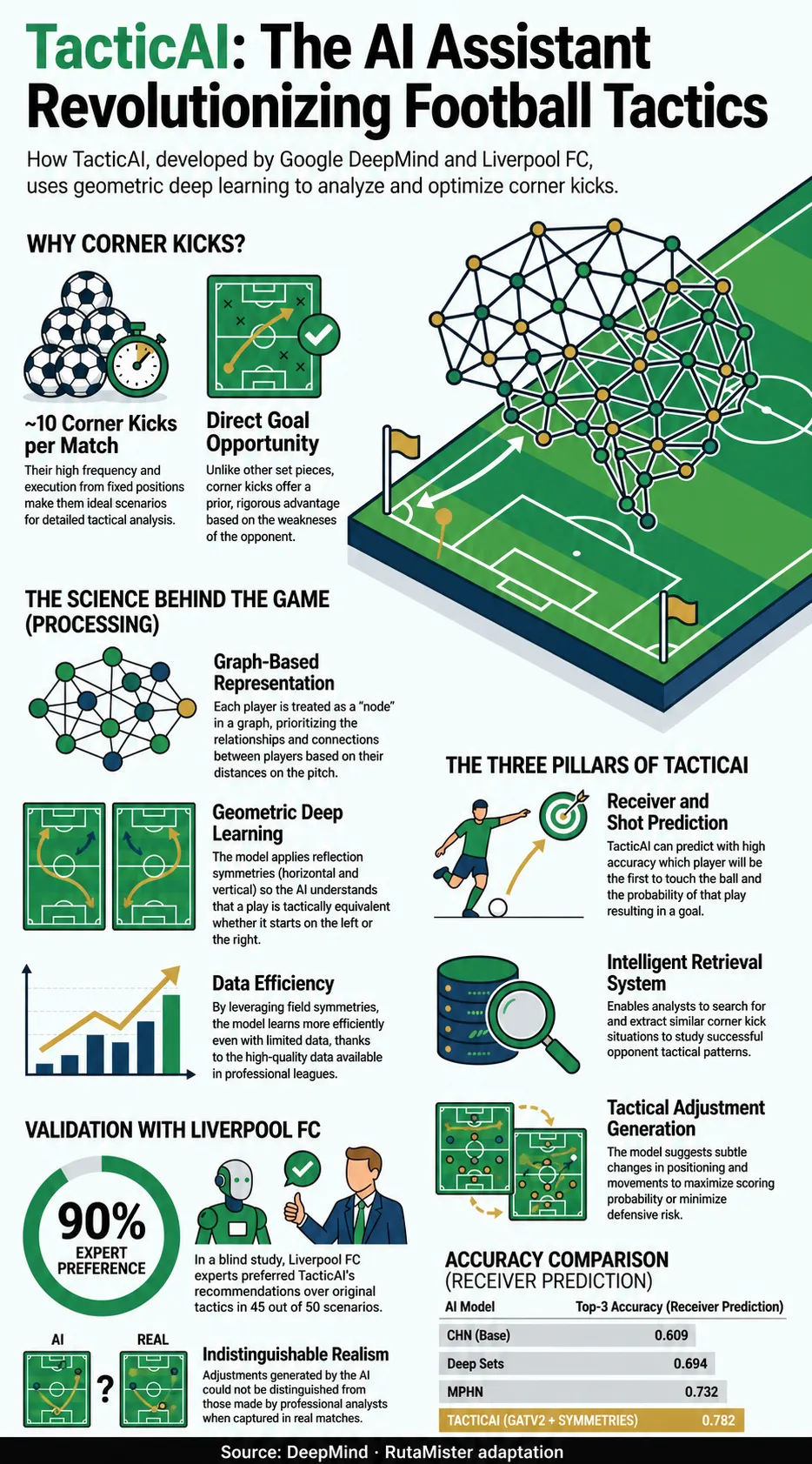
As an analyst, the true elegance of the model lies in its shot-prediction logic. Predicting a shot on goal directly is extremely complex (with an initial F1 of only 0.52). TacticAI solved this through a probabilistic decomposition: it first predicts the most likely receiver and, from there, computes the probability of a shot. This architecture raised its F1 accuracy to a solid 0.71.
The key capabilities of the system include:
- Receiver prediction: Identifies who will win first contact with the ball.
- Shot probability: Estimates the real goal threat after reception.
- Recommended adjustments: Proposes changes in player position and velocity to optimise the outcome.
The Assistant, not the Replacement: Human-AI synergy
TacticAI does not seek to displace the coach but to act as a high-precision copilot. The system lets staff "sample" alternative configurations in a virtual environment before taking them onto the pitch.
One of the most powerful uses detected by Liverpool FC is the model's ability to identify players who are not responding adequately to a tactic. By adjusting variables in the software, a coach can see whether a defender is poorly oriented or whether his reaction speed is insufficient to counter a specific movement. It is, in essence, a "what-if" simulator that allows tactical execution to be audited with unprecedented scientific rigour.
2026: from corners to open play — Palmeiras moves first
Scalability stopped being a promise in June 2026: Google DeepMind announced at its Google for Brazil event that Palmeiras — in collaboration with the Brazilian Football Confederation (CBF) — becomes the first club to build on TacticAI beyond set pieces. The announced goal goes beyond corners: simulating field scenarios and predicting open-play dynamics up to 8 seconds in advance. For now that is what it is, a collaboration announcement: the peer-reviewed work (Nature Communications) still covers set pieces only.
The technical leap is bigger than it looks. The corner was the perfect laboratory precisely because it is a closed situation, with 22 players in near-static positions. Open play multiplies the variables: the graph model has to update positions, velocities and player relationships in continuous motion, and still project the next few seconds with a precision a coaching staff can actually use.
For the everyday coach, the takeaway is the one this whole article defends: elite AI trickles down faster than it seems, but always as an assistant. Eight seconds of anticipation are worth nothing without someone on the bench who knows what to do with them. Source: official Google announcement (Google for Brazil, June 2026).
Conclusion: Toward the hybrid coach
TacticAI is the spearhead of a metamorphosis in professional sport. Corners were its testing ground, and the next step is already announced: open play with Palmeiras, and foreseeably throw-ins, other situations and other team sports.
We are entering the era of the "hybrid coach", where human intuition and leadership are amplified by the processing power of graph neural networks. That profile does not appear in isolation: it is the tip of an ecosystem in which clubs measure the game with entire data departments. Faced with this landscape, the debate is no longer whether technology should intervene in strategy, but rather: are we prepared to accept that, in the chess of modern football, the best move could be dictated by a deep-geometry algorithm?
Original source: TacticAI: AI assistant for football tactics — Google DeepMind.
About the author

Content produced by RutaMister from practical experience, editorial review and a training-focused approach for grassroots football coaches.
Frequently asked questions
What is TacticAI and who built it?
TacticAI is a tactical assistant developed by Google DeepMind with Liverpool FC. It analyses corner kicks using graph neural networks, predicts which player will reach the ball and the likelihood of a shot, and proposes position and velocity adjustments so coaches can test variants before the match.
Why did the study focus on corner kicks rather than open play?
Corners are ideal for AI analysis: they occur around ten times per match, always start from a fixed position and allow rehearsed patterns. That initial rigidity yields comparable, controlled data. They are also direct goal opportunities, so a small positional adjustment delivers a measurable change in outcome.
Will TacticAI replace the head coach?
No. TacticAI is designed as a copilot, not a replacement. It lets coaches test variants in simulation before taking them to the pitch and flags if a player is not responding well to a specific tactic. Final calls, dressing-room leadership and emotional reading still belong to the human coach.
Is TacticAI useful for a grassroots football club?
Not directly today. TacticAI relies on optical tracking and event data that grassroots football does not produce at that quality. Its value for a development coach lies in method: working set pieces with clear criteria, field symmetries and likely-receiver references rather than rigid blackboard drawings.
What is new with TacticAI in 2026?
It has announced its move beyond the corner-kick laboratory: since June 2026, Palmeiras and the CBF are the first to build on TacticAI for open play, with the announced goal of predicting moves up to 8 seconds in advance. It is a collaboration announcement, not a published result: the peer-reviewed work remains the corner-kick study.