How Luis de la Fuente won the 2026 World Cup: the plan against every opponent
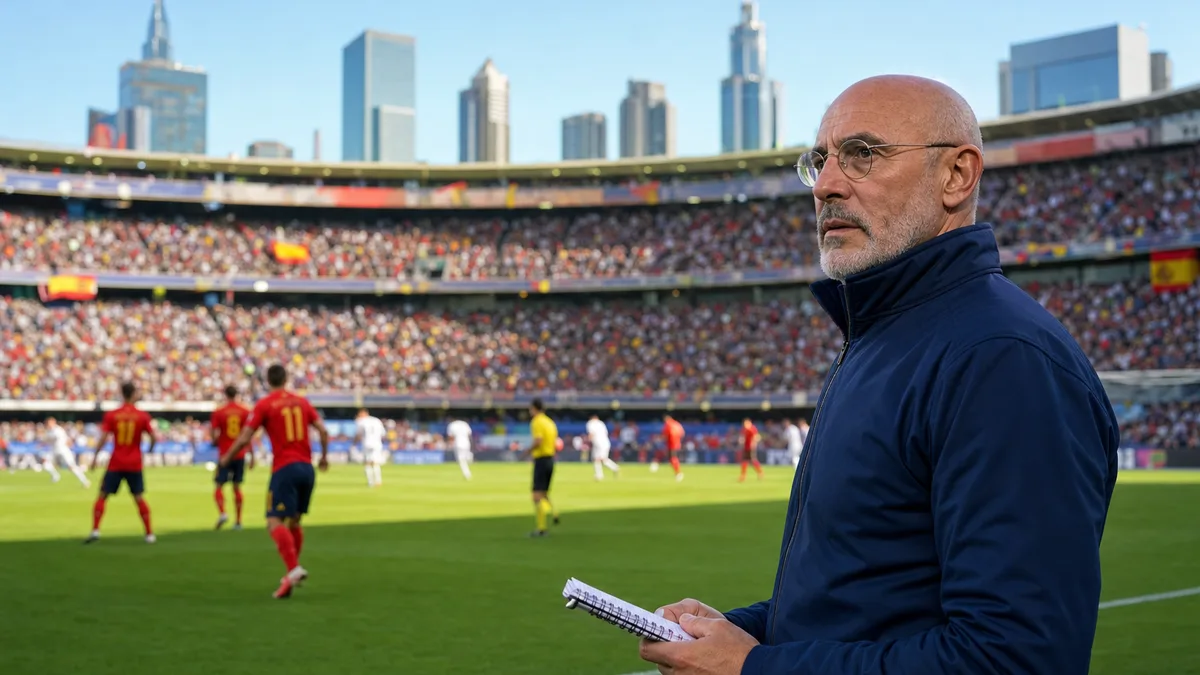
Spain won the 2026 World Cup without a fixed plan: Luis de la Fuente adjusted the team to every opponent, from Cape Verde's low block to extra time in the final.
- Record: 7 wins and 1 draw, with a single goal conceded in 8 games.
- Key call: Pedri benched against Belgium to adapt the midfield.
- Semi-final: 2-0 vs France with Dembélé locked up by Cucurella and only 3 shots on target conceded.
- Final: 1-0 vs Argentina, Ferran Torres scoring in the 106th minute.
- Signature: second world title after 2010, built on his U21 generation.
The team that arrived at the 2026 World Cup
Spain arrived as European champions with a recognisable model: the 4-3-3 with a single pivot that becomes a 3-2-5 in possession, with wide wingers and a coordinated press. That system is explained in detail in Luis de la Fuente's tactics; what matters here is different: how he adapted it game by game until lifting the trophy.
They also arrived with two structural absences (Dani Carvajal injured and Álvaro Morata left out of the squad) and with a dressing-room core that De la Fuente knew by heart: Fabián Ruiz, Dani Olmo, Mikel Oyarzabal and Mikel Merino had already won with him in the 2019 U21 side. That mutual trust explains several of the decisions that follow.
The review below goes match by match: what each opponent posed, what De la Fuente adjusted and what a grassroots coach can take away. For the title recap and the full squad, see the summary of Spain as 2026 World Cup champions.
Group stage: three opponents, three different problems
The opener against Cape Verde (0-0, 15 June in Atlanta) was the warning: a compact 5-4-1 that closed exactly the interior lanes the 2024 model used to open with the asymmetric full-back. Spain could not find the goal, but they did not panic either: they refused to change the idea over one poor result in the first game.
The other two group games were two different tests, both passed convincingly: 4-0 against Saudi Arabia (Lamine Yamal's first World Cup goal in the 10th minute, an Oyarzabal brace and an own goal from a Cucurella strike) and 1-0 against Uruguay through Álex Baena, assisted by Marcos Llorente. Top of the group with 7 points and no goals conceded; full dates and venues are in the 2026 World Cup calendar.
Grassroots lesson: against a low block, moving the ball better beats running harder: real width, switches of play and the patience not to gift counter-attacks. And a 0-0 on debut does not invalidate the model: you correct the detail, not the identity.
Austria and Portugal: knockout games won from the bench
In the round of 32 Spain cruised: 3-0 against Austria in Los Angeles, the first knockout tie of the tournament and their most complete performance up to that point.
The round of 16 was a different story: Portugal shut the game down and took it to the wire. Mikel Merino decided it in the 91st minute, having just come off the bench. No coincidence: Merino had already been the super-sub of Euro 2024, and De la Fuente used him again as a prepared weapon, not a last resort.
Grassroots lesson: the bench is a plan, not a reward. A substitute with a defined role (knowing what he is coming on to do, against which defence and in which zone) changes matches. At youth level that means preparing the substitutions before the game and giving minutes with a concrete intention, not just to share them out.
Belgium: benching Pedri, the bravest decision
The quarter-final brought the decision the whole tournament talked about: Pedri on the bench. De la Fuente preferred the physicality and late runs of Fabián Ruiz for the direct duel with Belgium's midfield of Onana and Tielemans. The plan showed early: Fabián scored in the 30th minute.
Belgium equalised through De Ketelaere before half-time, the only goal Spain conceded in the entire World Cup, and there came the second half of the decision: holding it. Spain did not abandon the plan over a temporary setback, and once again Merino off the bench made it 2-1 in the 88th minute.
Grassroots lesson: the plan rules over hierarchies. Benching an undisputed starter demands two things that apply just as much to a youth team: communicating it beforehand and face to face, and holding the decision when the scoreboard tightens. If the starting XI is dictated by status, the opponent already knows how you are going to play.
The coach's Sunday summary
Open course calls, up-to-date guides and new posts. Free, with one-click unsubscribe.
Leave your email and get the next issue:
France: the perfect game without the ball
The semi-final (2-0, 14 July in Arlington) was the game analysts quoted most, and not for the goals (an Oyarzabal penalty after a foul on Yamal and a Pedro Porro finish off a one-two with Dani Olmo) but for what Spain did without the ball: Cucurella locked up Dembélé and the pressure on Mbappé was collective, zonal and constantly covered. France ended with just 3 shots on target from 10 attempts, as reported by El Colombiano in their semi-final analysis.
With the ball, Spain controlled the game with 65% possession up to the 60th minute and then managed it. The stat that best sums up their tournament out of possession came from the tactical analysis by Primicias: an average of 11.23 seconds to win the ball back after losing it.
Grassroots lesson: cancelling a dominant player is a job for the whole team, not one marker: orienting the press, closing his receiving lane and preparing the cover before he gets the ball. That is trained with transition rules in small-sided games, not with a speech on matchday.
The final against Argentina: patience, extra time and a plan that did not break
On 19 July at MetLife Stadium, Spain met the most closed game of the tournament. According to the tactical analysis by Coaches' Voice, De la Fuente shifted the structure to a 4-2-3-1; Argentina defended in a 4-4-2 and ended extra time sitting in a 5-3-1. Regulation time ended goalless but left the final broken open: in added time, Enzo Fernández was shown a second yellow card for a late challenge on Cubarsí and Argentina faced the whole of extra time with ten men.
Extra time had two defining moments: the referee first disallowed a Nico Williams goal for an earlier Merino foul on Otamendi, and in the 106th minute, against ten men sitting deep, the title arrived: a Pedro Porro cross, a Nico Williams lay-off and a Ferran Torres finish. Torres had come on for Oyarzabal in the 62nd minute. 1-0, a second World Cup for Spain after 2010, and a closing of the circle: Rodri, the pivot the whole cycle was built on, was named the tournament's Golden Ball.
Grassroots lesson: identity is not the formation. Spain changed the structure in the final without changing the principles (coordinated pressing, play through the middle, width) and when the red card turned extra time into an attack against ten men sitting deep, they went back to the problem of the opening game against Cape Verde: patience, width and no cheap counters conceded. Playing a man up also has to be trained, and so does teaching a team to live with a 0-0.
The lessons of the title for a grassroots coach
What won this World Cup was not a system: it was a method of opponent-specific preparation built on a non-negotiable identity. That is the difference between adapting and improvising, and it is the most transferable idea of the whole tournament.
- Read the opponent without giving up your identity: five different plans across eight games, one recognisable playing model in all of them.
- The bench as a tactical tool: two decisive goals from Merino as a substitute and the title-winning goal from Ferran Torres, also off the bench.
- Defending is a collective achievement: one goal conceded in eight games without a destructive specialist: the best defence of the tournament was a system of covers.
- Methodological continuity pays: the spine of the team was formed under De la Fuente in the youth ranks, as his timeline of teams coached shows.
To take it into the weekend: prepare two or three concrete adjustments per opponent (not a new plan), define each substitute's role before the game and measure the reaction after losing the ball like any other task. Copying the formation from the final transfers nothing; the principles of the model, explained calmly, are in De la Fuente's base tactics.
About the author

Content produced by RutaMister from practical experience, editorial review and a training-focused approach for grassroots football coaches.
Frequently asked questions
What formation did Spain use at the 2026 World Cup?
The 4-3-3 with Rodri as the single pivot remained the base, but De la Fuente varied it by opponent: more physicality in midfield against Belgium and a 4-2-3-1 in the final against Argentina, according to Coaches' Voice. The identity, coordinated pressing and play through the middle, held across all eight games.
Why was Pedri benched against Belgium in the quarter-final?
It was a tactical call, not a form issue: De la Fuente preferred the physicality and late runs of Fabián Ruiz for the duel with Belgium's midfield of Onana and Tielemans. The plan worked: Fabián scored the opener and Mikel Merino, off the bench, made it 2-1 in the 88th minute.
How many goals did Spain concede at the 2026 World Cup?
Just one in eight games: De Ketelaere's goal for Belgium in the quarter-final (2-1). Spain kept clean sheets in every other match (against Cape Verde, Saudi Arabia, Uruguay, Austria, Portugal, France and Argentina) and finished as the best defence of the tournament.
What can a grassroots coach learn from Spain's World Cup?
Three things above the formation: prepare every game for the specific opponent without changing identity, give substitutes a defined tactical role (two goals from Merino off the bench) and train defending as a collective task. Copying the system without those principles transfers nothing.