Spain, 2026 World Cup champions after a 1-0 win over Argentina
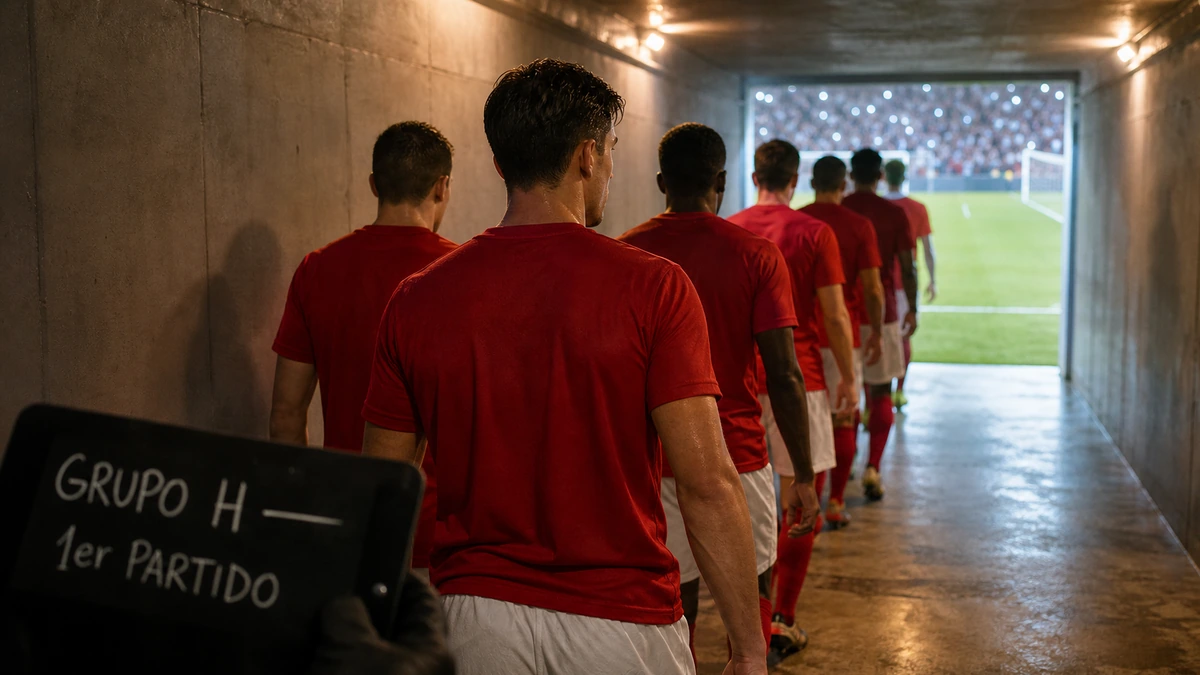
Spain are 2026 World Cup champions: they won Group H, eliminated Austria, Portugal, Belgium and France, and beat Argentina 1-0 in the final.
- 26-man squad announced by Luis de la Fuente on 25 May 2026.
- Group H: 0-0 against Cape Verde, 4-0 against Saudi Arabia and 1-0 against Uruguay — top spot on 7 points.
- Knockouts: beat Austria 3-0, Portugal 1-0 (Mikel Merino in the 90+1) and Belgium 2-1 (Fabián Ruiz and Merino).
- Semifinal: 2-0 over France in Dallas — Oyarzabal penalty and Pedro Porro.
- Final: beat Argentina 1-0 (19 July, MetLife Stadium), Ferrán Torres scoring in extra time.
Starting point: reigning European champions, watched favourites
Spain enter the 2026 World Cup from a position they have not held in a long time: reigning Euro 2024 champions and 2023 Nations League winners. The question is no longer whether they compete, but whether they have a ceiling at this tournament. They finished European qualifying without major problems and most of the Euro 2024 generation is still available.
Luis de la Fuente's challenge is double: keep a recognisable identity (4-3-3 with single pivot, vertical wingers, oriented press) without becoming predictable for opponents. The first game, against Cape Verde, already showed that being a declared favourite is no guarantee of scoring. For the head coach's full background and tactical plan, the Luis de la Fuente career and the analysis of Spain's current 4-3-3 are useful companions.
The 25 May squad: 26 names and an unusual club spread
Luis de la Fuente announced the official 26-man squad on 25 May 2026. The biggest talking point was the club breakdown: eight FC Barcelona players, three from Athletic Club, three from Atlético Madrid and a single name linked to Real Madrid (Marc Cucurella, who was on the books at Chelsea when the squad was announced; his transfer to Real Madrid was made official on 15 June, after the call-up). It is one of the lowest counts for the Madrid club at a World Cup.
The Spanish-club total reaches 18 players out of 26; the rest are spread across the Premier League, Bundesliga, Ligue 1 and Eredivisie. It is a squad with a heavy La Masia spine (eight Barça players), the same one that powered the Euro 2024 title.
By position, the list breaks down like this:
- Goalkeepers (3): Unai Simón (Athletic Club), Joan García (FC Barcelona), David Raya (Arsenal).
- Defenders (8): Marc Cucurella (Chelsea at the time of the call-up; signed by Real Madrid on 15 June), Álex Grimaldo (Bayer Leverkusen), Pau Cubarsí (FC Barcelona), Aymeric Laporte (Athletic Club), Marc Pubill (Atlético Madrid), Eric García (FC Barcelona), Marcos Llorente (Atlético Madrid), Pedro Porro (Tottenham).
- Midfielders (7): Pedri (FC Barcelona), Fabián Ruiz (PSG), Martín Zubimendi (Arsenal), Gavi (FC Barcelona), Rodri (Manchester City), Álex Baena (Atlético Madrid), Mikel Merino (Arsenal).
- Forwards (8): Mikel Oyarzabal (Real Sociedad), Dani Olmo (FC Barcelona), Nico Williams (Athletic Club), Yeremy Pino (Crystal Palace), Ferran Torres (FC Barcelona), Borja Iglesias (Celta de Vigo), Víctor Muñoz (Osasuna), Lamine Yamal (FC Barcelona).
The absence of Dani Carvajal, Spain's undisputed right-back at Euro 2024, is the most discussed individual call. His role is covered by Pedro Porro and Marcos Llorente as the versatile defensive option. The centre of defence is very young: Pau Cubarsí (19 years old) and Eric García share the role that in 2024 belonged to Le Normand and Laporte.
0-0 against Cape Verde: what happened and what it means
On 15 June 2026, Spain opened the World Cup against Cape Verde at the Atlanta Stadium. The result was a 0-0 that left both team and crowd flat. Cape Verde, a World Cup debutant, set up in a very compact 5-4-1 on the edge of their box and forced Spain to keep the ball without finding the free man between the lines — a pattern similar to the first 45 minutes of the Euro 2024 final against England.
De la Fuente's Spain had possession but no penetration. When the opponent defends with 9 or 10 players behind the ball, the wide-winger model loses some of its bite: if the opposition full-back doesn't push up, the winger ends up isolated with no space to accelerate. It is a problem of a different nature than what Spain faced at Euro 2024, where opponents (Croatia, Italy, Germany, France, England) had more ambitious profiles and left space between the lines.
The draw is not catastrophic in qualification terms (Cape Verde was the weakest opponent on paper, and a point is better than a loss), but it has triggered tactical debate: whether to start a physical pinning nine (Borja Iglesias) or a more associative one (Ferran Torres, Oyarzabal), with Víctor Muñoz as a pace and dribbling option, whether Yamal and Nico Williams should play narrower against low blocks, and whether the shape should shift to a more vertical 4-2-3-1 against sit-back opponents.
How Group H wrapped up: 4-0 over Saudi Arabia and 1-0 over Uruguay
After the opening draw, Spain closed out the group with two consecutive wins and secured top spot in Group H, which decided the round-of-32 matchup:
| Date | Match | Result / kick-off | Venue |
|---|---|---|---|
| Mon 15 Jun | Spain 0-0 Cape Verde (played) | 0-0 | Atlanta Stadium |
| Sun 21 Jun | Spain 4-0 Saudi Arabia (played) | 4-0 | Atlanta Stadium |
| Sat 27 Jun (early) | Uruguay 0-1 Spain (played) | 0-1 | Guadalajara Stadium |
Against Saudi Arabia on 21 June, Spain finished the job in 30 minutes that had escaped them against Cape Verde: Lamine Yamal opened the scoring on minute 10 with his first World Cup goal, Mikel Oyarzabal scored a brace before half-time and an own goal by Altambakti in the second half, from a Cucurella shot, completed the 4-0. The verticality of Yamal and Nico Williams made the difference against an opponent that pressed high for the first 15 minutes; once Saudi Arabia dropped their block, the interior combinations of Pedri and Gavi broke their shape.
Against Uruguay, in Guadalajara at 02:00 Spanish time, Spain edged it in a scrappy group-stage game. Álex Baena made it 0-1 at minute 42 from a Marcos Llorente assist, and the scoreline held to the final whistle. Spain finished top of Group H on 7 points, eliminated Uruguay and, crucially, avoided the round-of-32 cross with Argentina. For the full schedule, venues and tournament format, see the 2026 World Cup calendar guide.
The coach's Sunday summary
Open course calls, up-to-date guides and new posts. Free, with one-click unsubscribe.
Leave your email and get the next issue:
Likely starting XI: the 4-3-3 without Carvajal
On paper and pending official confirmation, Spain's base starting XI for the tournament fits the familiar 4-3-3, with two forced changes from Euro 2024: no Carvajal at right-back, and a transition at centre-back:
- Goalkeeper: Unai Simón remains the starting goalkeeper.
- Defence: Pedro Porro (right-back), Pau Cubarsí or Eric García alongside Aymeric Laporte (centre-backs), Marc Cucurella (left-back).
- Midfield: Rodri (pivot), Pedri (left interior), Fabián Ruiz or Dani Olmo (right interior).
- Attack: Lamine Yamal (right wing), Nico Williams (left wing) and a rotating number nine between Ferran Torres, Oyarzabal or Borja Iglesias.
The big tactical question is the profile of the number nine. At Euro 2024 that role belonged to Morata as the fixing connector. Without him, the team loses a profile it doesn't have a direct replacement for: Ferran offers movement and link play, Oyarzabal brings runs into the box but less pinning, Borja Iglesias is a more static target man. De la Fuente's choice between the three could be the difference against low blocks like Cape Verde.
What's new compared to Euro 2024
Compared with the squad that lifted the Euro 2024 trophy in Berlin almost two years ago, this list has five big novelties:
- Pau Cubarsí (19). FC Barcelona centre-back who missed the Euro 2024 list on age and form. He arrives as a potential starter after a full Champions League season.
- Marc Pubill. Right-back at Atlético Madrid (signed from Almería) who joins as a backup for Carvajal. His call-up was one of the surprises of the 25 May list.
- Joan García. FC Barcelona goalkeeper (signed from Espanyol). Earns the second or third keeper slot after a strong season and an immediate jump to Barça.
- Gavi's return. After a serious ACL injury he's back available. His likely role is a rotation interior.
- Álex Baena. Atlético Madrid midfielder with a more associative profile. Adds a different variant from the base 4-3-3.
- Víctor Muñoz (Osasuna). Pace and dribbling winger. His call-up widens the attacking rotation as a wide-channel runner, an alternative to Yamal and Nico Williams when the attack needs refreshing.
The most significant absences compared to 2024 are Dani Carvajal and, to a lesser extent, Álvaro Morata. The presence or absence of Morata as the focal number nine is one of the most debated decisions of the cycle.
The knockout path
The 2026 World Cup format introduces an important novelty: 48 national teams split into 12 groups of 4, with the top two and the eight best third-placed sides advancing to a round of 32 (the new "R32" stage). It punishes a single bad game less but lengthens the road to the title.
Spain finished first in Group H, which avoided the cross with Argentina. In the round of 32 they beat Austria 3-0 on 2 July in Los Angeles. In the round of 16, on 6 July in Arlington, Texas, they edged Portugal 1-0 with a Mikel Merino goal in the 90+1, moments after coming on as a substitute. And in the quarter-finals, on 10 July in Inglewood, California, they beat Belgium 2-1: Fabián Ruiz put Spain ahead in the 30th minute, Charles De Ketelaere equalised before half-time (41st), and Mikel Merino, again off the bench, scored the winner in the 88th. In the semifinal, on 14 July in Arlington, Dallas, Spain beat France 2-0 (France had knocked out Morocco 2-0): Mikel Oyarzabal opened from the penalty spot in the 22nd minute, after a Digne foul on Lamine Yamal, and Pedro Porro sealed it in the 57th after a one-two with Dani Olmo. In the final, on 19 July at MetLife Stadium (New Jersey), Spain were crowned world champions for the second time, beating Argentina 1-0 with a Ferrán Torres goal in extra time (106th minute); Rodri was named the tournament's best player (Golden Ball).
For a panoramic view of brackets, dates and venues, the full 2026 World Cup guide has the up-to-date calendar.
The three keys to the title
Beyond the squad list, these were the three issues that shaped Spain's run to the title they lifted on 19 July:
- The reference number nine. Without Morata, De la Fuente needs the player who pins the opposition centre-backs and leaves space for Yamal and Williams to attack the last third. The Ferran-Oyarzabal-Borja Iglesias rotation has not yet clicked.
- Rodri's fitness. The 2024 Ballon d'Or hasn't played a full long competition for over a year. If he returns to his best, the single pivot stays. If he needs rotation, Zubimendi will have to take the role.
- Handling low blocks. The Cape Verde game exposed the issue: against a 5-4-1, wide penetration is not enough. Spain need more interior combinations (Olmo, Gavi) and, possibly, a more static number nine to pin centre-backs.
De la Fuente's plan has always worked against opponents who try to win; the question was whether it would work against a side that only tries not to lose, and the final against Argentina answered it. The breakdown of how each game was solved, from Cape Verde's low block to extra time in the final, is in De la Fuente's plan against every rival.
About the author

Content produced by RutaMister from practical experience, editorial review and a training-focused approach for grassroots football coaches.
Frequently asked questions
When does Spain play at the 2026 World Cup?
Spain won Group H (7 points) then ran through the knockouts: 3-0 v Austria (2 Jul), 1-0 v Portugal (6 Jul, Merino goal in the 90+1), 2-1 v Belgium (10 Jul) and 2-0 v France in the semifinal (14 Jul). In the 19 July final they were crowned champions, beating Argentina 1-0.
How many Real Madrid players are in Spain's squad?
A single name linked to Real Madrid: Marc Cucurella, still a Chelsea player when the list was announced (25 May); his transfer became official on 15 June, mid-tournament. The low count comes down to Dani Carvajal's injury and Luis de la Fuente's preference for profiles like Pedro Porro or Marcos Llorente.
Who's in Spain's 2026 World Cup squad?
The 26-man list from 25 May: 3 goalkeepers (Unai Simón, Joan García, Raya), 8 defenders, 7 midfielders and 8 forwards, with Rodri, Pedri, Lamine Yamal and Nico Williams as the references. There are 18 players from Spanish clubs, eight from FC Barcelona and a single name linked to Real Madrid (Cucurella). The full position-by-position list is in the squad section.
What group is Spain in at the 2026 World Cup?
Spain played Group H against Cape Verde, Saudi Arabia and Uruguay and finished top on 7 points (two wins and a draw). The surprise was Cape Verde: runners-up with three draws, the first debutant to get out of the group stage since 2010. Uruguay and Saudi Arabia were eliminated.
What happened in Spain vs Cape Verde at the 2026 World Cup?
It ended 0-0. Cape Verde, a World Cup debutant, set up in a very compact 5-4-1 that denied Spain any wide penetration. De la Fuente's side kept the ball but couldn't find the free man between the lines. The draw doesn't endanger qualification, but it opens tactical debates about the number nine role and how to attack low blocks.
Who will play right-back for Spain at the 2026 World Cup?
The big absence compared to Euro 2024 is Dani Carvajal. His expected replacement is Pedro Porro (Tottenham), with Marcos Llorente as the versatile alternative. The difference matters: Porro is a more vertical profile but less associative in the 3-2 build-up that defined De la Fuente's 2024 model.
Who is Pau Cubarsí and why is he called up?
Pau Cubarsí is an FC Barcelona centre-back born in 2007 (19 at the 2026 World Cup). He missed Euro 2024 on age and minutes; after a full season as a starter for Barça and in the Champions League, he arrives as a potential starting centre-back alongside Aymeric Laporte or Eric García.
What is Spain's confirmed round of 32 matchup at the 2026 World Cup?
Confirmed: Spain-Austria on 2 July in Los Angeles (match 84 of the bracket). Austria finished second in Group J, behind Argentina. By winning their group, Spain avoided Argentina in this round: that cross (3 July in Miami) was the one reserved for the Group H runners-up.
Did Spain win the 2026 World Cup?
Spain were crowned world champions on Sunday 19 July 2026 at MetLife Stadium in New Jersey, beating Argentina 1-0 with a Ferrán Torres goal in extra time (106th minute). It is their second world title after 2010; Rodri won the tournament's Golden Ball.