José Mourinho: from interpreter with no playing career to Real Madrid coach
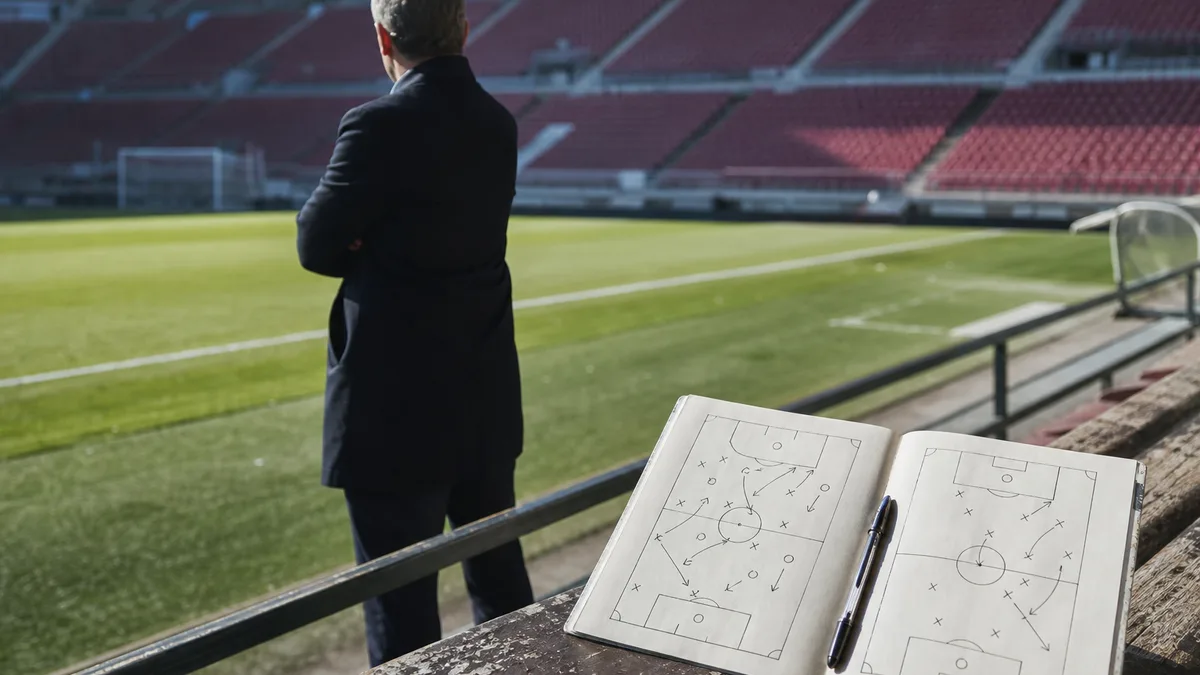
José Mourinho has been Real Madrid's head coach since June 2026, after a career spanning Porto, Chelsea, Inter, Manchester United, Tottenham, Roma, Fenerbahçe and Benfica. He was never an elite professional player, which makes his case a useful reference for coaches who start out without a strong playing background.
- Key titles: the Champions League with Porto (2004) and Inter (2010, treble).
- Benfica 2025-26: unbeaten but third, behind Porto and Sporting CP.
- Real Madrid move: official on 11 June 2026, a reported 15 million euro release clause, contract until 30 June 2029.
Career
José Mourinho Félix was born in Setúbal in 1963, the son of a goalkeeper who played for the Portuguese national team. Unlike most great coaches of his generation, he was never an elite professional player: he played as an amateur for Rio Ave, Belenenses, Sesimbra and Comércio e Indústria, retiring at 24 without ever rising above the lower tiers of Portuguese football.
His route to the touchline ran through translation and assistant work. In 1992 he started as interpreter for Bobby Robson at Sporting Lisbon, following him to Porto a year later. In 1996 he moved to Barcelona as assistant to Robson and, from 1997, to Louis van Gaal, completing his tactical education by watching a top-level dressing room up close without ever having played at that level himself.
His first job as head coach came at Benfica in 2000, lasting barely three months. From there he built a career spanning Porto (2004 Champions League), two spells at Chelsea, Inter Milan (2010 treble), Real Madrid (2010-13), Manchester United, Tottenham, Roma, Fenerbahçe and Benfica, up to his move to Real Madrid in June 2026, made official on 11 June with a reported 15 million euro release clause and a contract until 30 June 2029.
Method
Mourinho's football starts from a pragmatic idea: first make the team solid without the ball, then make it dangerous with it. His trademark is a compact mid-to-low block, with short distances between defenders and midfielders, and a very fast offensive transition as soon as the ball is regained: few touches, verticality and exploiting the space the opponent leaves while attacking.
That balance between defensive solidity and quick strikes has brought him titles in five different countries with very different setups depending on the squad: the 2004 Porto side defended in a very low block and hit teams on the counter, while the 2010 Inter or the 2011-12 Real Madrid had more capacity to dominate stretches of a match. What stays constant is prioritising the result over aesthetics and a dressing-room management built on publicly protecting the group from the press and the opponent — a very different trait from other profiles in this series such as Luis Enrique, who leans more on attacking identity and possession with purpose.
That management style follows a pattern documented by analysts and specialist press: the so-called third season syndrome. At Chelsea (2004-07), Real Madrid (2010-13) and Manchester United (2016-18), his first two years were successful and the third ended in his departure or dismissal, once friction with the board, the players or the press built up to breaking point. It is as relevant a lesson as his trophies: his method delivers fast, but it also burns out.
Lessons for grassroots football
The first lesson is that organisation without the ball can also be trained at youth level, though not as a permanent low block. Before asking for pressing or retreating, coaches must teach the distances between lines, who covers whom and what to do when the opponent beats the first press. Mourinho's question — what do we do when we don't have the ball? — is as valid for under-12s as for Real Madrid, even if the answer changes with age.
The second lesson is decision-making speed after winning back the ball. Many grassroots sessions work heavily on possession and barely on transition: what to do in the three seconds after a turnover. Bringing that question into rondos and possession drills connects them directly to real matches.
The third lesson has to do with Mourinho's own biography: he was never an elite professional player, yet he built the most decorated career of his generation through observation, organisation and communication. It is a useful argument for coaches who wonder —can I coach without having played?— and the answer, with nuance, is yes. The same logic applies to anyone who today is trying to get their first team without knowing anyone at the club: what shapes a coach is daily work with the group, not a playing CV.
The coach's Sunday summary
Open course calls, up-to-date guides and new posts. Free, with one-click unsubscribe.
Leave your email and get the next issue:
Inspired exercises
1. Retreating by lines with fast transition. With 12-14 players in two blocks of 6-7, one team attacks on a full pitch while the other defends in a mid-to-low block with 15-20 metres between defenders and midfielders. On winning the ball back, the defending team has six seconds to reach the opposite goal with as few touches as possible. It connects with Mourinho's core idea: order first, speed second.
2. Cover and support in a low block. A 5v5 situation in a small space (30x20 metres) where the defending team must hold a compact line and communicate out loud before every pass of the opponent's ball. Whenever a defender steps out to press, a teammate must cover the space within two seconds. It works on the positional discipline typical of Mourinho's teams, scaled down to a manageable size for grassroots football.
3. Verbal dressing-room management at the break. Not a pitch drill but a session habit: before half-time in a match or a match-like training session, the coach gives one short, specific message (one or two adjustments, not a list) and asks a captain to repeat it to the group. It reproduces Mourinho's direct, protective communication style with players, adapted to a development-focused tone and without the media pressure of the professional game.
Mistakes when copying him
The first mistake is copying the permanent low block without nuance. In professional football it can be a legitimate tactical choice; in grassroots football it holds back development, because young players need the ball, need to solve problems in tight spaces and need to make mistakes in order to learn. Systematically giving up the initiative limits that development.
The second mistake is imitating the "us against the world" mentality with youth teams. That dynamic can unite a professional dressing room under media pressure, but with children and teenagers it can create a toxic relationship with referees, opponents and families that adds nothing educational.
The third mistake is treating the third-season pattern as inevitable. Grassroots teams are not rebuilt every two or three years like a professional squad; a coach who burns out their message or their relationship with the group in a short time should review their communication, not assume that wear and tear is simply part of the job.
Timeline
- 1980-1987. Plays as an amateur for modest Portuguese clubs (Rio Ave, Belenenses, Sesimbra and Comércio e Indústria) and retires at 24 without ever reaching elite professional football.
- 1992-2000. Works as interpreter and assistant to Bobby Robson (Sporting Lisbon and Porto) and to Louis van Gaal (Barcelona), learning the trade from the inside without having played at top level.
- 2000. Takes charge of his first team as head coach, Benfica, for barely three months.
- 2002-2004. Coaches Porto: two Portuguese league titles, the 2003 UEFA Cup and the 2004 Champions League.
- 2004-2007. First spell at Chelsea, with back-to-back Premier League titles (2004-05 and 2005-06).
- 2008-2010. Manages Inter Milan and completes the 2010 treble (Serie A, Coppa Italia and Champions League).
- 2010-2013. First spell at Real Madrid, winning La Liga 2011-12 with a points record.
- 2013-2015. Second spell at Chelsea, winning the Premier League 2014-15.
- 2016-2018. Manchester United: League Cup and Europa League in 2017.
- 2019-2021. Tottenham, without titles; sacked six days before a League Cup final.
- 2021-2024. Roma: the club's first European title, the 2022 Conference League.
- 2024-2025. Fenerbahçe: sacked in August 2025 after Champions League elimination at the hands of Benfica.
- September 2025. Joins Benfica, back in Portugal 25 years after his first spell at the club.
- 2025-26. Finishes the Primeira Liga unbeaten (23 wins and 11 draws in 34 matches) but third, on 80 points, behind champions Porto (88 points) and Sporting CP (82 points).
- June 2026. Real Madrid pay his release clause (15 million euros) and appoint him head coach until 30 June 2029; he joins on 13 July, with pre-season.
About the author

Content produced by RutaMister from practical experience, editorial review and a training-focused approach for grassroots football coaches.
Frequently asked questions
What defines José Mourinho's coaching method?
José Mourinho's method is built on an organised mid-to-low block, very fast offensive transitions after winning back the ball, and dressing-room management focused on protecting the group from outside pressure. He prioritises the result over aesthetics and adapts his approach to each squad's resources.
Can you become a football coach without having been a professional player?
Yes. José Mourinho was never an elite professional player and still built one of the most decorated careers in European football, starting as an interpreter and assistant. His case confirms that training, observation and communication matter as much as a playing CV; more detail in how to become a grassroots football coach.
Why shouldn't grassroots coaches copy Mourinho's low block?
Because at development level, players need the ball and need to make decisions in order to improve. A low block can work as an occasional in-game resource, but turning it into the basis of the playing model limits young players' technical and tactical learning.
Did José Mourinho win the Primeira Liga with Benfica in 2025-26?
No. Mourinho's Benfica finished the 2025-26 Primeira Liga unbeaten, with 23 wins and 11 draws in 34 matches, but ended third on 80 points, behind champions Porto (88 points) and Sporting CP (82 points). Finishing unbeaten does not mean winning the title, and that was his last full season before joining Real Madrid.