How much does a football coach earn in Spain: the salary ladder of Tercera, Segunda and Primera RFEF
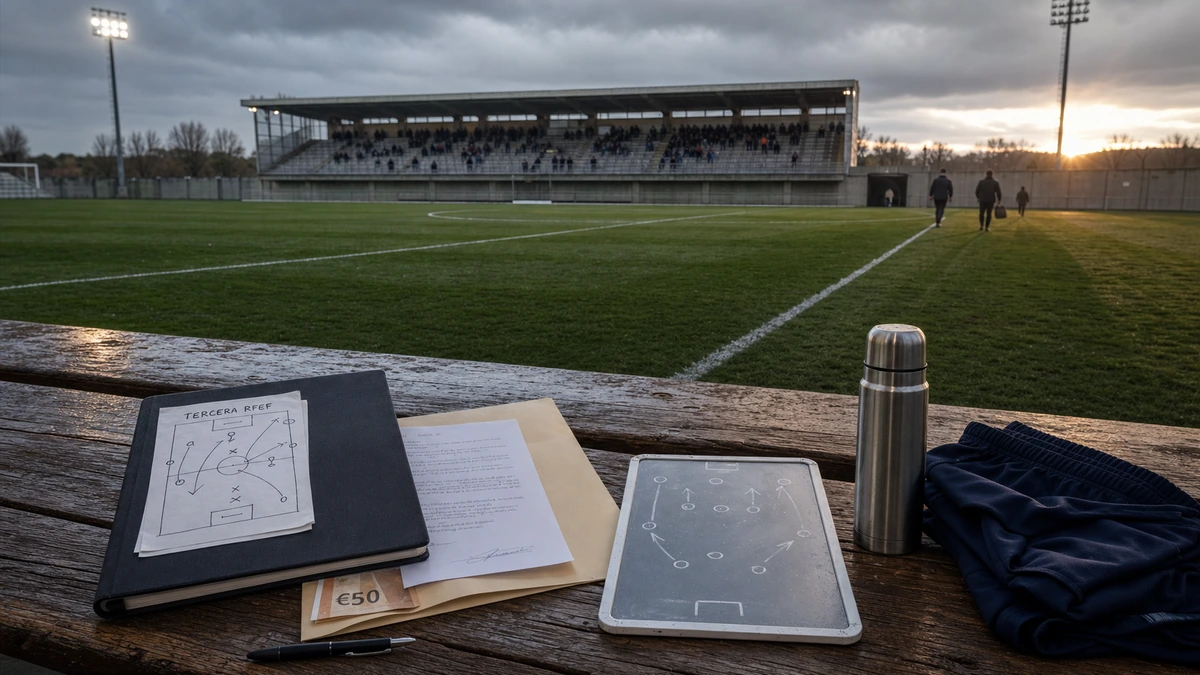
Coach salaries in the RFEF national block vary sharply by tier: between €400 and €5,000/month. No collective agreement covers coaches at any of the three levels: each figure is negotiated club by club.
- Tercera Federación (Tercera RFEF): €400-1,000/month is typical, up to €1,500/month at bigger-budget clubs.
- Segunda Federación (Segunda RFEF): no reliable salary reference; no collective agreement covers this tier.
- Primera Federación (Primera RFEF): €2,000-5,000/month.
- Minimum licence: UEFA A at all three tiers.
The short answer: €400-5,000/month depending on tier
The RFEF national block has three tiers: Primera Federación, Segunda Federación and Tercera Federación — Primera, Segunda and Tercera RFEF under their former names, which is what almost everyone still uses. None of the three has a collective agreement covering the coach: every figure is negotiated club by club.
The combined range runs from €400 to €5,000/month. Segunda Federación sits in the middle on club budget, but there is no reliable salary reference for that tier: no collective agreement covering it and no published club budgets to place it against.
The ladder at a glance
With two reference rows above and below: Segunda División (already professional football) and the regional level below Tercera Federación.
| Tier | Level | €/month range | Minimum licence |
|---|---|---|---|
| Segunda División | 2nd professional | €3,000-15,000/month | UEFA Pro |
| Primera Federación (Primera RFEF) | 3rd national | €2,000-5,000/month | UEFA A (art. 88, RFEF General Regulations 2025/26) |
| Segunda Federación (Segunda RFEF) | 4th national | No reliable estimate | UEFA A |
| Tercera Federación (Tercera RFEF) | 5th national | €400-1,000/month (up to 1,500 at higher-budget clubs) | UEFA A |
| Regional and grassroots football | Regional / grassroots | €0-500/month | UEFA C / UEFA B |
For the tier immediately below, see how much a grassroots football coach earns.
Tercera Federación (Tercera RFEF): €400-1,000/month, up to €1,500 at bigger clubs
Tercera Federación is the official name of what was always known as Tercera RFEF — still the form most people type. It is the fifth tier of Spanish national football, just above the regional level. The habitual range is €400 to €1,000/month, with a ceiling of €1,500/month at the higher-budget clubs.
The €400 floor is set by the cost of registering as self-employed: below that, a coach ends up paying to work. The €1,000 figure is what is habitually paid in the division, and €1,500 the ceiling reached at the higher-budget clubs, which run accounts of around a million euros a season.
The minimum licence is UEFA A in the men’s game; the women’s game opens at UEFA B. The habitual arrangement is self-employed status, invoicing the club monthly. What separates Tercera from the regional level below is not only pay: it is the licence required and the club structure behind it.
Segunda Federación (Segunda RFEF): what it pays
Segunda Federación — Segunda RFEF in common use — is the fourth national tier, between Tercera and Primera Federación. There is no reliable salary reference for this tier: no collective agreement covers it, no club budgets are published to place it against, and the figures circulating in the press cite no club, contract or document. That is why the table above gives it no range.
The minimum licence is UEFA A, the same as in Primera and Tercera Federación: what changes when you move up is the club budget and the competitive demand, not the badge on the bench. On contract arrangements, the employment contract carries more weight than in Tercera Federación, where self-employed status dominates, to the extent the club budget allows. The neighbouring tiers’ ranges help frame the conversation, not deduce Segunda Federación’s figure from them.
The coach's Sunday summary
Open course calls, up-to-date guides and new posts. Free, with one-click unsubscribe.
Leave your email and get the next issue:
Primera Federación (Primera RFEF): €2,000-5,000/month
Primera Federación — Primera RFEF under its former name — is the highest of the three tiers: the third national level, just below professional football. The range is €2,000 to €5,000/month, but the two ends do not rest on equally solid ground.
The floor is set by collective agreement BOE-A-2024-8956, which guarantees players at this tier a minimum of around €2,083/month: a coach responsible for that squad is not paid below it. The ceiling is marked by the accounts of the division’s leading clubs — Real Zaragoza runs a budget of €5-6 million in 2025/2026 — where a salary of a few thousand euros a month is a marginal share of spending.
The minimum licence for the head coach is UEFA A under article 88 of the RFEF General Regulations (2025/26 season); UEFA Pro is only mandatory in Primera and Segunda División. It is also the only one of the three tiers a collective agreement reaches, although it limits its scope to players and leaves coaching staff out. The employment contract is more common here than the self-employed status that dominates in Tercera Federación. That — the agreement and the budget scale — is what distinguishes it from Segunda Federación, not a difference in licence.
How clubs hire: employee, self-employed or amateur compensation
Three models, at any of the three tiers. Self-employed dominates in Tercera Federación and loses ground to the employment contract as the club budget rises.
- Employment contract with social security. The most protective: unemployment cover, sick leave, paid holiday, tax withheld by the club. A minority in Tercera Federación, more common further up.
- Self-employed (monthly invoice to the club). The dominant model in Tercera Federación: flexibility in exchange for paying the contribution (around €230-290/month for typical tier earnings) and your own withholding.
- Amateur compensation with no contract. The riskiest: no sick-leave cover, no record of activity, and no protection if the club stops paying.
Always insist the arrangement is in writing. If the club calls it "compensation" but the pay is above €800-1,000/month, there is real tax exposure.
What moves the figure within each tier
What changes as you move up is the starting range, not what makes pay vary within it.
- Club budget. A club with promotion ambitions pays 2-3 times more than a modest one in the same division.
- Qualification and track record. The minimum is the UEFA A licence at all three tiers (what each licence unlocks, in coach pay by UEFA licence); having won promotion or come down from a higher division raises the offer.
- Scope of the role. Running the reserve side or the academy alongside the first team raises the figure.
- Bonuses. Typically a survival bonus (10-30% of the fixed salary), rising to 50-100% if there is a promotion play-off, plus payments for cup rounds.
- Non-cash extras. Car, fuel or accommodation weigh on the decision even if they never appear on the payslip.
The extras are what separate two offers with the same fixed salary. Get them in writing, not in verbal agreements.
Before signing: the minimum checklist
Whatever the tier, check these six points before signing.
- Arrangement in writing. Employee, self-employed or compensation — any of them works, but it has to be on paper.
- Bonuses itemised. The exact figure for each and the condition that triggers it.
- Payment record confirmed. Ask the outgoing coach when they were paid. An evasive answer is a warning.
- Cover. If self-employed, whether the club covers the insurance or you do; on an employment contract, the social security registration and sick-leave cover.
- Exit clause. What happens if you are dismissed mid-season.
- Structural commitment. Coaching staff, squad size and which academy sides report to you.
Most of the trouble comes from not putting the non-financial terms in writing.
About the author

Content produced by RutaMister from verified public sources, specialised press and RFEF/BOE regulation.
Frequently asked questions
What is the legal minimum salary for a Tercera RFEF coach?
There is no legal minimum salary or collective agreement for Tercera RFEF coaches. BOE-A-2024-8956 covers professional footballers but excludes the technical staff. Any salary is freely negotiated with the club; the only references are press estimates (€400-1,000/month is typical, up to €1,500 at bigger-budget clubs) and the self-employed contribution if you go that route.
Do I need UEFA A or UEFA Pro to coach in Tercera RFEF?
The legal minimum is the UEFA A licence (180 hours, per Article 167 of the RFEF Regulation) for men's Tercera RFEF. The UEFA B (120 hours) is enough for women's Tercera RFEF only. Holding UEFA Pro is not mandatory but usually raises the salary on offer.
Is Tercera RFEF the same as Tercera División?
Yes, they are the same category with two renamings. "Tercera División" was the classic name until the 2021/22 reform, when it became Tercera RFEF. The RFEF later renamed it Tercera Federación, the current official name for the fifth men's national tier. Many people still search "Tercera RFEF" because that is the name the competition carried for years.
How much does an assistant coach earn in Tercera RFEF?
There are no consolidated public figures, but the typical reference is €200-700/month, around a half or a third of what the head coach earns. At modest clubs, the assistant is often a "compensated" role or even voluntary, especially if the role is part-time alongside another job.
Are promotion bonuses real, or just verbal handshakes?
Bonuses do exist but must be in the written contract to be enforceable. The typical figure is a 50-100% bonus of the annual salary for promotion to Segunda Federación; some clubs also pay extra per play-off round won. A verbal promise you never sign is just a handshake: legally you cannot claim it.
How much does a Primera RFEF coach earn?
A Primera Federación (Primera RFEF) coach earns between €2,000 and €5,000/month. The floor comes from collective agreement BOE-A-2024-8956, which guarantees players at this tier around €2,083/month: the coach responsible is not paid below it. The ceiling is set by the division's leading clubs, with budgets of several million euros a season.
How much does a Segunda RFEF (Segunda Federación) coach earn?
There is no reliable salary reference for Segunda Federación (Segunda RFEF): no collective agreement covers coaches at this tier and no club budgets are published to place it against. The minimum licence is the same as in the neighbouring tiers, UEFA A. For a frame of reference, see the ranges for Tercera Federación and Primera Federación on this same page.