2030 FIFA World Cup hosts: Spain, dates and key facts
The 2030 World Cup, the next World Cup after 2026, is jointly hosted by Spain, Portugal and Morocco, with three centenary matches in South America.
- Centenary matches: Uruguay, Argentina and Paraguay each host one match on 8 and 9 June 2030.
- Main phase: kicks off on 13-14 June and closes with the final on 21 July.
- Spanish venues: FIFA ratified 11 stadiums in 9 cities in December 2024; Málaga and A Coruña have already withdrawn and several venues remain under review.
- Format: 48 teams and 104 matches, with the proposed jump to 64 still unconfirmed.
- Qualification: all six hosts, Spain included, skip the qualifying process entirely.
What FIFA has confirmed
On 11 December 2024, the FIFA Extraordinary Congress ratified Spain, Portugal and Morocco as hosts of the 2030 FIFA World Cup and awarded three centenary matches to Uruguay, Argentina and Paraguay, marking 100 years since the first World Cup (Uruguay 1930): the first World Cup across three continents at once, and the second time Spain hosts it, 48 years after Spain 1982.
The bid took four years: Spain and Portugal announced their joint intention in October 2020, Morocco joined later, and the three-way bid —UEFA, CAF and CONMEBOL involved— was the only one left after the rival South American bid withdrew. Settled today: the three main hosts, the centenary matches and the calendar window; open: venues, format and the final's host, with date and source in each section.
The venues in Spain: which stadiums and their current status
The RFEF unveiled a shortlist of 15 stadiums on 14 July 2022, when the bid was still Spain-Portugal only. With Morocco on board, it submitted the definitive bid book on 31 July 2024 with 11 stadiums in 9 cities; FIFA finalised the list 12 days later, within 20 total stadiums (6 in Morocco, 3 in Portugal) out of 23 candidates, and ratified it on 11 December. Since then the Spanish list has changed twice.
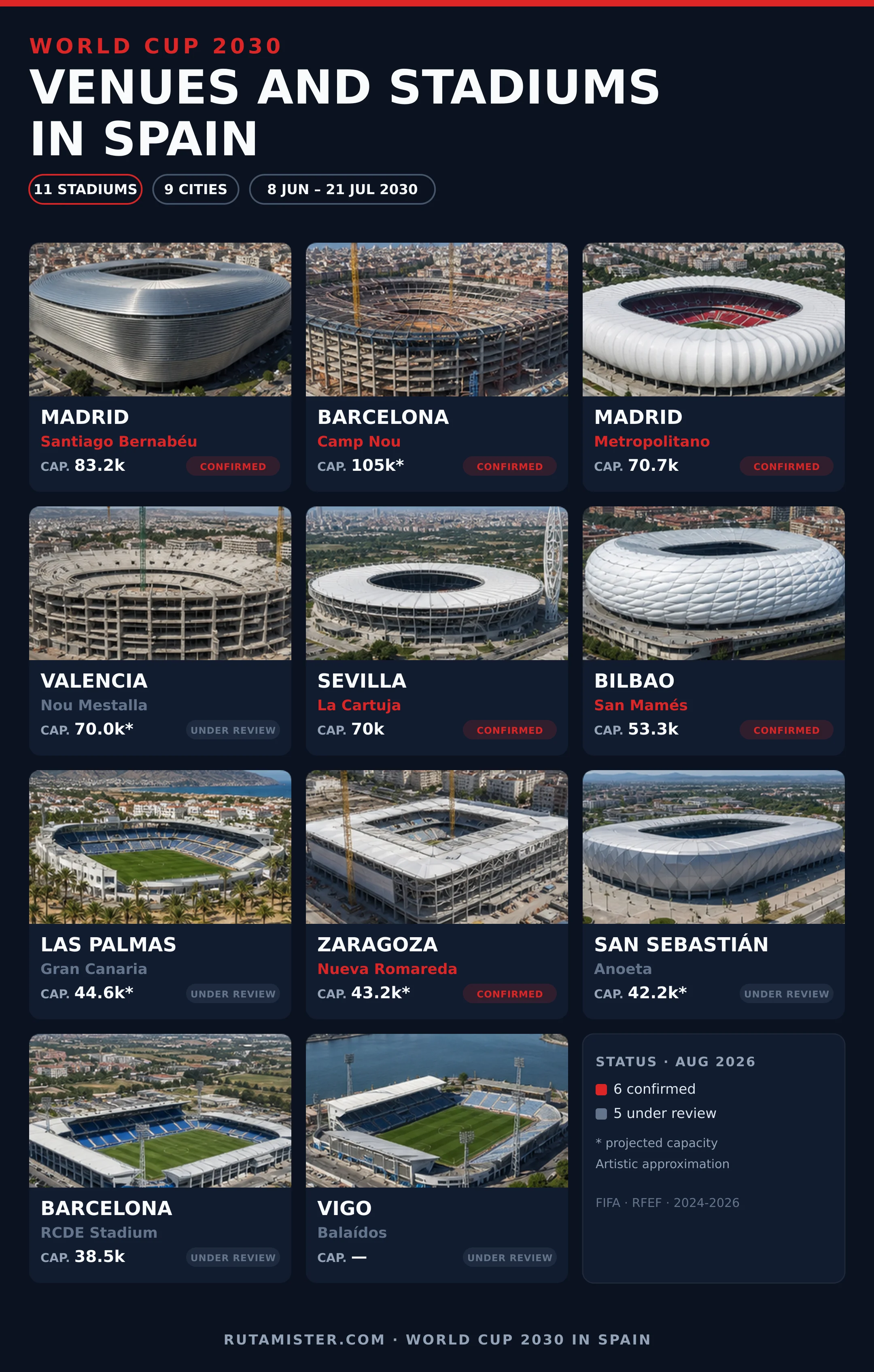
Málaga withdrew on 12 July 2025 (La Rosaleda renovation) and A Coruña on 16 March 2026 (cost, despite its plans for Riazor). In late March 2026 the RFEF proposed Nou Mestalla (Valencia) and Balaídos (Vigo) as replacements, still unconfirmed by FIFA.
The rest is not settled either: in May 2026, the Basque Country proposed merging San Mamés and Anoeta, and in August Gran Canaria's first tender failed. That same month, the RFEF admitted Spain could lose 2-3 of its nine venues, with RCDE Stadium the most vulnerable: until FIFA's closed list, only the six venues unchallenged since December 2024 are final.
Portugal, Morocco and the three centenary matches
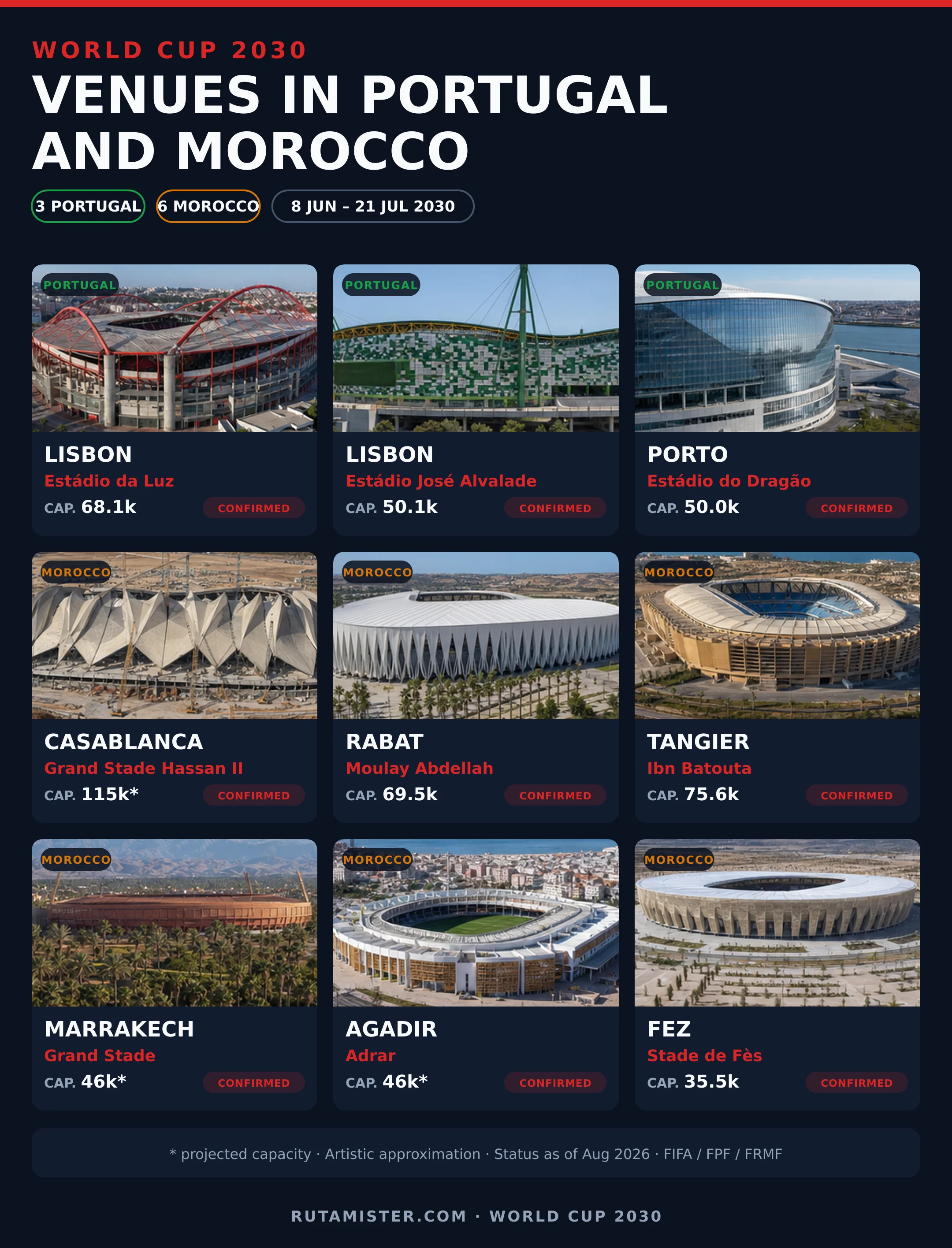
Portugal contributes 3 stadiums in 2 cities: Estádio da Luz and Estádio José Alvalade (Lisbon) and Estádio do Dragão (Porto). Morocco contributes 6 stadiums in 6 cities: the new Grand Stade Hassan II in Casablanca (a final candidate), Príncipe Moulay Abdellah in Rabat, Ibn Batouta in Tangier, Grand Stade de Marrakech, Adrar in Agadir and the Fez stadium —all 9 remain unchallenged since December 2024—; the first World Cup in North Africa and on the continent since South Africa 2010.
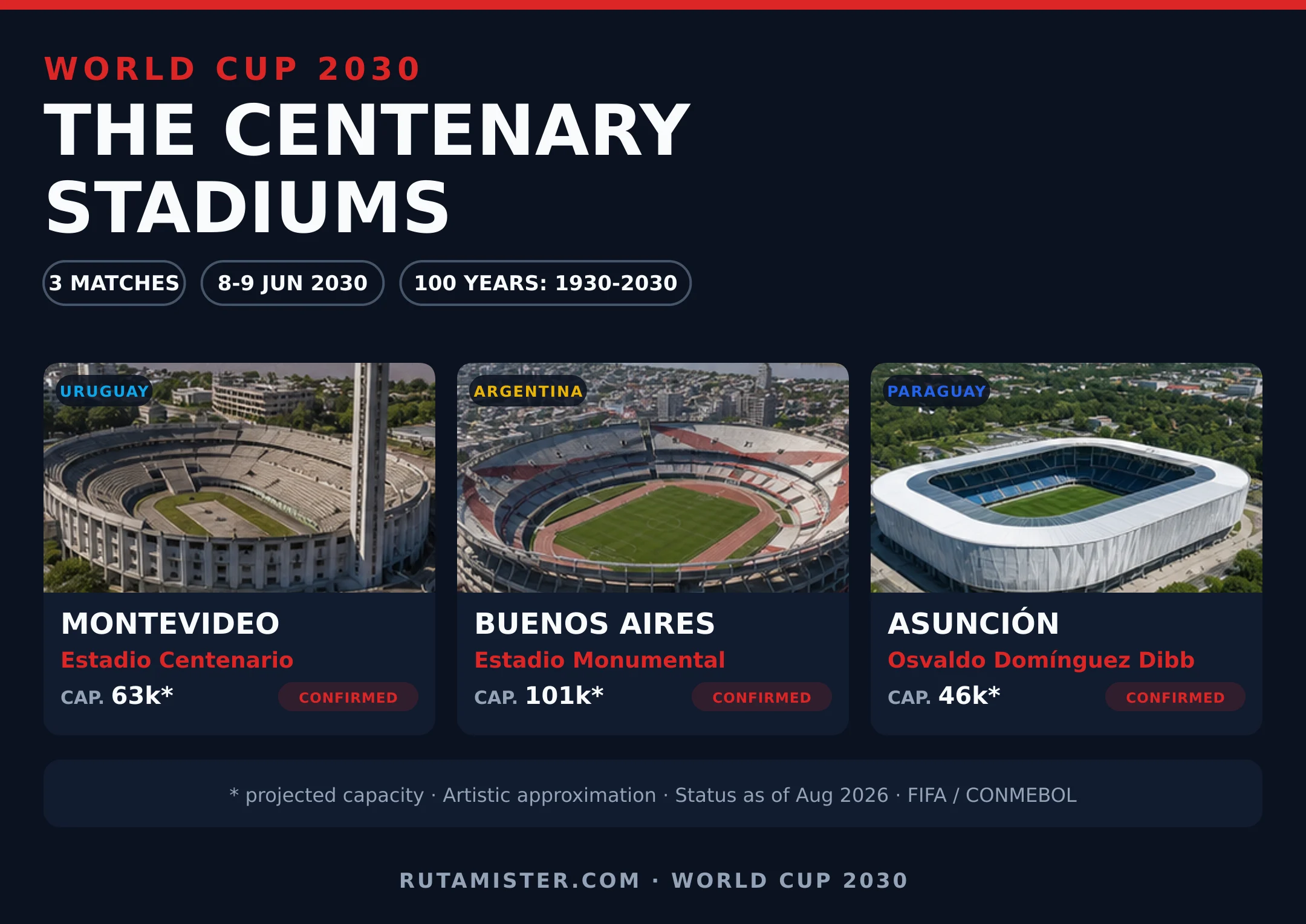
The three centenary matches are played on 8 and 9 June 2030 in South America: Uruguay opens at the Estadio Centenario in Montevideo (host of the 1930 final, won at home); Argentina, runners-up in 1930, plays at the renovated Estadio Monumental in Buenos Aires; and Paraguay, home of CONMEBOL, unveils the new Estadio Osvaldo Domínguez Dibb in Asunción.
Format and calendar: what is decided and what is missing
FIFA's plan since December 2024 keeps the 2026 World Cup format: 48 teams, 12 groups and 104 matches. The tournament runs from 8 June to 21 July 2030 —44 days, the longest ever—, with the centenary matches in South America (8-9 June) and the main phase starting in Morocco, Portugal and Spain on 13-14 June.
That format is no longer settled, though. In March 2025 CONMEBOL proposed expanding it to 64 teams for the centennial, and on 20 July 2026 its president, Alejandro Domínguez, stated on social media it would be played with 64 teams; FIFA said it would consider it, but has neither confirmed nor ruled it out, and several voices warn it would dilute the group stage. Still to be announced: the detailed calendar, the match distribution per city and the group draw, unlikely before 2029.
The coach's Sunday summary
Open course calls, up-to-date guides and new posts. Free, with one-click unsubscribe.
Leave your email and get the next issue:
Spain as host: automatic qualification and what it means for the national team
The six hosts —Spain, Portugal, Morocco, Argentina, Paraguay and Uruguay— automatically qualify and skip their confederations' qualifiers: the largest share of direct berths in the tournament's history, 6 of the 48 teams (or of the 64, should the expansion be approved).
For Spain it is unprecedented: it will be the first reigning world champion to host the next edition, after winning the 2026 World Cup in the final against Argentina; no previous champion defended it at home. Automatic qualification also frees up the cycle: with no qualifiers between 2027 and 2029, the coaching staff will have more FIFA windows for tailored friendlies and Nations League continuity, aiming to reach 2030 with a settled squad.
What is still to be decided
The final's host stadium is the biggest open question, though the field is narrow: FIFA requires a minimum of 80,000 seats for the final (60,000 for semifinals), a threshold no Portuguese stadium clears —not even Estádio da Luz, the largest of the three at 68,100— so in practice it comes down to Spain (Bernabéu or Camp Nou) and Morocco (Hassan II). The then-FPF president, Fernando Gomes, said in April 2024 that Portugal would get a semifinal "alongside whichever country does not host the final"; FIFA has not formalised that assignment. Meanwhile, Camp Nou is moving on a compatible timeline: installation of the roof's 46 pillars is all but complete (September 2026), the big roof lift is slated for summer 2027 and full completion for 2028, with the phased reopening pointing to 72,000 seats by January 2027.
The final venue list is not settled either, nor the format (48 or 64 teams): FIFA has set no date for either decision, and past cycles suggest 2027-2028. There is also no date for ticket sales or the detailed calendar, which FIFA usually publishes one to two years ahead.
Road to 2030
- 7 Oct 2020. Spain and Portugal announce their intention to submit a joint bid.
- 14 Jul 2022. The RFEF unveils a shortlist of 15 stadiums for the Spain-Portugal bid, before Morocco joined.
- 2022-2023. Morocco joins the bid and FIFA's official process begins.
- 31 Jul 2024. The RFEF submits its bid book with 11 stadiums in 9 cities.
- 11 Dec 2024. The FIFA Extraordinary Congress ratifies Spain, Portugal and Morocco as hosts, and awards the centenary matches to Uruguay, Argentina and Paraguay.
- 12 Jul 2025. Málaga withdraws as a host.
- 16 Mar 2026. A Coruña withdraws as a host.
- Late Mar 2026. The RFEF proposes Nou Mestalla and Balaídos as replacements.
- 31 May 2026. Basque institutions propose a joint San Mamés-Anoeta bid.
- 20 Jul 2026. CONMEBOL takes the 64-team jump as a given; FIFA does not confirm it.
- Pending. Confirmation of the final venue list, the format (48 or 64 teams), the final's host stadium and the detailed calendar.
- Aug 2026. The first tender for the Gran Canaria renovation fails and the RFEF concedes it could lose two or three venues in the final cut.
About the author

Content produced by RutaMister from practical experience, editorial review and a training-focused approach for grassroots football coaches.
Frequently asked questions
When does the 2030 World Cup start and end?
The 2030 World Cup opens on 8 June 2030 with the three centenary matches in Uruguay, Argentina and Paraguay; the main phase in Spain, Portugal and Morocco starts on 13-14 June, and the tournament closes with the final on 21 July, whose venue has not yet been decided.
Which countries are hosting the 2030 FIFA World Cup?
Spain, Portugal and Morocco are the three main hosts, ratified by FIFA on 11 December 2024: the first World Cup played across three continents at once. Uruguay, Argentina and Paraguay each host one centenary match on 8-9 June 2030, marking 100 years since the first World Cup, Uruguay 1930.
How many teams will play the 2030 World Cup?
The current plan is 48 teams and 104 matches, the same format the 2026 World Cup introduced. CONMEBOL takes the jump to 64 teams for the centenary as a done deal, but FIFA has not confirmed it. The six hosts have guaranteed spots; the rest will come through continental qualifiers.
Which Spanish stadiums are confirmed venues for the 2030 World Cup?
FIFA ratified a list of 11 stadiums in 9 cities in Spain in December 2024, including the Bernabéu, Camp Nou, Metropolitano and San Mamés. Málaga and A Coruña have since withdrawn, and RCDE Stadium, Anoeta, Nou Mestalla, Balaídos and Estadio de Gran Canaria remain under review pending FIFA's final cut.
Does Spain qualify automatically for the 2030 World Cup?
Yes. The six hosts —Spain, Portugal, Morocco, Argentina, Paraguay and Uruguay— enter the tournament directly without playing qualifiers, the largest share of direct berths in World Cup history. Spain will also be the first reigning world champion to host the next edition, after winning the 2026 World Cup in the final against Argentina.
When do the 2030 World Cup qualifiers start?
The full qualifying calendar is not set yet. Concacaf has already presented its format, with a first stage in September 2027 and a final round between June 2028 and October 2029; the other confederations have not made their dates official. The six hosts, Spain included, are exempt.
Where is the 2030 World Cup final being played?
It has not been decided yet. FIFA requires a minimum of 80,000 seats for the final, a threshold no Portuguese stadium clears, so the choice comes down to the Santiago Bernabéu or Camp Nou in Spain and the Grand Stade Hassan II in Casablanca. FIFA has set no date; past cycles suggest 2027-2028.